İstanbul
Yağmurlu
14°C
İstanbul
14°C
Yağmurlu
Çarşamba
Çok Bulutlu
17°C
Perşembe
Hafif Yağmurlu
17°C
Cuma
Hafif Yağmurlu
17°C
Cumartesi
Hafif Yağmurlu
15°C

New admissions rules exclude women from some defense and security courses in Syria, narrowing study options and drawing criticism over equal access to state institutions.
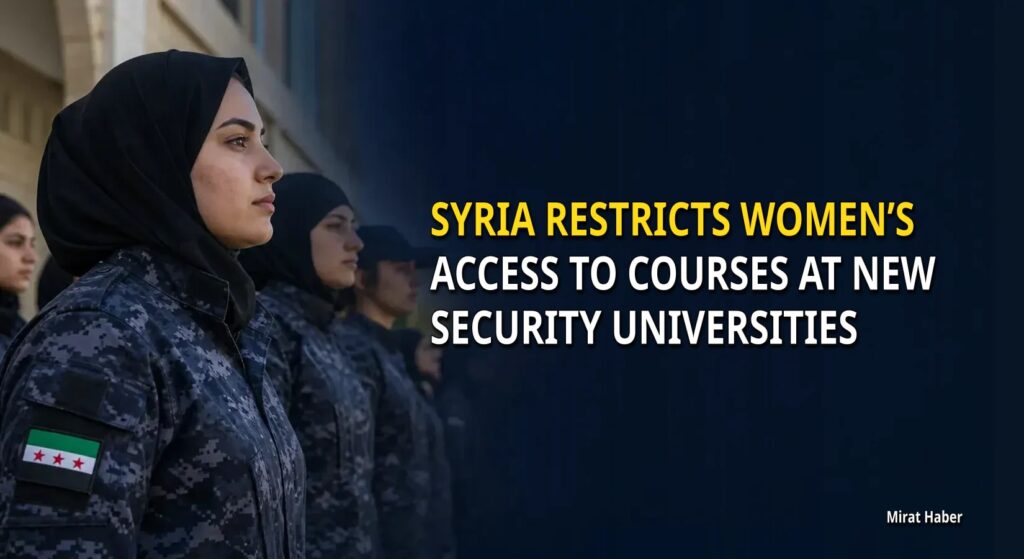
Syria’s new university admissions rules exclude women from certain courses at two recently established defense and security universities, narrowing educational options for prospective students. The restrictions, reported by DW on October 26, 2026, have drawn criticism over equal access to education and public service, although women can still study the subjects at other, more generalist institutions. The rules announced in October 2026 restrict access to particular institutions and programs, rather than imposing a nationwide prohibition on women studying the subjects concerned. According to DW, women can pursue those subjects at other universities or colleges, but that alternative may require changing institutions or moving to another province. The connection between education and security employment is central to the two new universities. Admission to the National University of Defense Sciences requires students to serve in the Syrian military. Graduates of the Syrian University for Security Sciences must commit to serving up to 20 years in the internal security forces. Officials have said that some gender-based admissions conditions were carried over from Assad-era colleges merged to create the new institutions. That explanation places part of the policy’s origins before the current administration, rather than establishing that every restriction was newly introduced. The exclusions extend beyond the two security universities. DW reported restrictions on female applicants at a railway institute in Aleppo, oil and gas training institutions in Rmeilan, Homs, Deir el-Zour and Baniyas, and a radio and television course in Idlib. Men, meanwhile, were barred from kindergarten and nursing training and midwifery courses, which were designated for women. For Lin Najab, a 23-year-old mechatronics engineering student from Damascus, the changes could complicate plans to pursue a master’s degree. She told DW that she now had to consider alternatives, including moving to another province. Her experience illustrates the difference between a subject remaining formally available and a student being able to access it locally. Najab described several obstacles to relocation: uncomfortable student dormitories, conservative attitudes toward women living alone, and family objections grounded in security concerns or opposition to daughters studying away from home. In her account, an alternative place on a course does not necessarily resolve the practical difficulty created by an exclusion closer to home. For prospective applicants, the reported rules make two distinctions especially important: Najab argued that admission should depend on academic standards rather than gender. Aleppo activist Fatoun Kharbatli likewise opposed limiting fields of study by sex, saying people should be able to choose according to their abilities. Human Rights Watch described the admissions rules as discriminatory and said they violated Syria’s international legal obligations. The organization also characterized them as part of a concerning pattern in which transitional authorities restrict women’s participation in state institutions and reinforce gender stereotypes. Support for the restrictions also featured in DW’s reporting. Qamar al-Yaser, a mother of three in rural Damascus, argued that the excluded sectors involve physical demands, travel and overnight stays at remote work sites, conditions she considered more suitable for men. That is a supporter’s justification, not evidence that women lack the ability to undertake the courses. The controversy comes amid other reported changes in education. For the 2026–2027 school year, journalists identified textbook images of women with uncovered hair that had been removed or altered to show headscarves. The education ministry had separately announced the removal of images and symbols associated with Bashar Assad’s former government. Whether the admissions restrictions signal a lasting direction remains contested. Analyst Nadra Bunni, writing for Syria In Transition, said it was still unclear whether gender-based restrictions would become a defining feature of the new Syria. She also questioned whether the authorities would allow public criticism to influence or reverse government decisions. No. DW reported that women can still study the subjects offered by the two new security institutions at other, more generalist universities or colleges. The restrictions concern admission to particular institutions and courses, although studying elsewhere may require relocation. No. Alongside restrictions affecting women at security and vocational institutions, DW reported that men were excluded from kindergarten and nursing training and midwifery courses designated for women.Key facts about the admissions restrictions
What do the new admissions rules change?
What the restrictions mean for students choosing where to study
A dispute over education and women’s role in state institutions
Questions about access to study
Are women banned from studying these subjects throughout Syria?
Are the admissions restrictions limited to women?
Reporting basis: DW’s October 26, 2026 report on Syria’s admissions restrictions.
