
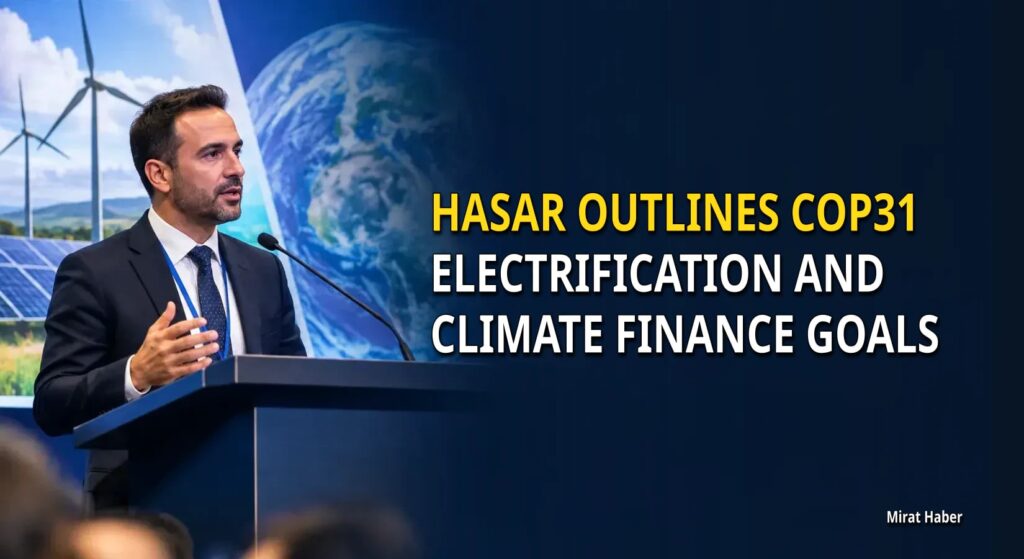
COP31 Chief Climate Diplomacy Officer and Head of Climate Change Prof. Dr. Halil Hasar outlined goals for electrification, access to climate finance and waste reduction at COP31 in Antalya. In remarks reported by Bigpara, Hasar highlighted efforts to connect projects with financing, particularly in developing countries, and turn climate pledges into action. The announcements concern the summit’s goals and planned mechanisms rather than results already achieved. Hasar said the priority as the Paris Agreement enters its second decade is to deliver on existing commitments. He summed up this approach by saying: “The world does not need new promises; it needs existing promises to be kept.” Hasar said Türkiye was acting as a bridge between developed and developing countries. He described its approach to negotiations as an inclusive, results-oriented process that takes all parties’ views into account. Strengthening dialogue and facilitating consensus were also part of that approach, he said. In Hasar’s remarks, success is measured not only by decisions set out in negotiating texts, but also by the tangible results those decisions produce in practice. Electrification, climate resilience, green industrialisation, zero waste and access to climate finance are listed among the priorities of the COP31 Action Agenda. The “35 by 35 Global Electrification Pledge” outlined by Hasar aims to raise electricity’s share of global final energy consumption to 35% by 2035. That figure refers to electricity’s share of final energy consumption, not renewables’ share of electricity generation. Hasar says the transition needs to be supported by investment in renewable energy and electricity grids. According to Hasar, electrification could contribute to energy security as well as reduce greenhouse gas emissions. He also cited greater economic resilience to fluctuations in fossil fuel prices as an expected benefit. These are anticipated effects of the announced goal, not emissions reductions or energy security outcomes already achieved. The Climate Implementation Bridge is being developed to help countries, particularly developing countries, overcome barriers to accessing climate finance. According to Hasar, the mechanism focuses on matching projects in countries’ nationally determined contributions and adaptation plans with existing sources of finance. For project developers, BRIDGE’s role is therefore not to distribute money from a new fund, but to help turn climate goals into viable projects that can secure financing. Hasar said the mechanism would support project preparation and capacity building as well as facilitate access to finance. Hasar described the Zero Waste movement, launched under the patronage of Emine Erdoğan, as an environmental initiative that had spread from Türkiye to the world. The goal on the COP31 agenda is not to halve total global waste volumes, but to halve the increase in waste volumes by 2035. Describing resource efficiency and the transition to a circular economy as elements of climate action, Hasar said the waste sector was responsible for about one-fifth of human-caused methane emissions. He listed reducing organic waste, increasing recovery, capturing landfill gas and preventing food waste among the measures that could reduce emissions. In his remarks, Hasar identifies Murat Kurum as COP31 President and says implementation-focused initiatives are being pursued under his leadership. According to Hasar, BRIDGE aims to facilitate access to the Green Climate Fund, development banks and private capital. The mechanism is not described as a new financing fund.Key goals on the COP31 agenda
Turning pledges into action is the test for negotiations
What is the electrification target for 2035?
What does BRIDGE offer projects in developing countries?
Zero Waste target focuses on the increase in waste volumes
Questions about COP31
Who is the COP31 President?
Which sources of finance does BRIDGE aim to make more accessible?
İstanbul
Az Bulutlu
17°C
İstanbul
17°C
Az Bulutlu
Çarşamba
Hafif Yağmurlu
19°C
Perşembe
Hafif Yağmurlu
19°C
Cuma
Yağmurlu
20°C
Cumartesi
Hafif Yağmurlu
17°C