İstanbul
Az Bulutlu
17°C
İstanbul
17°C
Az Bulutlu
Çarşamba
Hafif Yağmurlu
19°C
Perşembe
Hafif Yağmurlu
19°C
Cuma
Yağmurlu
20°C
Cumartesi
Hafif Yağmurlu
17°C

ECIPE Director Fredrik Erixon called for Türkiye to be included in “Made in EU”, warning that excluding integrated trading partners would raise production costs in Europe.
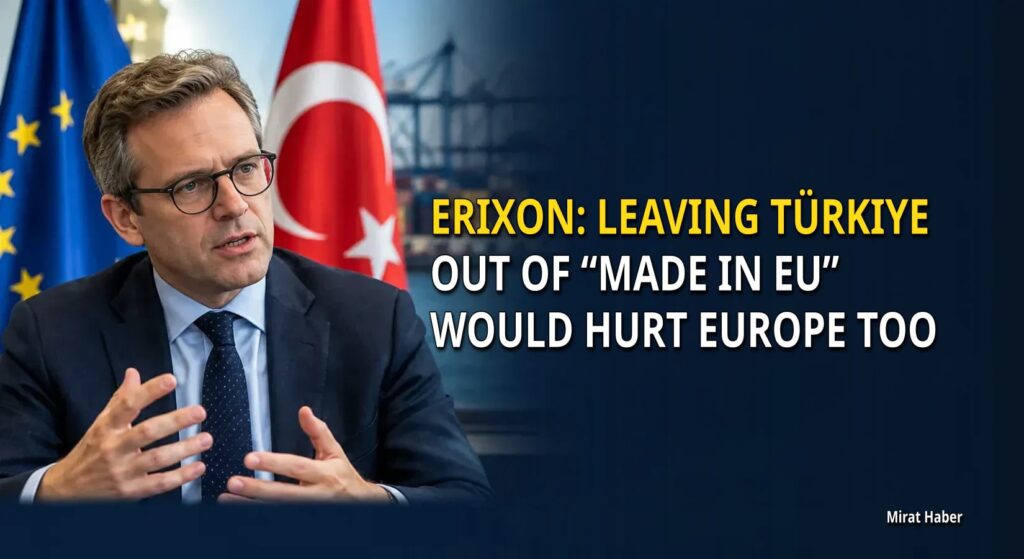
Fredrik Erixon, director of the European Centre for International Political Economy (ECIPE), said Türkiye should be included in the “Made in EU” rules being developed by the European Union. Speaking to Bloomberg HT, Erixon pointed to supply-chain links between Türkiye and European industry, arguing that exclusionary rules would raise costs for European manufacturers and make exports more expensive. The central question is which trading partners outside the EU would be covered by an approach that favours goods produced in Europe. According to Erixon, there is support for including the United Kingdom and Norway. The inclusion of Türkiye, along with Japan, South Korea and Canada, which have free trade agreements with the EU, is also under discussion. For Türkiye, a key argument is the scale of its trade with the EU under the Customs Union. Erixon said this relationship played an important part in the case for including Türkiye. The debate therefore extends beyond where goods are manufactured to which countries work alongside European industry in producing them. Erixon was cautious about the negotiating timetable. Describing a rapidly changing process, he said he considered it highly unlikely that the goal of reaching an agreement by the end of the year, during Ireland’s presidency, would be met. That assessment is a prediction about the outcome of the negotiations. Erixon used automotive parts trade as a concrete example concerning Türkiye. He said Türkiye had a substantial trade surplus with the EU in this sector and explained that a significant share of the parts shipped to Europe were used in production there, becoming components in goods later sold to third countries. Under this assessment, a restriction that raises the cost of a component bought from Türkiye would affect more than trade in that part: it would also feed into the cost of the finished product in Europe. Erixon warned that import barriers could make European exports to other markets more expensive. For parts suppliers in Türkiye and manufacturers in Europe, the crucial question is therefore how the scope of the rules will be defined. Erixon’s position is that trade rules should take account of interconnected production processes. Turning to consumers, Erixon said the impact would not be limited to industrial companies. Higher costs for imported raw materials and intermediate goods could spread across sectors, he said, and materials used in housing construction in particular could become more expensive. These are warnings about potential consequences of the rules, not reports of price increases that have already occurred. A second strand of Erixon’s criticism concerned how trading partners might respond. He warned that if the EU restricted other countries’ access to the European market, those countries could impose similar restrictions on European companies. He said this could have adverse economic consequences for the EU, which runs large trade surpluses with the rest of the world. Erixon also argued that high trade barriers could weaken Europe’s production capacity and growth potential. He identified European industry’s reliance on internationally integrated supply chains as a central consideration when assessing protectionist rules. The political dimension of the debate concerns trading partners’ trust in Europe. According to Erixon, excluding countries with free trade agreements could diminish the value of existing agreements and damage the EU’s standing as a predictable partner. Erixon considered that warning in the context of Europe’s pursuit of new partnerships. He said the EU was considering a closer partnership with Canada and aimed to deepen relations with Japan, South Korea and Southeast Asian countries. Pointing also to negotiations with Latin American countries and Australia, he said rules that made market access more difficult could conflict with those objectives. His argument rests on trade between Türkiye and the EU under the Customs Union and their integrated supply chains. He particularly emphasises that automotive parts bought from Türkiye are used in European manufacturing and become components in products exported to third countries. Erixon considers it highly unlikely that the goal of reaching an agreement by the end of the year, during Ireland’s presidency, will be met. He says the negotiations are moving through a rapidly changing process.Key points in the debate
Which countries feature in the “Made in EU” debate?
How costs could spread to producers and consumers
The risk of retaliation over market access restrictions
Frequently asked questions
Why does Erixon support including Türkiye?
Is an agreement expected by the end of the year?