İstanbul
Yağmurlu
22°C
İstanbul
22°C
Yağmurlu
Cumartesi
Hafif Yağmurlu
17°C
Pazar
Parçalı Bulutlu
16°C
Pazartesi
Yağmurlu
19°C
Salı
Az Bulutlu
10°C

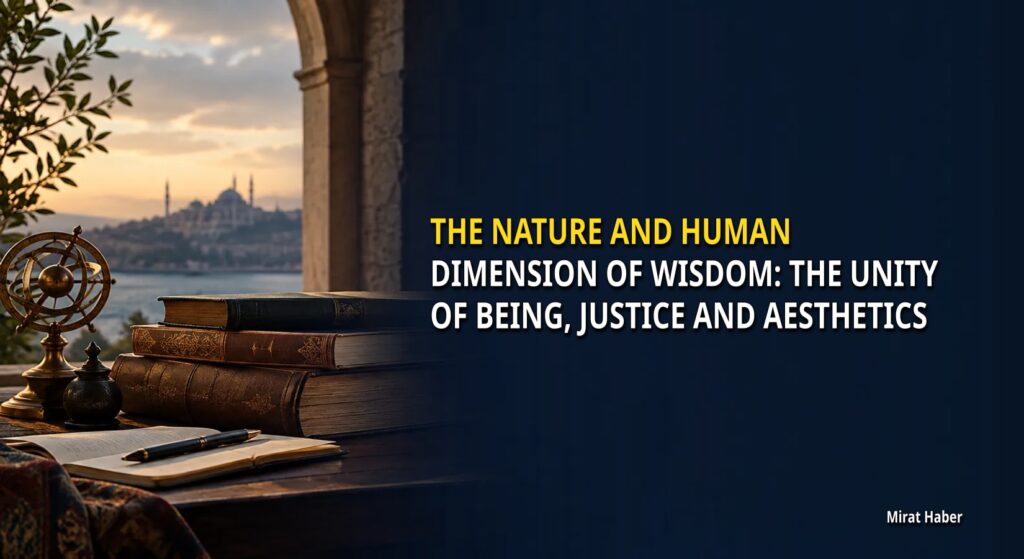
Wisdom is the highest intellectual and moral expression of the profound relationship human beings establish with existence, with other people and with the Creator. Neither mere wording grounded in a text nor an accumulation of information in the mind, wisdom transcends the limits of knowledge and discourse, expressing a transcendent balance that guides human life. This study takes a holistic approach to wisdom’s epistemological/cognitive foundations, its place in existence, its expression through propriety and etiquette in human relationships, its manifestations in art and aesthetics, and the individual and social factors that lead to its loss.
In the Islamic intellectual tradition, wisdom is the transformation of knowledge into action and existential awareness. Neither a simple transmission of information nor a sequence of rational deductions, wisdom brings words and knowledge together to reconstruct the relationship between human beings and existence on a transcendent plane. The most concrete and distinct historical example of this transcendent bond is found in the person/Sunnah of the Prophet, peace be upon him. The Sunnah is the establishment, through actual practice, of a balance between the divine knowledge brought by the Holy Qur’an and concrete life; for this reason, it is regarded in the history of thought as a manifestation of wisdom.
İmam Matüridî, a founding figure in Islamic theology and epistemology, offers an exceptionally concise and comprehensive definition of wisdom: “Wisdom is to place the stone in its proper place with justice.” This definition reveals wisdom’s inseparable connection with justice and balance. Placing the stone where it belongs means correctly identifying the place of things, people and events within their natural and divine order. Allah, as the owner of all dominion, has acted with wisdom in everything He has done, and all creation rests upon an order of wisdom. For human beings, therefore, acting wisely means having the ability to grasp this divine order and subtlety within existence.
The concept of wisdom is connected with different layers of knowledge and action. The following table summarizes these fundamental concepts in terms of their intellectual and practical meanings and their relationship to wisdom: Concept; Intellectual / Practical Meaning; Relationship to Wisdom… Wording: verbal expression, textual transmission. Wisdom goes beyond wording; it reveals the deeper meaning behind words. Knowledge (Information): rational information that can be learned. Wisdom is not mere knowledge; it is knowledge brought to maturity through deeds and divine grace. Justice: giving people their due, placing things correctly. It is the measure of wisdom in the concrete world; it is the principle of putting the stone in its proper place. Sunnah: the unity of prophetic knowledge and action. It is wisdom lived out as a balance between divine knowledge and existence.
Wisdom activates human intuition, refining a person’s relationships with things, the Creator and other people. This refinement enables people to consider matters not from the shallow and immediate standpoint they happen to occupy, but from a higher intellectual perspective and a broader frame of reference. A mind that penetrates the depths of matters gains the ability to place things within existence correctly.
Wisdom does not remain an abstract philosophical theory; it manifests itself in concrete life as propriety and etiquette, refining and lending beauty to a person’s body, gaze and conduct. Turning from concrete circumstances towards abstract realms of thought, and from the material towards the spiritual, brings spiritual maturation and an aesthetic quality to one’s perspective.
The fundamental expression of wisdom in social and human relationships may be called “justice in giving everything its place.” The ability to determine the right attitude towards the person one is dealing with is the most distinctive quality of a wise mind. In concrete life, this takes shape through the following basic principles:
Treating a child as a child, with regard for their world and developmental needs,
Approaching a young person as a young person, understanding their energy and what they are seeking,
Treating women and men justly in light of their respective realities,
Treating state officials with regard for the responsibilities of their office, and the public with regard for their needs and feelings, and so on…
This refinement and sensitivity, capable of giving every being its due, form the essence of what the tradition calls “moral cultivation.” The ultimate source of this cultivation is the Lord, who nurtures and educates. By sending prophets and scriptures to educate and shape human beings, the Creator has offered humanity this method of cultivation.
To possess propriety and etiquette is essentially equivalent to possessing wisdom. The accumulated understanding passed down through history as “experiential knowledge” is this wise method of cultivation, formed through the right relationship with Allah, transformed into culture and transmitted from generation to generation.
The way wisdom is acquired differs qualitatively from conventional processes of gaining knowledge by taking lessons or reading books. Although reason and the heart are the two fundamental faculties of human knowing, they have different functions in relation to wisdom. Reason seeks tangible conclusions through concrete situations and rational analysis. The heart, by contrast, is the seat of intuition. Because wisdom requires an intuitive understanding beyond rational deductions, it is directly connected with the heart. A person whose heart has been purified, who has attained spiritual purity and whose mind has come into harmony with the heart becomes a potential bearer of wisdom.
The development and nature of wisdom can be explained through the following fundamental principles:
Effort and Experience (Experiential Knowledge): Wisdom is not suddenly bestowed upon a person. It is a spiritual fruit of sustained effort, putting acquired knowledge to the test in practice and lived experience. Experiential knowledge is a state of “acquaintance” gained directly through living and experiencing. A person’s servanthood, the tests they face in relation to their livelihood and their firsthand experience of human relationships allow knowledge to become purified.
Divine Bounty and Grace: Wisdom is a divine bounty bestowed by Allah after a person has made their own effort. In the history of thought, this is summarized by the principle, “Wisdom is given; it is not something bought or learned.” Knowledge can be learned, but wisdom is a gift descending from above into a heart that has become ready for divine grace.
Reverence and Fear of Allah: The fear in the principle “The beginning of all wisdom is the fear of Allah” is not an ordinary shudder of apprehension, but deep reverence for the Creator and an awareness of responsibility. Wisdom represents a transcendent spiritual station that goes beyond both unrefined love and unrefined fear.
Dignity and Freedom from Reactivity: A person of wisdom attains the quality of being “dignified.” Wise conduct is free of impulsive reactions. It is the ability, whatever the circumstances, to remain free from personal ambitions and emotional fluctuations and act with clarity to carry out “the right and just action that is required.”
Wisdom and faith share an inseparable unity and an inner dynamic. It is the presence of wisdom that allows faith to become deeds and morality rather than remain an abstract belief. Faith joined with wisdom directly transforms a person’s deeds into propriety and refinement.
This transformation lends an aesthetic dimension to a person’s expressive power and way of thinking. A person with a wise mind grasps events not merely in their concrete, outward form, but through their deep layers of meaning. This profound understanding gives rise to the following forms of aesthetic expression:
Literature and Verbal Art: A mind working with wisdom allows expression to become art and literature. In conveying the truth behind things and events, such a mind makes the fullest use of the power of simile and description.
The Beautification of Character: Wisdom adorns attitudes, actions and relationships with mercy, compassion, justice and balance. When others observe this wholeness, they can clearly see that the person is acting wisely.
Drawing Closer to the Attribute of Beauty: By lending beauty to a person’s character and servanthood, a wise disposition brings them closer to the divine attribute of “Beauty” (infinite beauty). As a person draws closer to the attribute of Beauty, they become more beautiful spiritually; as they become more beautiful, wisdom manifests itself in them more distinctly.
While wisdom emerges through faith, deeds, morality and divine grace, its disappearance and decline result from particular forms of individual and social deterioration. Every attitude that distances people from their Lord and their own innate nature causes wisdom to withdraw from the heart and from society.
The factors that lead to the loss of wisdom and their consequences are compared in the following table: Cause of Loss; Nature and Character; Effect on Wisdom and Outcome…
Sins and Forbidden Acts: lying, gossip, violations of others’ rights and deeds that lead people away from servanthood. By corrupting the purity of the heart, they destroy the mind’s capacity to bear wisdom and its readiness for divine grace. Oppression: deprivation of the light of truth, concealment of divine knowledge. It creates pitch darkness by destroying the balance within existence and the measure of justice (“putting the stone in its proper place”). Ignorance: a condition arising where wisdom and divine light are absent. It obscures wisdom and leads people to place things and human beings where they do not belong. Social Corruption: the decay of social bonds, morality and an atmosphere of trust. It makes it impossible for wisdom to be practised and transmitted as experiential knowledge and culture at the social level. Oppression and ignorance are wisdom’s greatest adversaries. Oppression is not merely physical coercion; it is the concealment of divine knowledge and truth, the extinguishing of their light. Where wisdom is absent and divine knowledge is concealed, ignorance takes full hold.
While forbidden acts and sins lead to the decline of wisdom at the individual level, the spread of corruption and degeneration at the social level results in its complete disappearance. Reviving wisdom therefore requires a profound spiritual and human purification in which faith becomes deeds, deeds become morality, and morality becomes propriety and etiquette.
Abdülaziz Tantik
Mirat Haber – YouTube