İstanbul
Yağmurlu
22°C
İstanbul
22°C
Yağmurlu
Cumartesi
Hafif Yağmurlu
17°C
Pazar
Parçalı Bulutlu
16°C
Pazartesi
Yağmurlu
19°C
Salı
Az Bulutlu
10°C

Modern societies have moved beyond the predictable local dangers of the Industrial Revolution and entered a “Risk Society” phase dominated by unpredictable risks such as nuclear risks, climate crises, pandemics, global terrorist networks and cyber threats. Faced with growing uncertainty and a climate of fear, states are prioritising security concerns, while measures taken in the name of maintaining social order are placing individual freedoms and legal rights under serious pressure. Amid this structural transformation, the modern state no longer derives its legitimacy solely from the conventional distribution of welfare or the traditional maintenance of public order, but also from its function of “protecting society from uncertainties and crises” . The liberal state model’s inability to cope adequately with modern risks has compelled governments to expand their surveillance, oversight and risk management mechanisms. This manifests itself in three main dimensions:
– The First Face (The Protective Face): The compassionate, preventive modern face that seeks to protect society from pandemics, terrorism, climate crises and cyberattacks.
– The Second Face (The Repressive Face): The authoritarian face that emerges when security paranoia and excessive surveillance spiral out of control, destroying individual freedoms and bringing society under rigid control.
This dual character of power also occupies a central place in academic analyses of social and psychological dynamics. In this understanding, the state is the sole legitimate actor with a monopoly on coercive power within society. Yet in democratic societies, unless this immense state power is kept in check through institutional oversight and the separation of powers, the door will inevitably be opened to authoritarian regimes, as historical experience has shown. In short, while today’s state model serves as a modern shield protecting society against global risks, it always carries the risk of becoming a repressive sword that stifles freedoms if legal limits are not upheld.
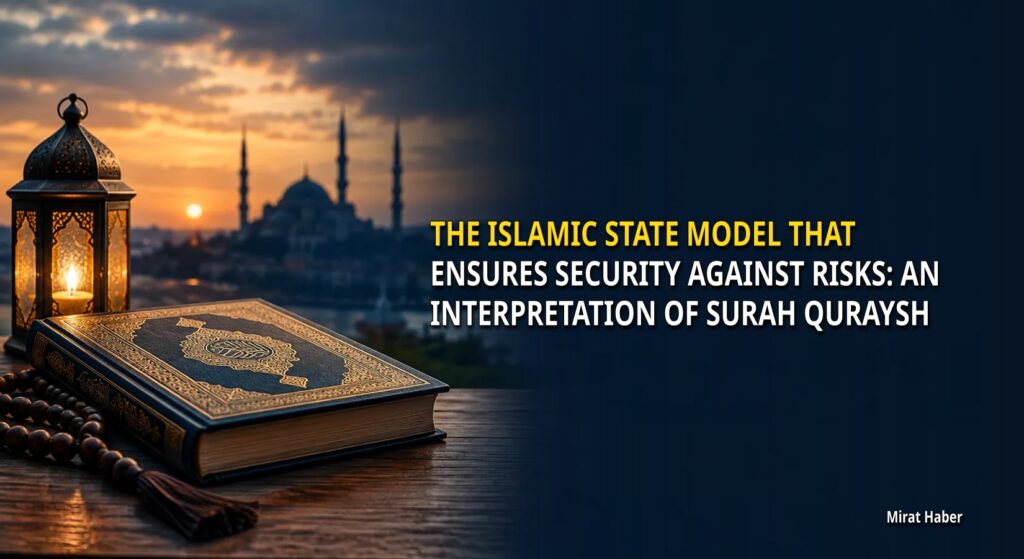
In Islamic political and legal philosophy, one of the state’s two most fundamental pillars of legitimacy is justice; the other is security, which ensures stability and peace (el-Emnü vel-İstikrâr). In the Holy Qur’an, Surah Quraysh describes the city/state as enjoying two great blessings: “being fed and delivered from hunger, and being made secure from fear” (min havfin) (Qur’an, Surah Quraysh, 106/4). This shows that, from the outset, security and risk management are regarded as fundamental duties of the state. In modern state sociology, particularly Ulrich Beck‘s Risk Society theory, premodern societies grappled mainly with “the risks of scarcity and hunger“, whereas modern societies are tested by “technological, ecological, epidemiological and security-related crises“. The noble verse directly addresses two fundamental kinds of existential crisis that threaten a society’s existence and sustainability:
The modern Security and Risk State derives its legitimacy precisely from its ability to manage and protect these two areas—socioeconomic security and physical/sociological security—simultaneously. The word “havf” (fear) in the verse expresses not merely a crime that has already occurred or an attack that is underway, but also a perception of future threats, uncertainty and the anticipation of risk. The most distinctive feature of the Security and Risk State is that it is not reactive (responsive), intervening only after a crisis or crime has occurred, but preventive in character, taking precautions before risks materialise. The promise and duty in the noble verse of making society “secure from fear (the social risks that may arise)” obliges the state to strengthen its structures before a crisis arrives, conduct risk analyses and take proactive (anticipatory) measures against factors that threaten society’s survival and security.
A close examination of the verse’s structure shows that “feeding” (economic/social security) and “providing safety” (physical/legal security) are presented as two successive, complementary elements:
This shows that the modern models of the “Protective State” (social security and poverty prevention) and the “Security and Risk State” (eliminating threats) are not mutually exclusive. Rather, as stated in verse 4 of Surah Quraysh, they are two complementary areas of fundamental responsibility. On the other hand, the greatest vulnerability of the Security and Risk State model is the risk that, on the grounds of “eliminating fear and threats“, it will completely destroy individual freedoms and turn into a Police State (the Janus face). This divine reference in Surah Quraysh defines security not as an instrument of repression and control, but as a blessing, a source of social peace and a foundation of freedom on which the servant of Allah can lead a dignified life. Thus, in Islamic political philosophy, managing risks and threats does not give public authority licence to exercise arbitrary domination. On the contrary, it imposes on the state a duty to protect individuals’ lives, property and intellect within a framework of justice.
Verse 4 of Surah Quraysh is a historical and divine synthesis of the functions of the “Security and Risk State” and the “Welfare/Investment State” in modern state theory. The Islamic State is obliged to serve as a preventive and compassionate security shield that protects its society against both economic risks (hunger/poverty) and existential threats (fear/chaos). If only our own leaders understood this and shaped state policies accordingly. For acting with an awareness of security as a divine trust that safeguards citizens’ lives, property and dignity, rather than seeing it merely as an instrument of repression, is also the most fundamental condition of social legitimacy.
Prof. Dr. Ali Seyyar
Mirat Haber – YouTube