İstanbul
Yağmurlu
22°C
İstanbul
22°C
Yağmurlu
Cumartesi
Hafif Yağmurlu
17°C
Pazar
Parçalı Bulutlu
16°C
Pazartesi
Yağmurlu
19°C
Salı
Az Bulutlu
10°C

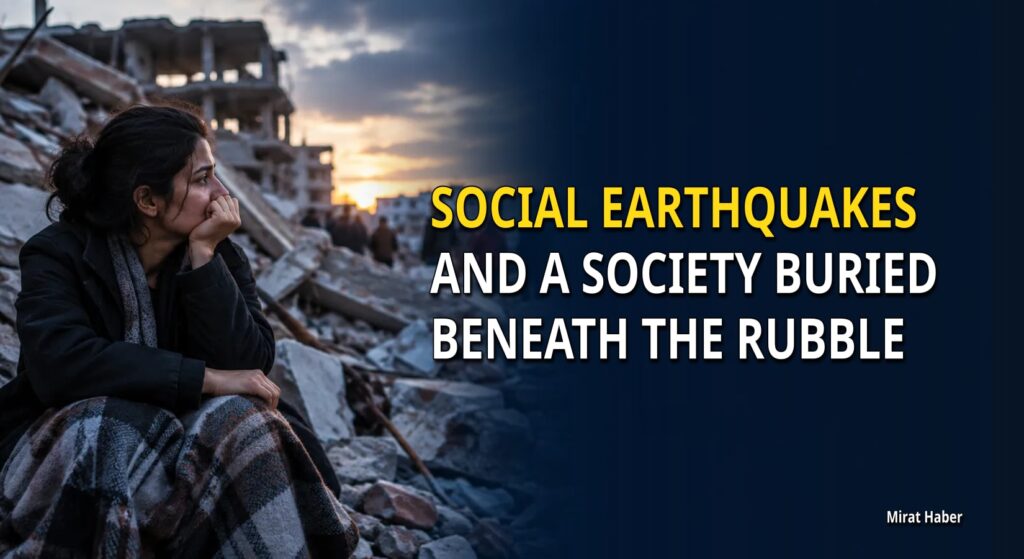
Earthquakes bring to mind collapsed buildings, people trapped beneath rubble and damaged cities. Yet other earthquakes threaten societies and are at least as destructive as physical ones: the weakening of the family, young people being drawn into addiction, the spread of crime and violence, economic injustice and the erosion of moral values…
The social problems we face today are not independent of one another. They are different manifestations of a deep disintegration extending from faith to education and from the family to the economy.
Almighty Allah says:
ظَهَرَ الْفَسَادُ فِي الْبَرِّ وَالْبَحْرِ بِمَا كَسَبَتْ أَيْدِي النَّاسِ
“Corruption has appeared on land and at sea because of what people have done with their own hands.” (Rûm, 30/41)
Societies, like buildings, are built on solid foundations. Where morality, justice and a sense of responsibility weaken, social collapse becomes inevitable.
One of the most important causes of social earthquakes is the erosion of faith and values.
Outlooks that reduce human beings to their desires and material interests, separate freedom from responsibility and measure success solely by economic power profoundly affect the structure of families and society.
Islam, by contrast, defines the human being as accountable to Allah and having duties towards society. It considers rights alongside duties, freedom alongside morality, and worldly life alongside awareness of the hereafter.
Education, too, is not simply about imparting knowledge and vocational skills. What truly matters is raising generations who are as moral as they are knowledgeable, as conscientious as they are successful, and as just as they are strong.
The greatest danger is that wrongdoing becomes normal over time. Treating the forbidden as commonplace, reducing moral sensitivity to a matter of personal preference and remaining silent in the face of evil all accelerate social decay.
Almighty Allah says:
وَلْتَكُنْ مِنْكُمْ أُمَّةٌ يَدْعُونَ إِلَى الْخَيْرِ وَيَأْمُرُونَ بِالْمَعْرُوفِ وَيَنْهَوْنَ عَنِ الْمُنْكَرِ
“Let there be a community among you that calls to goodness, enjoins what is right and forbids what is wrong.” (Âl-i İmrân, 3/104)
For remaining silent in the face of wrongdoing prepares the ground for it to grow.
A society’s future is directly linked to the strength of its families and the direction its young people take.
Addictions such as alcohol, drugs, gambling and betting threaten young people’s lives, family harmony and society’s future. The Qur’an states that alcohol and gambling create enmity and hatred among people (Mâide, 5/90-91).
Protecting reason, the will and future generations is among Islam’s fundamental objectives. For this reason, the struggle against addiction must involve not only prohibition and punishment but also education, family support and rehabilitation.
The weakening of the family is also one of the most important signs of social disintegration. Discrediting marriage, eroding fidelity and viewing family responsibilities as a burden shake the most important institution in which generations are raised.
Almighty Allah explains the foundation of the relationship between spouses as follows:
وَجَعَلَ بَيْنَكُمْ مَوَدَّةً وَرَحْمَةً
“He has placed love and mercy between you.” (Rûm, 30/21)
The family is not merely a union of people living in the same home; it is a trust that must be protected.
يَا أَيُّهَا الَّذِينَ آمَنُوا قُوا أَنْفُسَكُمْ وَأَهْلِيكُمْ نَارًا
“O you who believe! Protect yourselves and your families from the Fire.” (Tahrîm, 66/6).
A family that does not know who and what holds sway in its child’s world has abandoned that child to the influence of the streets and screens.
Nor can the struggle against violence, abuse and crime be neglected. Social peace can be achieved only where human dignity is protected, the law applies equally to everyone and justice prevails.
إِنَّ اللَّهَ يَأْمُرُ بِالْعَدْلِ وَالْإِحْسَانِ
“Indeed, Allah commands justice and benevolence (doing good).” (Nahl, 16/90).
Today’s economic problems are not limited to the high cost of living and insufficient incomes. Excessive consumption, waste, borrowing, interest, gambling and the desire to get rich easily also weaken the fabric of society.
Betting and gambling, increasingly widespread on digital platforms in particular, lure young people into dreams of making money without working for it.
Islam upholds lawful earnings, work, honest trade and economic justice as fundamental principles.
يَا أَيُّهَا الَّذِينَ آمَنُوا لَا تَأْكُلُوا أَمْوَالَكُمْ بَيْنَكُمْ بِالْبَاطِلِ
“O you who believe! Do not consume one another’s wealth through unjust means.” (Nisâ, 4/29).
Interest, gambling, deception and unjust gain are not merely individual sins; they are practices that also wound social justice.
When a society’s hunger for profit takes precedence over the distinction between what is lawful and forbidden, consumption replaces blessings, easy money replaces work, and self-interest replaces brotherhood.
Social problems cannot be solved through penalties, laws or economic measures alone. These are, of course, necessary; but they are unlikely to produce lasting results unless supported by morality, conscience, compassion and a sense of responsibility.
The principles Islam sets forth—the oneness of Allah, justice, trustworthiness, chastity, compassion and respect for the rights of others—are the foundation of a strong society.
Our Prophet (peace and blessings be upon him) likens believers in their relations with one another to a single body. When an organ suffers, the other organs share its pain (Buhârî, Edeb, 27; Müslim, Birr, 66).
This is the social solidarity we need: a society whose members share one another’s troubles, protect the oppressed, stand against injustice and spread goodness.
Islam is not limited to individual acts of worship. It is a comprehensive way of life that sets out principles for every sphere, from family to commerce and from education to law and public administration.
The Rightly Guided Caliphate approach likewise offers a system based on applying Islam’s political and administrative rulings to governance. Within this system, reform is possible when Islam guides not only individual life but also the public order.
Within this framework:
* In education: Faith, knowledge, morality and a sense of responsibility must be developed together.
* In the family: Marriage, compassion, fidelity and the protection of future generations must be the foundation.
* In the economy: Lawful earnings, production, work and social justice must be upheld.
* In governance: Trustworthiness, competence, consultation, justice and accountability must be fundamental principles.
Yet no model of governance can automatically solve every problem unless the members of society fulfil their individual and moral responsibilities. Justice and morality must be practised both in government and throughout every part of society.
Social change begins with people first putting themselves right.
Almighty Allah says:
إِنَّ اللَّهَ لَا يُغَيِّرُ مَا بِقَوْمٍ حَتَّى يُغَيِّرُوا مَا بِأَنْفُسِهِمْ
“Allah does not change the condition of a people unless they change what is within themselves.” (Ra’d, 13/11).
For this reason, Muslims must not look for faults only in others; they must also examine their own lives, families, business dealings and morals.
Our Prophet (peace and blessings be upon him) commanded believers to oppose evil with their hands, their tongues or their hearts, according to their ability (Müslim, Îmân, 78).
Reform, however, must be pursued with wisdom, not anger; with justice, not division; by building, not destroying.
It is a Muslim’s duty to offer solutions rather than drive people to despair, to spread goodness rather than evil, and not to shirk social responsibility.
What we need today is not merely economic development, political change or security measures. Our real need is to rebuild the individual through faith, the family through compassion, society through justice and life through morality.
Let us not forget: just as solid foundations keep buildings standing, faith, morality, justice and a sense of responsibility towards Allah keep societies standing.
Where morality collapses, the family is shaken; where justice disappears, society is shaken; where responsibility is abandoned, civilization is shaken.
The way out from beneath society’s rubble is not to normalize wrongdoing but to return to our true selves; not to find fault only with others but to pursue reform beginning with ourselves, and to put Islam’s principles of justice, compassion and morality into practice once again in every sphere of life.
Let us not forget: just as solid foundations keep buildings standing, faith, morality, justice and a sense of responsibility towards Allah keep societies standing. Reforming a society is possible by rebuilding the individual through faith, piety and good character.
Kadir Bekil
Mirat Haber – YouTube