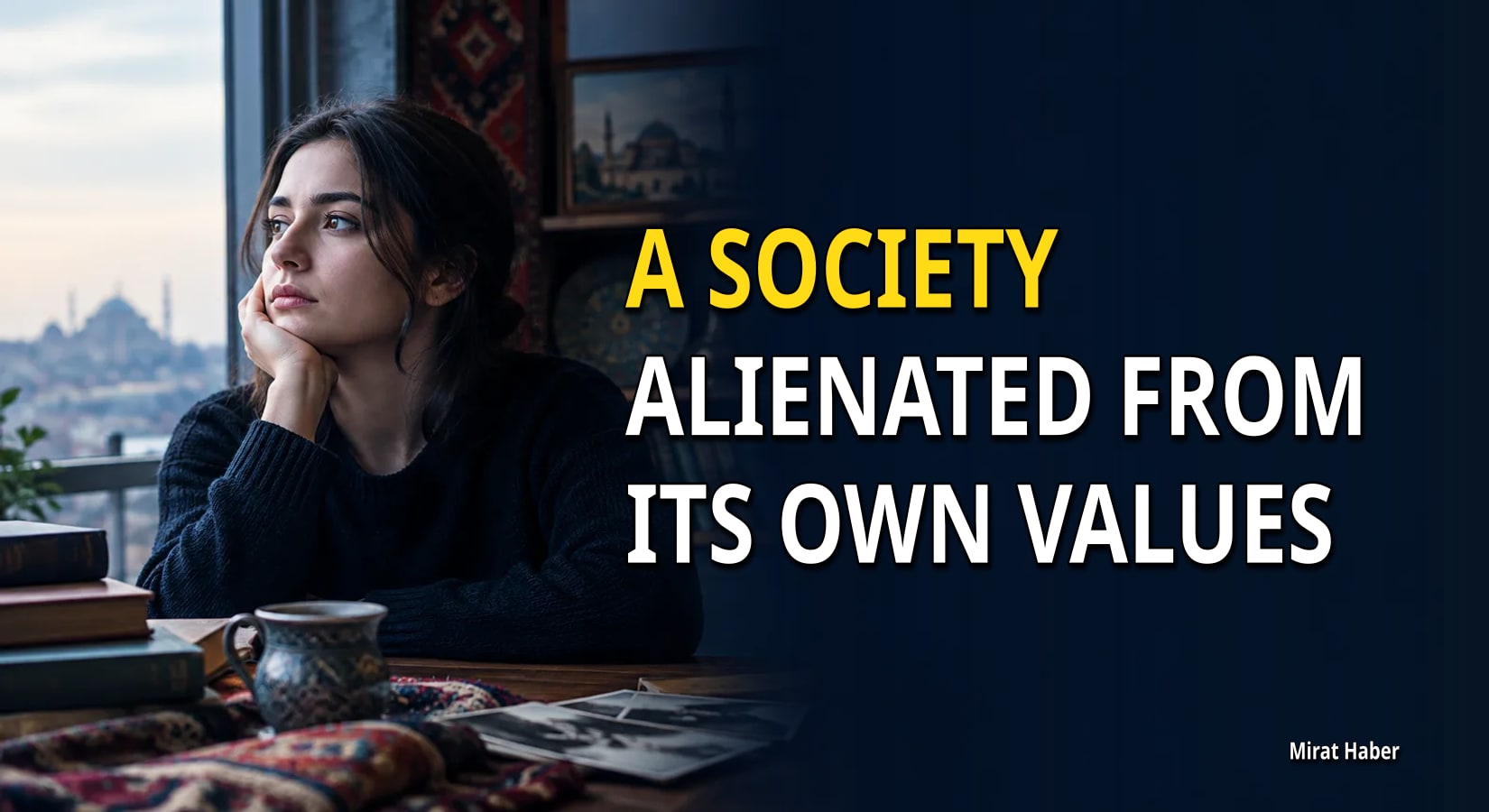
A nation’s independence gains meaning not merely through protecting its borders, but through its ability to shape its laws, approach to governance and social order in accordance with its own values. Societies unable to develop a system rooted in their own beliefs, history, culture and moral heritage eventually begin to live under laws produced within the intellectual frameworks of others. What is imported, then, is not only a set of legal rules, but also the conceptions of the individual, society, family, freedom and the state on which those rules rest. This weakens a nation’s ability to think in terms of its own values and determine its future through its own will.
The adoption of Western law as the foundation of Türkiye’s modernisation process is a historical example of this. The adoption of the Swiss Civil Code, the Italian Penal Code and various provisions from other European legal systems in 1926, during the Republican era, was not merely a technical legal change. These choices redefined the relationship between society’s traditional values and the state’s legal structure. Western conceptions of the state and law also influenced the formation of the constitutional order. Yet the central question here is not so much which country a law was taken from, but which values it rests on and how compatible it is with society’s beliefs. Distancing a Muslim society’s legal order from the sources of its own faith changes not only its laws, but also the fundamental standards that govern life.
A widening gap between a society’s laws and its values weakens its sense of belonging and shared identity. When people’s understanding of right, wrong, rights, justice and responsibility conflicts with the principles adopted by the state, alienation begins to emerge between society and its institutions. While people sustain their own beliefs and culture in their private lives, in the public sphere they encounter the rules of a different system of values. Such a divide damages society’s shared consciousness. As faith and law, morality and governance, and society’s values and the state’s principles drift apart, the nation’s own vision of civilisation also loses its influence.
This also creates profound contradictions in people’s sense of identity and belonging. Individuals who see no reflection of their own values in public life gradually begin to regard their culture as a measure of backwardness and imported values as a measure of progress. This outlook weakens their confidence in their own history and civilisational heritage. More importantly, it erodes society’s belief that it can draw on its own intellectual resources to find solutions to its problems. Intellectual dependence thus becomes more enduring than political and legal dependence. Rather than thinking in terms of their own values, people turn to thinking in terms of what others hold to be true; rather than developing their own civilisation, they turn to adopting the systems created by other civilisations.
From an Islamic perspective, the fundamental standard for law and justice is not people’s shifting ideas, but the rulings laid down by Allah. Islam has established the fundamental principles, rights and responsibilities concerning people’s individual and social lives. When a Muslim society bases its laws on the fundamental principles of human-made systems incompatible with the rulings of Islam, it creates an order that contradicts its own faith. The Qur’an’s understanding of truth and justice cannot be subordinated to the rulings of systems of falsehood. Islam is not a faith and way of life to be shaped according to the standards of other ideologies. A Muslim society’s responsibility is not to adapt Islam to other systems, but to establish its laws and social order in accordance with the principles set out by Islam. For an outlook that confuses the standards of truth and falsehood severs the bond between a society’s faith and its life.
A constitution is not merely a legal text governing the institutions of the state. It is also a foundational framework that defines the individual’s position in relation to the state, the principles by which society will live and the limits of political authority. A Muslim society’s constitution and laws should therefore not be formulated independently of its own faith, moral values and understanding of justice. The connection between the source of law and society’s religious values is not merely a cultural preference, but a fundamental matter that defines a civilisation’s identity. Islam’s understanding of justice requires limiting rulers’ powers, protecting people’s rights and treating people of other faiths justly as well.
A nation’s true independence lies not merely in its ability to choose its own rulers, but also in its ability to determine the values by which it will be governed. A society seeking to build its own civilisation cannot be content merely to apply laws produced by others. It must shape its laws, approach to governance and social order on the basis of its own beliefs and principles. For a Muslim society, the fundamental source of this will is the guidance of the Qur’an and the example of the Prophet Muhammed.
For a society that does not trust its own values eventually begins to seek its own future within the intellectual frameworks of others. A nation that ceases to make its own faith the standard for life condemns itself to an independence confined to political borders.
İslam Başaran
Mirat Haber – YouTube
After Tufan and Gülsüm’s affair came to light in Haysiyet, Yıldız said her marriage was…
104 civil society organisations have urged European Parliament President Roberta Metsola to act over remarks…
According to Diken’s report citing The New York Times, US Treasury Secretary Scott Bessent moved…
A study with Dilara N. Anbarcı as first author examined the possible functions of the…
According to Sözcü, citing a report by Akif Yaman, Serenay Sarıkaya and Mert Demir are…
According to Hürriyet, the plan against Belgium calls for different formations in and out of…