
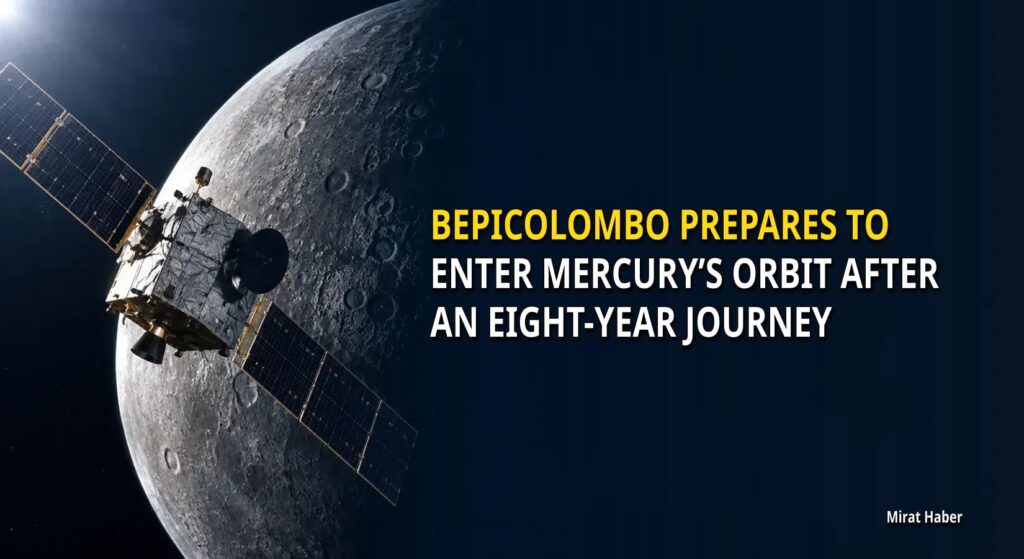
BepiColombo, a joint European-Japanese space mission, is preparing to enter Mercury’s orbit after an eight-year journey. According to Haberler.com, citing a BBC report, the spacecraft has travelled about 10 billion kilometres and will perform an 11-minute braking manoeuvre to enter orbit. If successful, the mission will allow scientists to investigate the ice at the planet’s poles, its surface hollows and its large metallic core. To remain in orbit around Mercury, BepiColombo must slow down on its final approach so that the planet’s gravity can capture it. The planned 11-minute braking manoeuvre will therefore be a decisive stage of the journey. The report notes that if a problem occurs during the manoeuvre, the spacecraft could fly past Mercury instead of entering orbit. Orbital arrival is therefore not yet complete. The need to slow down has not been limited to the final approach. Throughout its journey, the spacecraft has followed a route designed to reduce its speed to counter the Sun’s powerful gravity. Along the way, it flew past Earth once, Venus twice and Mercury six times. One of the mission’s scientific goals is to explain why ice exists in the polar craters of the planet closest to the Sun. Another target is the thousands of hollows scattered across its surface. These formations, which are described as distinct from impact craters, are thought to be about 100 thousand years old; this age is presented as an estimate to be investigated, not an established date. Observations will be divided between two spacecraft. The European Space Agency’s (ESA) spacecraft will examine the surface up close, while the Japan Aerospace Exploration Agency’s (JAXA) spacecraft will observe the planet from a distance. The research programme’s next major technical stage will therefore be the separation of the spacecraft, which have been travelling together, a few weeks after they reach Mercury. Jessica Marshall, a systems engineer at Airbus, which built the spacecraft, says separating the two craft after eight years attached to each other will be a tense stage for the team. Following orbital insertion, this separation is another important part of the mission plan. Temperatures on Mercury can rise to 430 degrees and fall to minus 180 degrees. The planet is also exposed to intense solar radiation. BepiColombo’s investigations, expected to last at least a year, will focus on the planet, where these conditions prevail. According to the report, only two NASA spacecraft have visited Mercury so far. Mariner 10 flew past the planet three times in the 1970s. Messenger entered orbit in 2011 and remained there for four years. BepiColombo is preparing to study the planet following these two missions. Slightly larger than the Moon, Mercury completes an orbit around the Sun in 88 days, while a rotation on its axis takes about 59 Earth days. The planet’s large metallic core, despite its small size, is another feature researchers hope to explain. BepiColombo was launched from French Guiana in 2018. The journey, initially expected to take seven years, was extended by a year because of a propulsion system malfunction.The mission’s critical stages
Why is entering Mercury’s orbit critical?
What questions will researchers seek to answer?
Following earlier missions into a harsh environment
Questions about BepiColombo
Where was BepiColombo launched from?
Why did the journey take longer than planned?
İstanbul
Hafif Yağmurlu
17°C
İstanbul
17°C
Hafif Yağmurlu
Pazar
Hafif Yağmurlu
16°C
Pazartesi
Yağmurlu
19°C
Salı
Az Bulutlu
9°C
Çarşamba
Parçalı Bulutlu
9°C