İstanbul
Hafif Yağmurlu
11°C
İstanbul
11°C
Hafif Yağmurlu
Pazartesi
Hafif Yağmurlu
8°C
Salı
Hafif Yağmurlu
8°C
Çarşamba
Hafif Yağmurlu
8°C
Perşembe
Çok Bulutlu
9°C

Four physicists from Türkiye feature in the AD Scientific Index’s list of 100 women scientists for 2027. Hatice Duran Yıldız placed in the top 10.
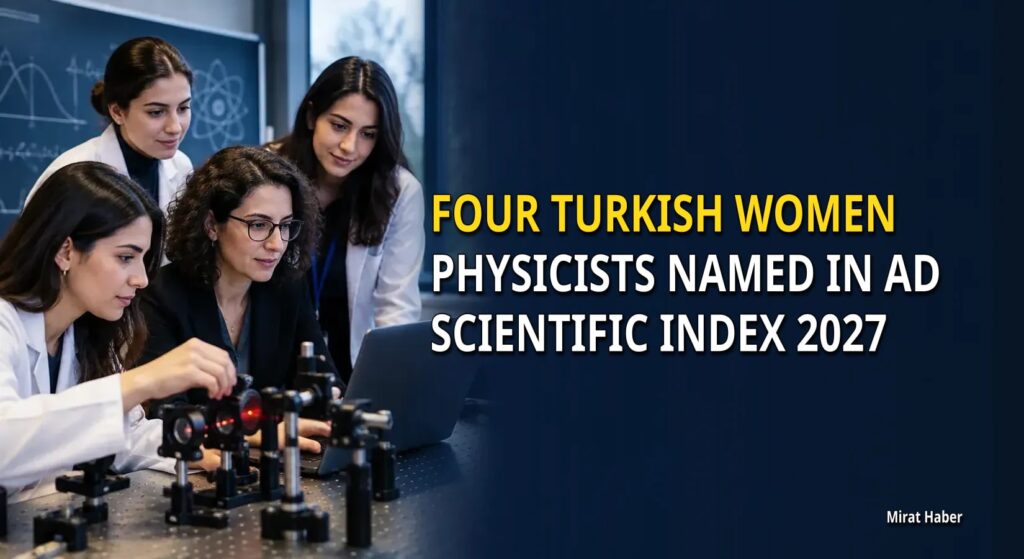
Four physicists from Türkiye feature in the AD Scientific Index’s “World’s Top 100 Women Scientists” report for 2027. According to results reported by Milliyet, Prof. Hatice Duran Yıldız placed in the top 10, while Türkiye tied with Brazil for sixth place by number of researchers listed. In their comments, the academics highlighted their research teams’ collective efforts and the importance of supporting young women in science, rather than individual achievement. According to Milliyet, Hatice Duran Yıldız placed in the top 10, Prof. Aysel Kayış Topaksu ranked 29th, Prof. Deniz Sunar Çerçi 50th and Prof. Gülsen Önengüt 73rd. The results appeared in the AD Scientific Index’s report for 2027, which ranks women researchers by their H-index. In the country rankings, the United States was followed by Italy, India, Spain and the United Kingdom, in that order. Türkiye and Brazil shared the same position with four researchers each. These results reflect representation within the report’s list of women scientists. Hatice Duran Yıldız of Ankara University works in high-energy physics and accelerator technologies. Her research at CERN dates back to 1998. Speaking to Milliyet, Yıldız highlighted her family’s support for her success and said she hoped it would inspire other women, particularly young girls. Deniz Sunar Çerçi, a faculty member in the Department of Physics at Yıldız Technical University, works in nuclear physics and participates in CERN experiments. The report described Çerçi as the first Turkish scientist appointed to a management role by CERN’s CMS management, in September 2020. Çerçi stressed that research at CERN draws on years of collective effort by thousands of scientists, students, engineers and technical staff from different countries. She viewed her place on the list not simply as a personal achievement, but as recognition of the work of her teams and the young researchers they have trained. The academics’ messages to young people focused on sustaining scientific curiosity and not allowing social expectations to limit their choice of field. Yıldız urged young women not to scale back their ambitions because of the obstacles they encounter, or hesitate to make themselves visible in science. Çerçi said girls’ choices in science should not be confined to a narrow range of fields. She said women academics should not shy away from responsibility or downplay their achievements, and should make room for one another. Her comments highlighted not only young people’s individual efforts but also the responsibility of the academic community to support them. Gülsen Önengüt recalled feeling isolated while working in a male-dominated physics department in the United States. She described her experience in Türkiye as an environment with more women, where she did not feel alone, and said she supported girls interested in science. According to Milliyet, the AD Scientific Index ranked the 100 women researchers with the highest H-index scores from a pool of 6.3 million scientists. Gülsen Önengüt and her former student Aysel Kayış Topaksu both appeared on the list. Önengüt retired after 28 years at Çukurova University, while Topaksu is known for her international work in high-energy and particle physics.Key findings
Where did the Turkish physicists rank?
CERN research and the emphasis on teamwork
A message for young women researchers
Questions about the ranking
What measure was used for the ranking?
Which professor and former student appeared on the list together?
Source: Milliyet’s report on the ranking results and the academics’ comments.