
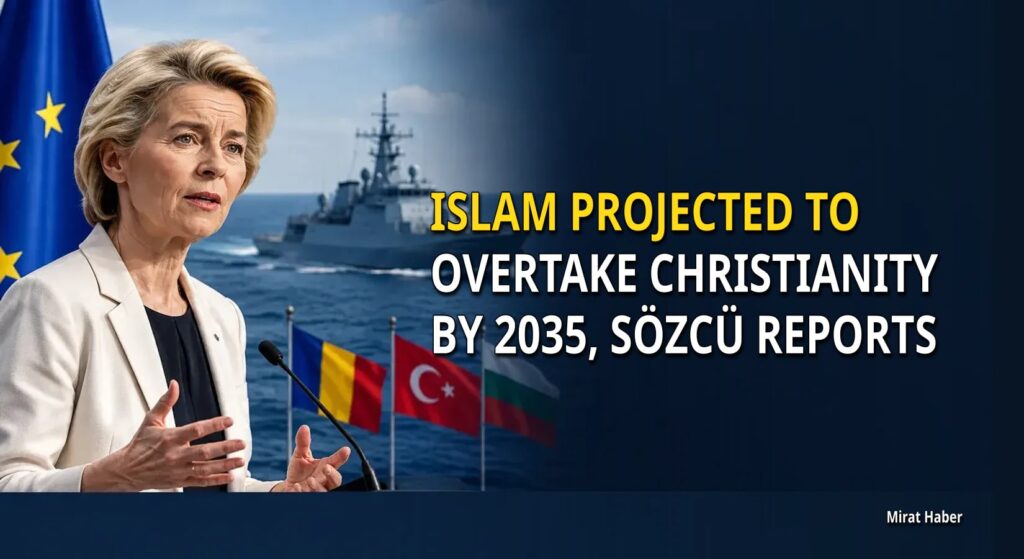
Islam is expected to overtake Christianity in the number of followers by 2035, according to a Sözcü report citing the Pew Research Center. The projection of global religious populations attributes the growth primarily to demographic trends rather than religious conversion. The report says the Christian population will also continue to grow, but its geographic centre will shift towards sub-Saharan Africa. Interpreting the figures in the report requires distinguishing between two different types of population change. Natural population change is the difference between births and deaths. Converting to another religion or leaving religion altogether is a separate process. The research cited in the report explains Muslim population growth primarily as a result of births outnumbering deaths. The figures for 2020–2025 put the average fertility rate for women who are neither Muslim nor Christian at 1.6 children. This comparison is among the indicators used in the report to explain population growth across religious groups. Population growth does not, however, mean a net gain through religious conversion. According to the assessment reported by Sözcü, both Islam and Christianity could lose more followers through religious switching, including leaving religion altogether, than they gain. The losses could be greater for Christianity. University College London professor David Voas, whose comments to Axios are cited in the report, also emphasises the link between changes in religious populations and demographic processes. Voas points to rapid population growth in North Africa, the Middle East, the Near East and South Asia, and the large Muslim populations in those regions. The projected change is not limited to the relative size of the two religions. A significant shift in the geographic distribution of Christians is also expected. While the global total is projected to rise, some countries could see declines. According to the report, the United States, which had the world’s largest Christian population at 217 million in 2020, is expected to see that number fall to 174 million by 2070. The US is projected to lose more Christians in absolute numbers than any other country over that period. The Democratic Republic of the Congo is projected to move in the opposite direction, with its Christian population expected to reach about 300 million by 2070. Voas’s assessment that Christianity’s centre of gravity is shifting towards the Global South reflects this geographic divergence. According to Voas, Islam becoming the largest religion by population does not necessarily mean a major shift in political or cultural power. In the comments cited by the report, he says he does not expect a major change in the balance of power, at least in the medium term. He therefore draws no automatic, direct link between population rankings and global influence. That distinction matters for readers following these figures: a forecast of the number of believers should not be interpreted as a prediction of political dominance. Voas also rejects claims that Muslims will take over Europe, saying he does not expect such a development in the foreseeable future. The report’s figures for 2035 and 2070 are projections, not outcomes that have already occurred. No. Sözcü’s report, citing the Pew Research Center, presents 2035 as the projected time frame for Islam to overtake Christianity in the number of followers, not as an outcome that has already occurred. The research cited in the report attributes the growth primarily to demographic trends, particularly births outnumbering deaths. Religious switching is assessed separately.Key findings from the projection
Religious population projections: Natural growth and conversion are different processes
The geographic distribution of Christians is changing
Will population growth change the global balance of power?
Frequently asked questions
Is the 2035 forecast a certainty?
Is Muslim population growth mainly driven by conversion?
İstanbul
Yağmurlu
22°C
İstanbul
22°C
Yağmurlu
Cumartesi
Hafif Yağmurlu
17°C
Pazar
Parçalı Bulutlu
16°C
Pazartesi
Yağmurlu
19°C
Salı
Az Bulutlu
10°C