
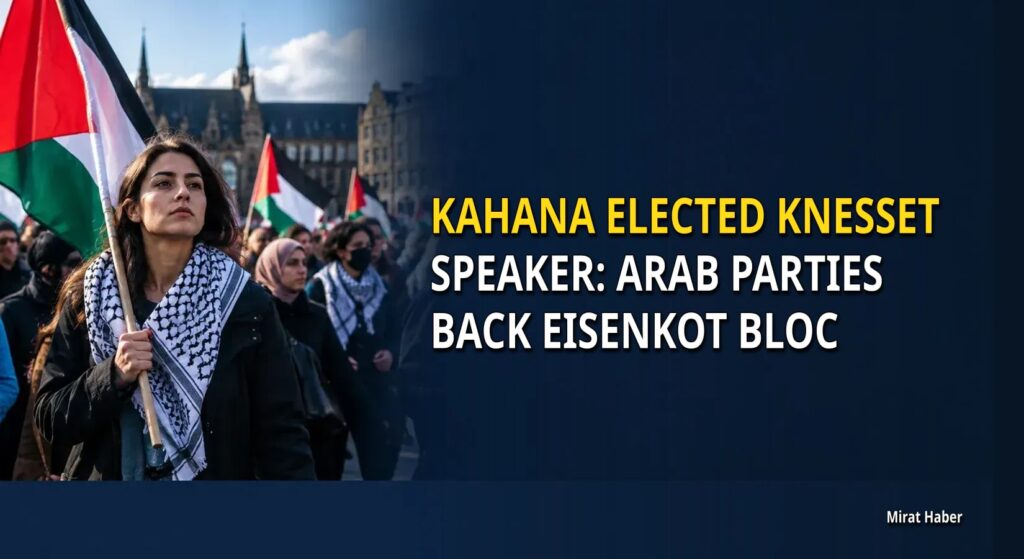
Matan Kahana was elected speaker of Israel’s Knesset on 17 November 2026, defeating Likud candidate Ofir Katz, according to Memurlar.Net. Kahana’s election, backed by Gadi Eisenkot, who has been tasked with forming a government, matters for control of the legislative agenda. But the support secured for the speakership has yet to resolve disagreements over participation in a governing coalition. According to the report, Yashar, Yisrael Beytenu, B’Yachad and the Democrats supported Kahana’s candidacy. With backing from the Arab parties, these four parties commanded support exceeding half of the 120-member parliament. Cooperation in the speaker’s election thus extended beyond Eisenkot’s own bloc. His opponent, Ofir Katz, was nominated by Prime Minister Binyamin Netanyahu’s Likud party. Katz, who chaired the governing coalition’s parliamentary group during the previous term, received support from the ultra-Orthodox Shas party. The other ultra-Orthodox party, United Torah Judaism, announced that it would not support Kahana. However, the report says that before the vote, the party had not decided whether to vote against him or abstain. Its announcement should therefore not be taken as a statement of how it ultimately voted. One disagreement surrounding the speaker’s election concerned whether members of Arab parties would be elected deputy speakers. Religious Zionism leader Bezalel Smotriç made his support for Kahana conditional on no deputy speakers being appointed from parties that do not recognize Hamas as a terrorist organization. Kahana rejected that condition. Likud also said it had offered support on the same terms and nominated Katz after its offer was rejected. The condition was a demand made by political actors in negotiations over support, not an independent assessment of the parties’ positions. Eisenkot backed Kahana, saying parliament did not distinguish between first- and second-class voters. The election of nine temporary deputy speakers, including Ahmed Tibi and Velid Taha, was also on the agenda for the same session. The immediate effect will be a change in who holds the office that controls the legislative agenda. According to Memurlar.Net, Eisenkot’s bloc plans to move quickly to bring forward bills repealing legislation on the Netanyahu government’s judicial changes. That is a stated legislative objective, not an indication that those laws have been repealed. Electing a speaker and changing legislation remain separate stages. Likud opposed replacing the speaker while talks on a national unity government were continuing. The party called for harsh, unilateral steps to be avoided. The disagreement therefore extended beyond who held the speakership to how the legislative process should be conducted. The next decisive stage in forming a government is Eisenkot’s coalition negotiations. According to the report, the 27 October 2026 election produced no clear winner; of the 120 lawmakers, 67 recommended Eisenkot, prompting President Isaac Herzog to task him with forming a government on 8 November 2026. He has 28 days to complete that task, and the president can grant an extension of up to 14 days if necessary. However, some parties in Eisenkot’s bloc oppose entering a governing coalition with Arab parties. Whether the support secured in the speaker’s election can translate into a coalition agreement therefore remains the central question in the government formation process. Born in Haifa in 1972, Matan Kahana is a retired colonel who commanded an F-16 squadron in the Israeli Air Force. He also served in the Sayeret Matkal unit during his military career. He entered politics in 2019 with the New Right party, part of the Yamina alliance. He served as religious affairs minister in Naftali Bennett’s government in 2021-2022. Kahana left parliament in July 2025 and joined Yashar, the party founded by Eisenkot, in September that year. He was re-elected to parliament in October 2026 from fifth place on the party’s candidate list. Kahana’s election ended the tenure of Likud lawmaker Amir Ohana, who had served as speaker since 29 December 2022. No. According to the report, this election required only a simple majority, rather than an absolute majority.Key facts from the vote
The political balance behind the speaker’s election
Dispute over conditions on Arab parties’ representation
What will a new Knesset speaker change?
Kahana’s path from military service to politics
Two questions about the election
Who did Kahana replace as Knesset speaker?
Was an absolute majority required to elect the speaker?
İstanbul
Hafif Yağmurlu
17°C
İstanbul
17°C
Hafif Yağmurlu
Çarşamba
Hafif Yağmurlu
19°C
Perşembe
Az Bulutlu
19°C
Cuma
Yağmurlu
20°C
Cumartesi
Hafif Yağmurlu
17°C