
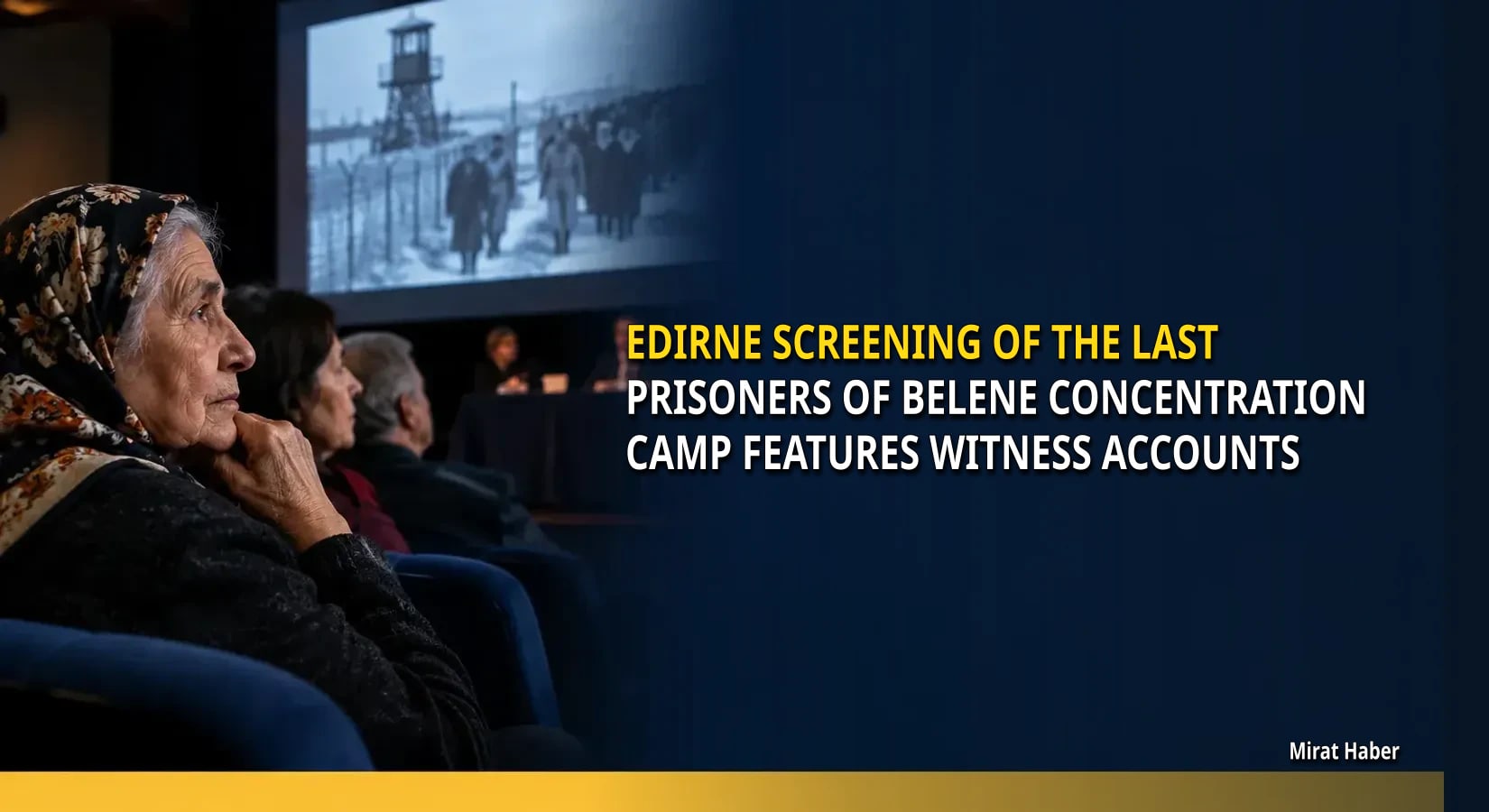
“The Last Prisoners of Belene Concentration Camp” was screened at the Atatürk Cultural Center in Edirne. The film presents testimony from people who opposed forced name changes and assimilation policies in Bulgaria. After the screening, Turks from Bulgaria who lived through that period described their experiences in the camp and their journeys to Turkey.
The film recounts the experiences of people imprisoned in Belene Concentration Camp for opposing forced name changes and assimilation policies in Bulgaria between 1984 and 1989. Through testimony from prisoners and their families, it examines the suffering caused by imprisonment without a court order, the struggle to preserve human dignity and the lasting effects on society.
The discussion after the screening continued the film’s account of that period through firsthand testimony. İsmet Balkanlı, Fahri Yaşaroğlu, Şükrü Korkmaz, Recep Recepoğlu, Sefer Oral, Sultan Çetin, Mehmet Vatansever, Seyit Ali Akgün and Hatice İslam shared their experiences in Belene and described how they came to Turkey.
Safiye Yurdakul, president of the Association for Justice, Rights, Culture and Solidarity in the Balkans (BAHAD), said the documentary portrayed the inhumane treatment experienced by people of all ages, from babies to the elderly. She said those imprisoned in the camp had lived under the psychological pressure of fearing death, yet continued their struggle. Yurdakul said the search for justice continued today and called for those responsible to be brought to trial to prevent similar persecution from recurring. She expressed hope that Bulgaria would make progress on democracy and the rule of law.
Bulgaria’s consul general in Edirne, Radoslava Kafedzhiyska, said the camps had become symbols of communist repression over time. She said tens of thousands of Bulgarian citizens had been imprisoned in these camps without trial or conviction, including Bulgarian intellectuals and people from different ethnic, religious and social backgrounds. Kafedzhiyska’s figure referred to the camps as a whole, while the documentary focuses on testimony from 30 prisoners and their families.
The audience included Turks from Bulgaria living in Edirne, visitors from Bulgaria, academics, the documentary team and members of the public. Combining the screening and discussion in one program allowed viewers both to follow the documentary’s accounts and to hear directly from people who had suffered persecution about their experiences in the camp and their migration to Turkey. Those attending included Edirne Deputy Mayor Gökçe Onur Öktem, Cevat Güneş, president of the Thrace Balkan Turks Culture and Solidarity Association, and BAHAD Vice President Rıfat Yağcı. In her remarks, Consul General Kafedzhiyska said she believed the documentary would serve as a reminder of the importance of unity and democracy.
The screening and discussion were jointly organized by the Thrace Balkan Turks Culture and Solidarity Association and BAHAD, with support from Edirne Municipality and various Balkan associations.
The documentary, a New Bulgarian University production, was directed by Dimitır Kotsev-Şoşo, written by Hristo Hristov and produced by Prof. Lyudmil Hristov.
Key facts about the screening
What period and experiences does the documentary cover?
Speakers stress justice and the rule of law
Witnesses meet audiences in Edirne
Questions about the screening and production
Which organizations arranged the screening in Edirne?
Who directed, wrote and produced the documentary?
Source: Anadolu Agency