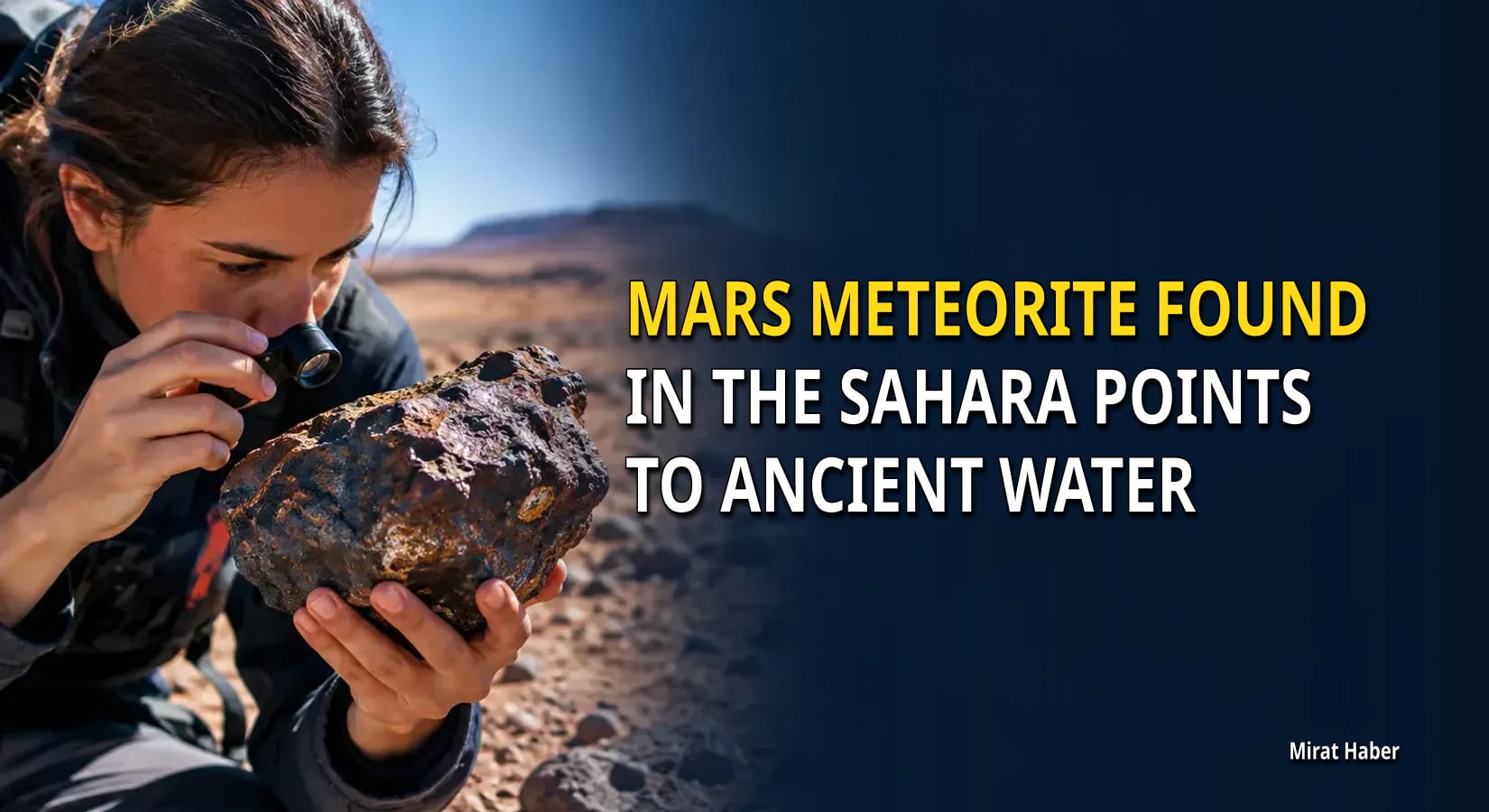
Editorial news visual · Mars meteorite found in the Sahara points to ancient water · Mirat Haber
A Martian meteorite named Teghaza 001, found in Mali’s Sahara Desert, has yielded evidence suggesting that rocks interacted with water early in the planet’s history. A scientific team that included NASA researchers examined the mineral and chemical properties of the rock, which is at least 4.1 billion years old. The findings could help explain why Mars became dry.
According to TRT Haber’s report, which cited CNN International, researchers compared the meteorite’s mineral and chemical properties with data from Mars. The comparison identified 13 possible locations in the planet’s southern highlands where the rock could have originated; no single point of origin was confirmed.
The meteorite is thought to have broken away from Mars and been ejected into space when a celestial body struck the planet. This explanation was reported as the researchers’ assessment of how the rock left Mars.
The evidence of water comes from mineral and chemical traces within the rock. The scientific team said these traces indicate that water existed in Mars’s crust early in its history and that rocks interacted with it. Studying Teghaza 001 could help researchers investigate the relationship between water on early Mars and the planet’s later drying. Scientists believe the finding could be valuable not only for understanding Mars’s past but also for explaining how Earth has continued to retain water. These potential contributions reflect the researchers’ assessment of the finding’s future scientific value.
The meteorite was determined to be at least 4.1 billion years old. Its age indicates that the rock carries evidence from early in Mars’s history.
No. The report describes the study as an investigation by a scientific team that included NASA researchers.Key facts about the study
How did researchers investigate its origins on Mars?
What does the finding mean for Mars research?
Questions about Teghaza 001
How old is Teghaza 001?
Was NASA solely responsible for the research?
According to Onedio, Candice Brook alleged that a Galatasaray teammate’s girlfriend sent Leroy Sane a…
Heavy snow and blizzard conditions disrupted travel in Rize’s highlands. Snow reached 70 centimetres on…
Zeynel Emre claimed that Tekirdağ Metropolitan Mayor Candan Yüceer, who resigned from YENİ Parti, could…
MHP leader Devlet Bahçeli stressed safeguarding the Republic and interpreting its founding ideas in light…
Serbia coach Veljko Paunovic said Dusan Vlahovic will not join the national team because of…
A report citing Brazilian media names Danilo among Emre Belözoğlu's transfer targets. However, it gives…