
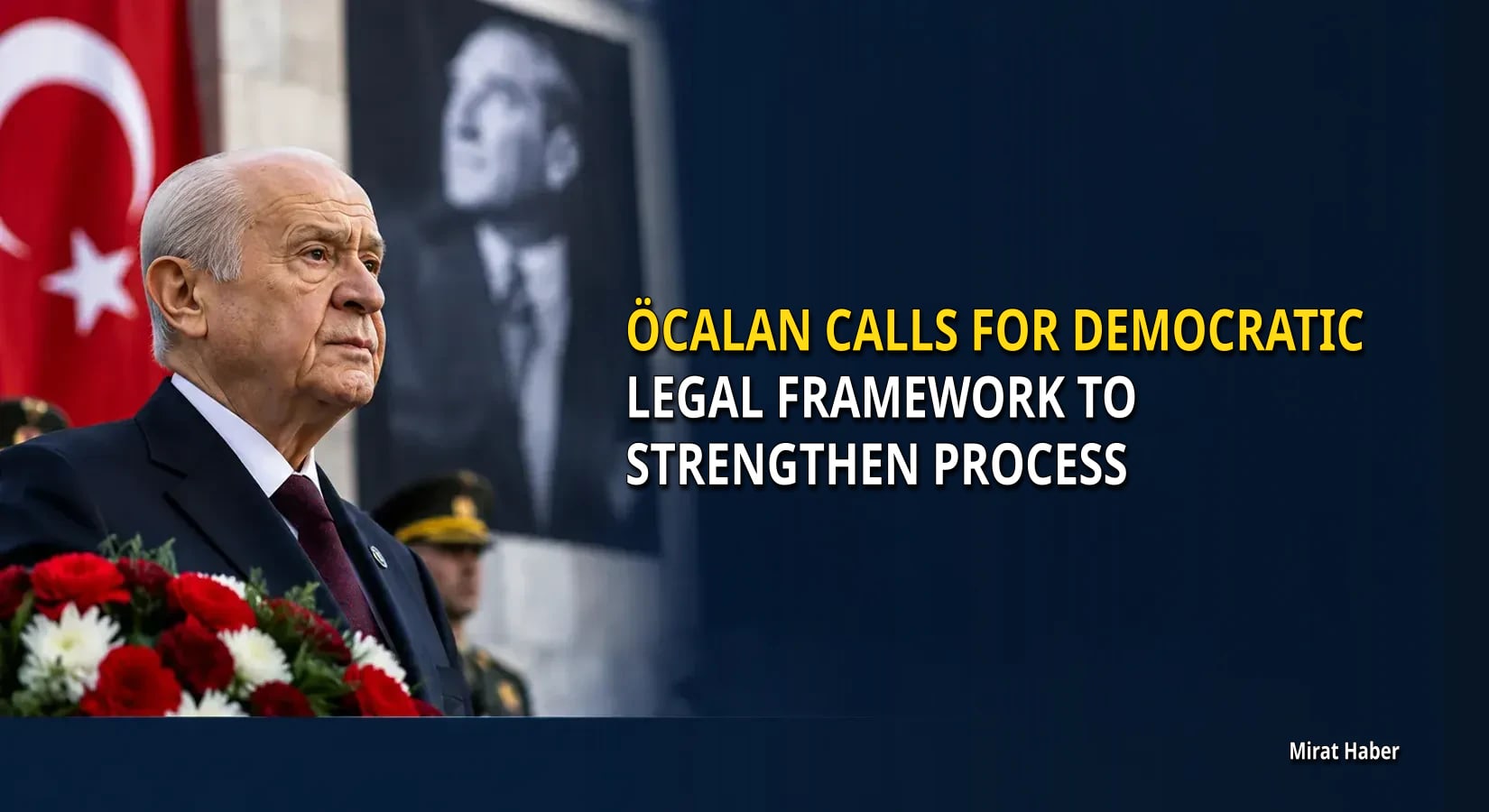
The DEM Parti İmralı Delegation conveyed to the public a call by PKK leader Abdullah Öcalan, whom it met on İmralı Island on 22 November, to strengthen the process through a democratic legal framework and free political activity. The delegation’s written statement called for a legal basis to be established and the relevant bodies to become operational. Öcalan described resolving the Kurdish issue as a matter of democracy concerning all political and social groups in Turkey.
At the current stage of the Peace and Democratic Society Process, the delegation wants a legal basis to be established, the bodies envisaged under the framework law to become operational, and means of communication to be provided so that Öcalan can explain his work directly to the public. These points in the statement are presented as demands for the next stage, not as decisions on new steps already taken.
The delegation linked its request for communication access to enabling Öcalan to give the press and the public a comprehensive account of his two years of work on the historical partnership and peace between Turks and Kurds. The statement thus addressed both the institutional functioning of the process and how it would be explained to the public.
The delegation’s statement also said that Öcalan was determined to continue and deepen his work as “Coordinator for Peace and Politicisation”. This wording was used as the delegation’s account of Öcalan’s role in the process. In Öcalan’s assessment, demands for justice, law and democracy were not confined to Kurds; they were described as shared demands concerning everyone in Turkey. He also argued that efforts to resolve the Kurdish issue would benefit every political and social group in Turkey.
The specific issues highlighted in the statement regarding different peoples and faiths were the freedom to practise their cultures, the ability to exercise their rights securely, and the protection of those rights through democratic institutions. These were presented as goals of Öcalan’s vision of a democratic society, not as new rights provisions that had entered into force.
The delegation reported that Öcalan had moved to newly built premises within İmralı Prison and viewed this change positively in terms of his working and living conditions. It then said that means of communication needed to be provided so that he could personally explain his work. Öcalan, meanwhile, alleged that deaths were occurring in prisons, that prisoners were having their eligibility for release revoked, and that different practices were being introduced in different prisons. He characterised these practices as a provocation against the process. These remarks about prisons were among Öcalan’s assessments relayed by the delegation.
Öcalan warned that blocking political space through a cycle of pressure, provocation and reaction could create room for undemocratic forces to act. He argued that the most effective response to attempts to derail the process was to strengthen the democratic legal framework and free political activity.
He said democratic politics should be conducted on the basis of consistent principles rather than reactions to day-to-day events. He called on the political sphere to demonstrate its ability to foster democracy.
Öcalan said that Kurdish participation in the Republic could take place on a secure democratic footing and advocated recognition of all identities. He expressed the view that Turkey could become a model in the Middle East by legally guaranteeing the status of Kurds as a fundamental founding component. He used the term “Democratic Republic” to describe this political goal.
The meeting and statement were reported by BBC Türkçe and BirGün, based on the delegation’s written statement.
The DEM Parti İmralı Delegation met Abdullah Öcalan on İmralı Island on 22 November.
The delegation consisted of Deputy Speaker of the Turkish Grand National Assembly Pervin Buldan, Şanlıurfa MP Mithat Sancar and lawyer Özgür Faik Erol.
Key points of the statement
What steps does the delegation want taken?
What issues stand out regarding rights and social life?
Assessments of prison conditions and practices
Emphasis on political space and legal guarantees
Questions about the meeting
When and where did the meeting with Öcalan take place?
Who was in the İmralı Delegation?