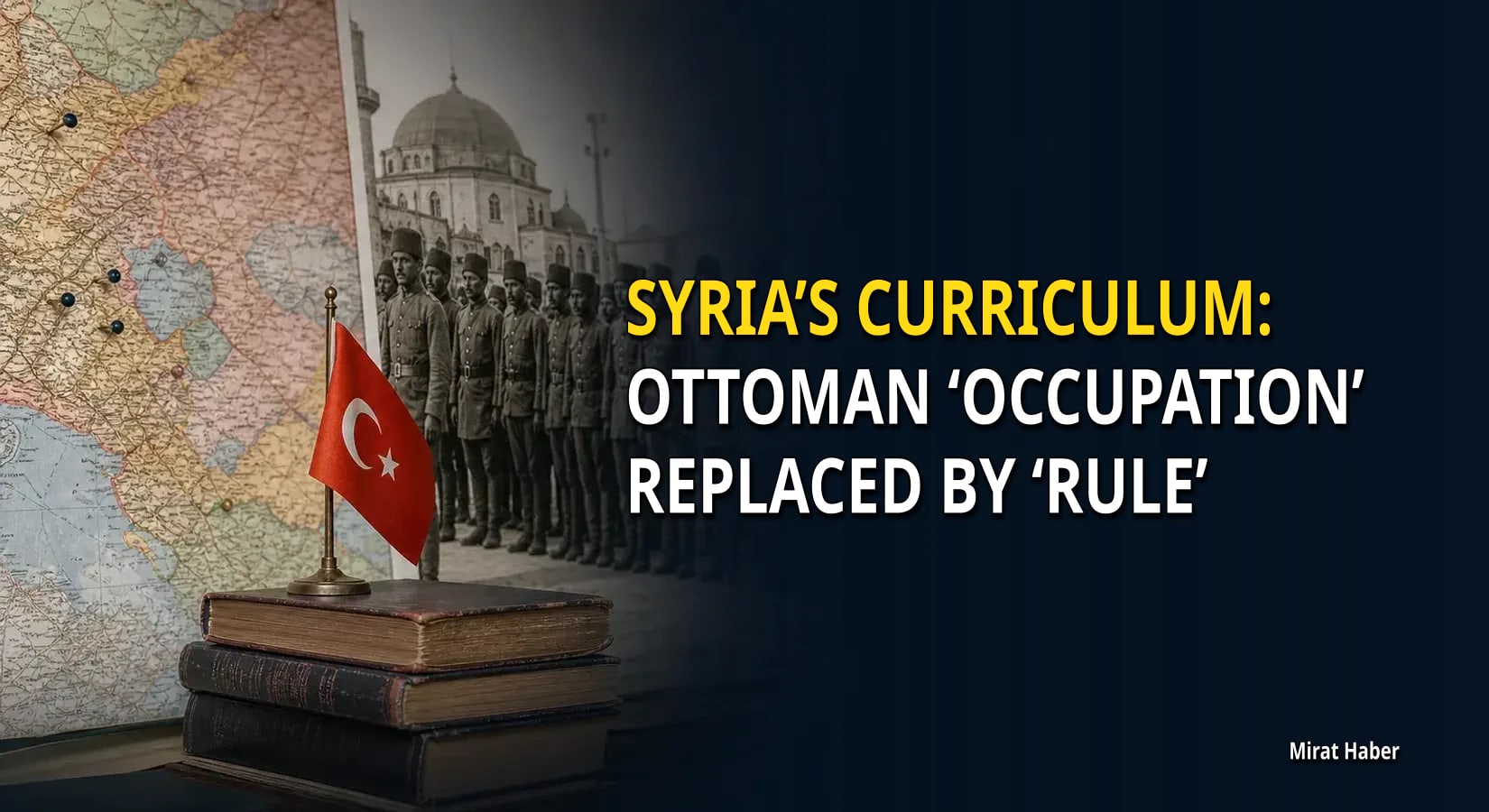
Editorial news visual · Syria’s curriculum: Ottoman ‘occupation’ replaced by ‘rule’ · Mirat Haber
The portrayal of the Ottoman period in Syria’s school curriculum has reportedly changed. Sözcü reported that sections about Turks had been rewritten, while Anadolu Agency reported a change to the anti-Ottoman narrative. Evrensel’s headline identified a specific revision: the replacement of “occupation” with “rule.” The change directly affects the historical account students encounter.
According to Evrensel, the term “occupation” was removed from the description of the Ottoman period and replaced with “rule.” Anadolu Agency covered the same subject as a change to the anti-Ottoman narrative, while Sözcü said sections about Turks had been rewritten. The reports share a focus on how the curriculum describes the Ottoman period and presents Turks.
These headlines frame the same change differently: Sözcü focuses on the rewritten sections, Anadolu Agency on the narrative’s perspective, and Evrensel on the wording that changed. It is therefore important to distinguish the specific textual revision from the significance each outlet attaches to it.
Bianet’s reporting extends beyond the historical narrative. In its coverage of the new curriculum, the outlet reports that content on women, the arts and citizenship has been removed. That report points to a separate change in content, distinct from the revised wording about the Ottoman period. For students, the most specific difference identified in the reports is the description of the Ottoman period as “rule” rather than “occupation.” Sözcü’s report that sections about Turks have been rewritten also presents the change as a revision to the account within those sections, rather than simply a change to a heading.
For students, teachers and families following curriculum developments, it is important to distinguish two issues: changes to the language describing Ottoman history, and Bianet’s report that content on women, the arts and citizenship has been removed. These are different kinds of revisions: the first concerns the language used to describe history, while the second concerns the subjects included in the curriculum.
According to Evrensel, “rule” replaced “occupation” in the account of the Ottoman period. Anadolu Agency also reported that the anti-Ottoman narrative had changed. Bianet reported the removal of content on women, the arts and citizenship. This was reported as a separate curriculum revision from the wording change in the Ottoman narrative.
Key facts
What changed in the portrayal of Ottoman history?
How the content changes for students
Frequently asked questions
What term replaced “occupation”?
What other curriculum changes have been reported?
We are those who have rejected all gods other than Allah. Just as we believe…
A story that begins with a child wearing a Halloween costume is really about a…
1. Muhammed (peace and blessings be upon him), our finest spiritual guide among those chosen…
The Metaphysical and Linguistic Definition of Destiny: In the tradition of Islamic theology, the literal…
The 2027 Annual Programme aims to introduce AI scoring of answers to open-ended questions, conduct…
Some estate agents reportedly demand a deposit or consultancy fee before showing homes. Lawyer Ali…