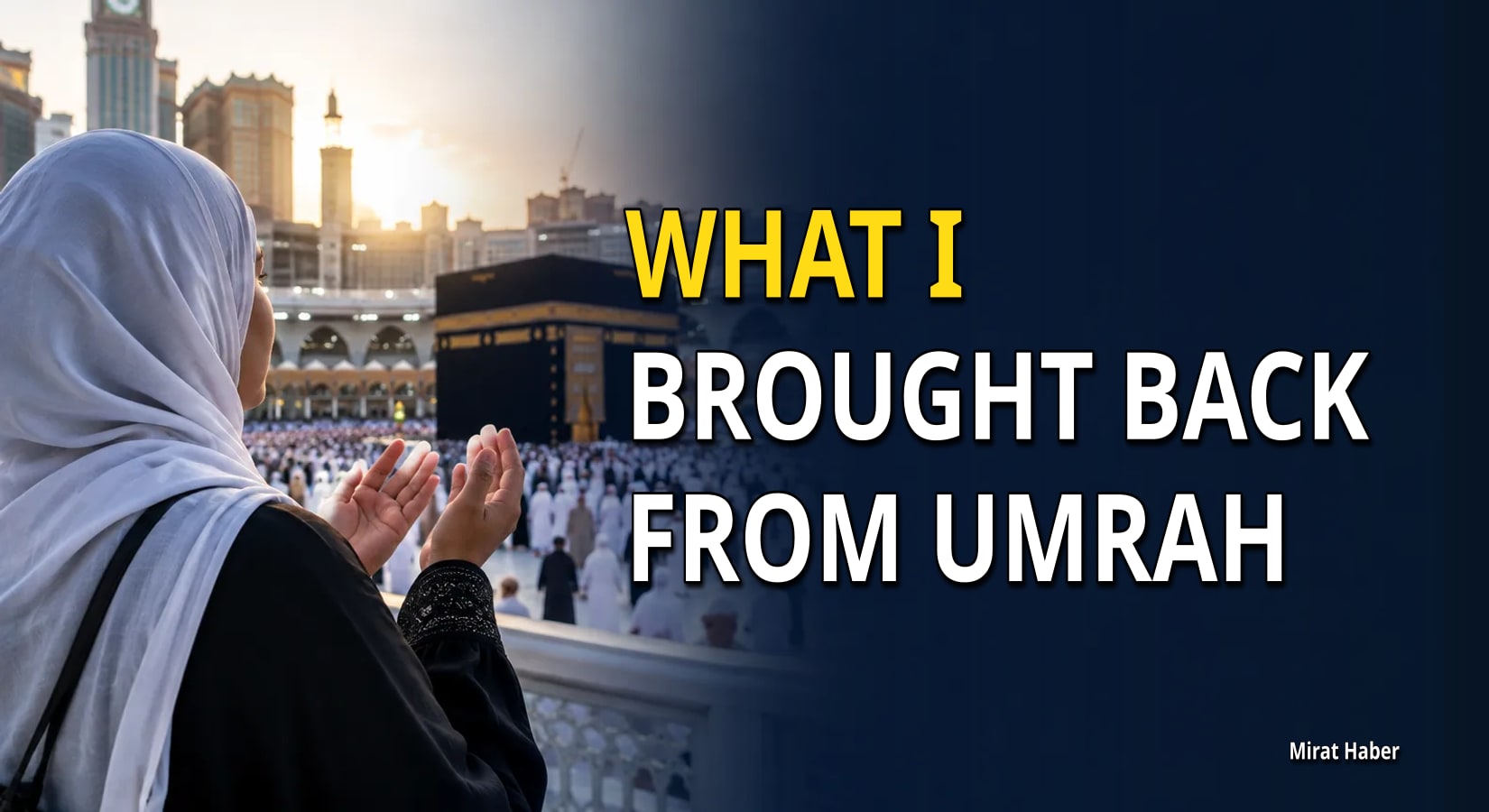
We performed our Umrah and returned from the holy lands. Around the Kaaba, we witnessed people from all over the world, with different languages, colours and cultures, turning in the same direction. We climbed Hira and stood deep in thought before that small cave where revelation reached humanity. We visited Bedir and Uhud. We went to the place believed to be the site of the house where the Prophet Muhammed was born. In the streets of Mecca, where Muslims once walked in fear and anxiety, persecuted for their faith, we witnessed thousands of people praying today. In this city, where conveying Allah’s verses to people once came at a heavy price, we witnessed the proclamations of Allah’s greatness, the prayers and the tears of people arriving in great numbers from every corner of the world. Looking at the Kaaba in the stillness of the night, you feel the distance between yourself and the world growing, while the distance between yourself and your Lord narrows. With every step, you encounter a memory; in every street, a struggle; in every place, a history that changed humanity’s destiny. Yet amid all this beauty, you also encounter questions that weigh on your heart and occupy your mind.
As I returned from Mecca and Medina, this question was on my mind: What are we seeking in these lands, and what are we finding? Is Mecca sacred simply because the Kaaba is there? Is Medina important only because the Messenger of Allah’s tomb is there? Is Hira meaningful merely because it is a cave on a mountaintop? Of course not. Understanding the sanctity of these lands requires us to understand the message Allah sent to humanity and how that message was put into practice. Revelation descended at Hira; in Mecca, people’s beliefs and thinking were reshaped; and in Medina, revelation was brought into society’s everyday life. Allah’s commands found expression in every sphere of life, from human relationships to trade, from justice to governance. Mecca and Medina are not merely cities of worship; they are also historical witnesses to how revelation transforms individuals and society.
Today, millions of people worship in Mecca. The Quran is recited, prayers are performed and pilgrims circle the Kaaba. Yet restrictions on publicly expressing revelation’s social and political injunctions present a serious contradiction that deserves reflection. How can we explain the inability to speak freely about the Quran’s messages concerning life, law, justice and governance in the very lands where it was revealed? While systems that exclude revelation from life prevail in many parts of the world, it is troubling that Muslims struggle to discuss these matters even in the lands where revelation descended. Maintaining security and order during worship is one thing; restricting revelation’s social message is another. The Quran was not revealed merely to be recited, to earn spiritual rewards or to bring people spiritual comfort. It was sent to give direction to human life, establish justice and set out principles that would deliver humanity from oppression.
In verse 25 of Surah Hadîd, Allah tells us that the prophets were sent with clear proofs, and that the Book and the balance were sent down with them so that people might uphold justice. This verse clearly shows that the purpose of revelation is not confined to individual acts of worship. At the heart of the opposition the Messenger of Allah faced in Mecca was revelation’s challenge to prevailing understandings of belief, authority and social order. Today, however, we worship in the lands where revelation descended and return without questioning our own lives or the system we live under. We read the Quran but do not reflect enough on what it means for how we live. We perform our acts of worship but do not give due attention to the responsibilities they place upon us. What we have lost is not the form of worship, but the understanding of ourselves and of life that those acts of worship should cultivate.
When I entered the Prophet’s Mosque in Medina, I called out inwardly, “O Muhammed, O Ebû Bekir, O Ömer!” I received no answer. Of course, I was not seeking their physical presence. I was looking for the Ebû Bekirs and Ömers of today, for people who embody the Prophet Muhammed’s character, struggle and sense of responsibility. I wanted to see Ebû Bekir’s loyalty, Ömer’s justice and the Messenger of Allah’s sense of responsibility towards humanity in today’s Muslims. With a heavy heart, I sat in the mosque and observed the people. A strong longing for Paradise was evident in what I saw; yet I kept wondering how fully people were accepting the responsibility to build a life that leads to Paradise. Of course, we cannot know what is in people’s hearts. But looking at the present condition of Muslim societies, we must question our own understanding of what it means to be servants of Allah.
In the time of the Messenger of Allah, the mosque in Medina was not merely a place for prayer. People were educated there, social issues were discussed, the problems of those in need were addressed, and the principles of justice and brotherhood were put into practice. The mosque was not separate from life but at its centre. There was no separation between worship and social responsibility. Today, we pray in the same mosque, turn towards the same qibla and read the same Book. Yet there is a considerable gap between the change worship brought about in people’s lives then and the change it brings about in our lives today. If the Prophet Muhammed’s example finds no expression in our lives, Ebû Bekir’s loyalty in our relationships or Ömer’s justice in our approach to governance, we are neglecting Islam’s practical expression in life. Loving them, speaking their names and visiting the places where they lived become meaningful when we take on the responsibility they bore.
Allah says, “Indeed, in the Messenger of Allah you have a fine example.” (Ahzâb, 33/21) Following the Messenger of Allah’s example means not merely repeating his acts of worship, but also bringing his submission to revelation, his understanding of justice, his character and his sense of responsibility towards humanity into our own lives.
It is saddening to see Umrah visits increasingly taking on the character of religious tourism. Amid hotels, shopping centres, tour itineraries, souvenirs and photographs, the true purpose of Umrah can fade into the background. Of course, there is nothing wrong with people worshipping in comfortable conditions, shopping or making memories. The problem arises when all these things take precedence over the purpose of worship. If we climb Hira without reflecting on why revelation was sent down, visit Bedir without understanding the sacrifices faith demands, go to Uhud without grasping the importance of obedience and responsibility, and spend time in Medina without considering what kind of society the Messenger of Allah built, then we have returned without learning the lessons our visits should have taught us.
The Messenger of Allah said, “One Umrah is an expiation for the sins committed between it and the next Umrah.” (Buhârî, 1773; Müslim, 1349) Umrah is a great opportunity to reckon with our past, cleanse ourselves of our sins and give our lives a new direction. But purification means not merely asking forgiveness for past sins, but also changing the outlook on life that led us to those sins. As we declare our submission to Allah before the Kaaba, we must demonstrate what that submission means in our lives when we return home. Allah says, “Say: Surely my prayer, my worship, my life and my death are for Allah, Lord of all worlds.” (En‘âm, 6/162) The verse tells us that not only prayer and worship, but the whole of life belongs to Allah. This is the fundamental awareness that Umrah should remind us of.
I used to ask people returning from Umrah, “What did you bring us from there?” The answer I usually received was, “Dates, Zamzam water—what else?” Yet what interested me was not what they had brought in their suitcases, but what they carried in their hearts and minds. We should have brought back from Hira an understanding of revelation’s right to shape life; from Mecca, patience and resolve for the sake of faith; from Bedir, self-sacrifice; from Uhud, an awareness of responsibility and obedience; and from Medina, justice, brotherhood and the understanding that revelation must be put into practice in society. We should have returned having learned from the Kaaba submission to Allah; from ihram, the meaninglessness of claims of superiority among people; and from circling the Kaaba, whom and what we should place at the centre of our lives.
Someone returning from Umrah should have a changed understanding of their responsibilities towards their family, neighbours, business dealings, society and Allah’s religion. Their stand against injustice, their relationship with worldly possessions, their compassion for others and their sense of justice should grow stronger. They should see Allah’s religion not merely as a means to their own salvation, but as a trust to be conveyed to humanity. The Messenger of Allah says, “You are all shepherds, and you are all responsible for those in your care.” (Buhârî, 893; Müslim, 1829) This sense of responsibility shows that worship does not begin and end within the walls of a mosque, but extends to every sphere of life.
What we need to recover today is the unity of worship and life. We need to restore the connection between serving Allah and living according to His commands. We need to see Mecca and Medina not merely as cities where we find spiritual peace, but as places where we learn what kind of people and what kind of society we should be.
I returned from Umrah not only with dates and Zamzam water, but with growing questions in my mind, a heavier burden of responsibility and an ache in my heart at the present condition of the Muslim community. For when the Messenger of Allah descended from Hira, he did not keep the spiritual experience he had in the cave to himself. He conveyed revelation to people, brought it into the centre of life and devoted his entire life to that cause. The greatest trust we, too, can carry home from the holy lands is to put into practice the truth that revelation offers humanity and help others live by it.
The true benefit of Umrah is revealed as much by the direction our lives take after returning from the Kaaba as by how many times we have circled it.
İslam Başaran
Mirat Haber – YouTube
In the previous part of our series on Hazrat Ömer’s (may Allah be pleased with…
Agriculture and Forestry Minister İbrahim Yumaklı rejected Ümit Özlale’s allegations about Gübretaş, saying neither he,…
Hürriyet reported that Archie Brown’s contract contains a €23 million release clause. According to the…
Amedspor beat Gaziantep FK 2-1 away in the 13th round of Süper Lig fixtures. Gift…
Istanbul Governor’s Office expects cold weather from Sunday, November 29, 2026, with strong winds, rain…
Following criticism of the Cengiz Topel reference in his song OHAOHAOHA, Lvbel C5 said he…