
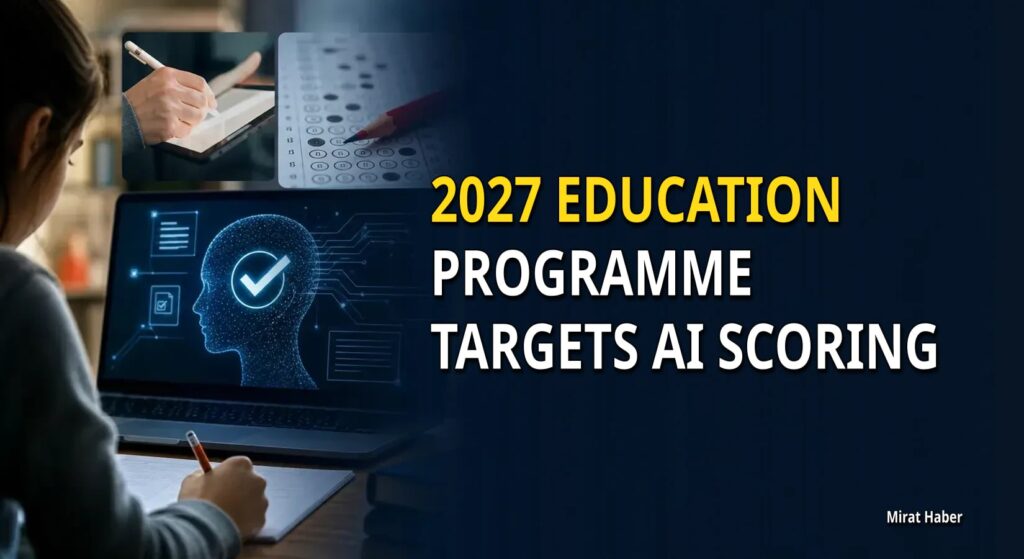
The 2027 Annual Programme, published in the Official Gazette with President Recep Tayyip Erdoğan’s signature, includes technology targets for educational measurement and assessment. According to BirGün’s report dated 27 October 2026, plans affecting students and teachers in Türkiye include using AI to score answers to open-ended questions and moving the ABİDE study to an electronic format. These are listed in the programme as future targets. The use of AI specified in the programme is to score answers to open-ended questions. Another target is to introduce new methods in line with technological developments for assessing centrally administered exams. Both areas focus on the use of technology in assessment; AI scoring is presented as a target of the 2027 programme, not as an already implemented practice. The other digital initiative in measurement and assessment concerns the Monitoring and Evaluation of Academic Skills study. ABİDE, which runs in two-year cycles, is to be conducted electronically under the name e-ABİDE. The study aims to measure students’ ability to apply what they have learned in everyday life and their levels of cognitive competence in grades 4, 8 and 10. School-Based Monitoring, planned for middle and high schools, focuses on Turkish, mathematics and science. It aims to establish students’ learning outcomes and skill levels through multiple-choice and open-ended questions. The programme thus lists electronic research, school-based monitoring and answer scoring as separate areas of work. For students, the programme’s technology dimension is not limited to assessing exam answers. It will also establish the extent to which students have acquired digital skills in their middle school information technology and software course. While this work focuses on the course’s learning outcomes, e-ABİDE will examine students’ ability to apply knowledge in everyday life at specific grade levels. A National GençTek Summit is planned to allow teachers and students working in IT to share the products they have developed and promote their wider use. Unlike the assessment of digital skills, this part of the programme concerns an event for sharing the resulting products. There are also plans to prepare materials for teachers to use in classroom assessment. These will include examples of process-focused and game-based activities. Training will also be organised to develop the professional competencies of primary school classroom teachers. Alongside its technology targets, the programme envisages work on access to preschool education and regular attendance in basic education. Plans include analysing the need for preschool facilities, taking account of demographics and the use of existing capacity. Training will also be organised to improve the knowledge, skills and competencies of staff working in this field. To improve preschool access, the programme aims to introduce temporary village preschool classes, preschool classes at schools serving transported pupils, and home-based preschool education models. These are listed in the programme as different approaches to supporting access to preschool education. The targets also include monitoring provincial and district action plans to be prepared for the children of seasonal agricultural workers and nomadic and semi-nomadic families. Work will be carried out to reduce absenteeism in basic education, and activities under the Education Participation and Absenteeism Monitoring Programme will continue. For the cultural and social aspects of school life, there are plans to hold workshops, seminars, talks, exhibitions and recitals in libraries. As part of efforts to combat addiction, theatre, painting and short film competitions, along with debating events, are envisaged in cooperation with various institutions and organisations. e-ABİDE will cover students in grades 4, 8 and 10. The aim is to conduct the ABİDE study, which runs in two-year cycles, electronically. The summit will be organised to enable teachers and students working in IT to share their products and promote their wider use.The programme’s key education targets
How will AI be used in exam assessment?
What is planned for students and teachers?
Steps to address access to education and absenteeism
Frequently asked questions about the programme
Which grades will e-ABİDE cover?
Who will the National GençTek Summit be for?
İstanbul
Yağmurlu
14°C
İstanbul
14°C
Yağmurlu
Çarşamba
Çok Bulutlu
17°C
Perşembe
Hafif Yağmurlu
17°C
Cuma
Hafif Yağmurlu
17°C
Cumartesi
Hafif Yağmurlu
15°C