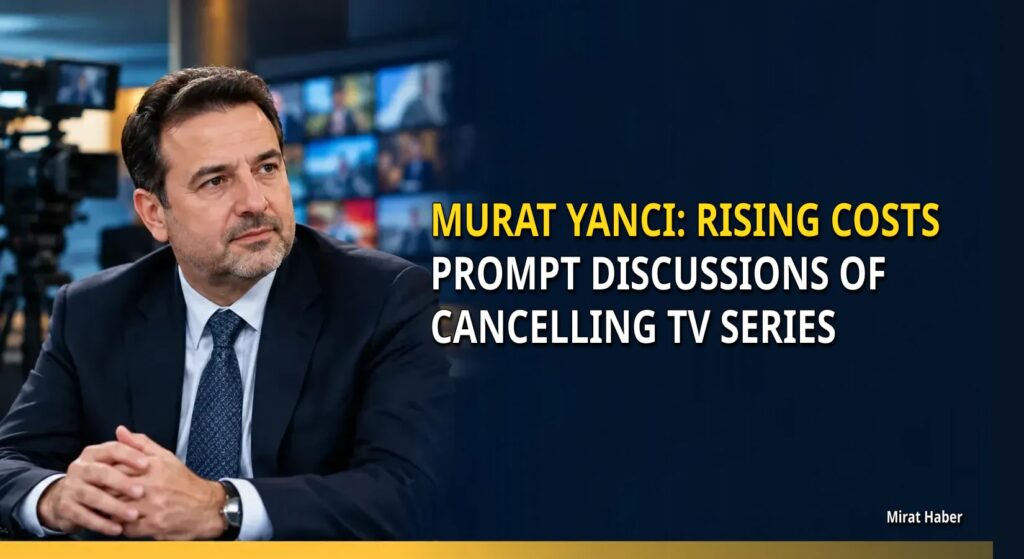
Demirören Medya TV Group President Murat Yancı said rising production costs and falling advertising revenue had prompted discussions at industry meetings about even cancelling TV series en masse. In remarks reported by Onedio, citing Hürriyet columnist Ahmet Hakan, Yancı warned about the financing of television broadcasts; however, no decision to cancel series en masse was announced. Onedio reported that news of Halef: Köklerin Çağrısı and Sevdam Karadeniz coming to an end had brought the industry’s difficulties back into focus. Yancı’s assessment, however, focused on the economic conditions of television broadcasting rather than the circumstances of individual productions. Describing the nature of the crisis, Yancı said: “This is not a crisis about the quality, scripts or viewing figures of the series we produce.” He said that while production costs for series were rising, advertising revenue in the Turkish media was falling rapidly. His assessment did not limit the problem of failing to cover costs to fictional productions. Saying that many programmes were in the same position, Yancı called on all parts of the industry to act together. One of Yancı’s objections concerned the advertising conditions faced by television broadcasters and digital platforms. He argued that certain advertisements were banned on television while digital platforms faced no such restrictions. He cited advertisements for dietary supplements as an example. Yancı said series produced at a cost of hundreds of millions of lira were shown to the public free of charge on television, while digital platforms charged for their content. He alleged that television broadcasters paid tens of millions of lira in fines even for minor violations, while digital platforms escaped penalties. These remarks represent Yancı’s assessment of advertising rules and regulatory oversight. For viewers, the remarks concern the continued availability of series shown free of charge on television. However, mass cancellation is not an announced broadcasting decision; it is an option discussed at industry meetings, according to Yancı. The remarks therefore do not mean that all series will end. Yancı is calling for urgent cost reductions and joint action across the industry. Another issue Yancı highlighted for the industry was exports. Saying that TV series exports had reached approximately 1 billion dollars, he claimed that exports would come to an end if no measures were taken. This is Yancı’s warning about the future, not a loss that has already occurred. Yancı also argued that the television industry would face devastation if no solution were found. Asking who wanted to destroy television broadcasters and the TV series industry, he did not name any person or organisation. No. Yancı said this option had been discussed at industry meetings; no decision to cancel series en masse was announced. Yancı cited Spain, saying that incentives there covered up to 40 percent of production costs for series. Using this example, he called for support and a reduction in the burden on the industry.Key points from the remarks
Cost pressures extend beyond TV series
Criticism of unequal advertising rules and penalties
What could change for viewers and the industry?
Questions about TV series and the call for support
Has a decision been made to cancel TV series en masse?
Which country did Yancı cite in his call for incentives?
İstanbul
Az Bulutlu
13°C
İstanbul
13°C
Az Bulutlu
Salı
Az Bulutlu
13°C
Çarşamba
Az Bulutlu
17°C
Perşembe
Az Bulutlu
19°C
Cuma
Çok Bulutlu
20°C