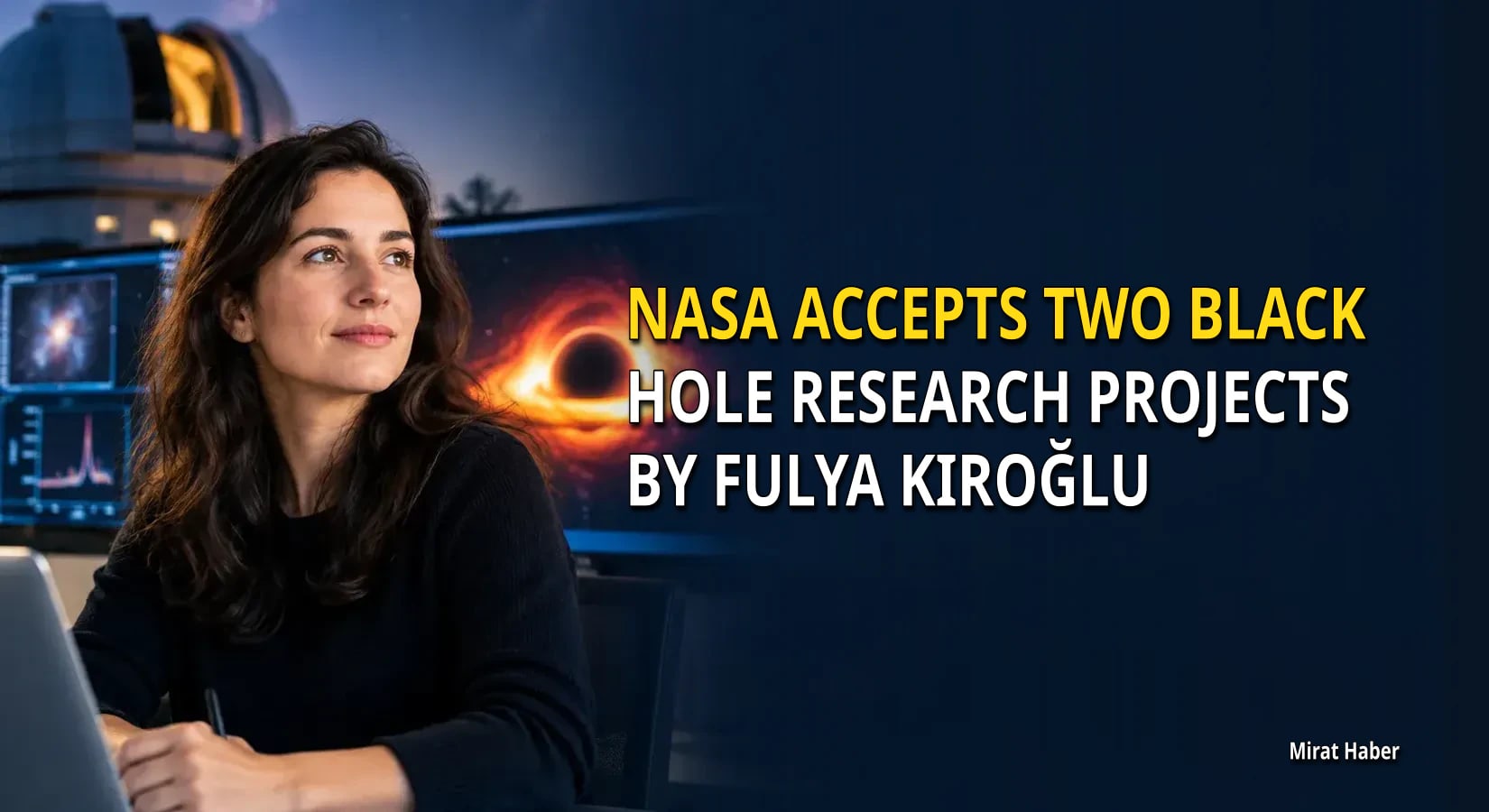
Editorial news visual · NASA accepts two black hole research projects by Fulya Kıroğlu · Mirat Haber
NASA has accepted two black hole research projects by Dr. Fulya Kıroğlu, a graduate of the Department of Physics at Middle East Technical University (ODTÜ). According to Milliyet, Kıroğlu, who conducts her research at Northwestern University in the US, will examine black hole–star interactions and the effects of dense gas environments in the early universe in studies linked to observations by the Fermi and Nancy Grace Roman space telescopes.
The first project will use NASA’s Fermi Gamma-ray Space Telescope to investigate extremely bright gamma-ray sources that black hole–star interactions could produce. According to Kıroğlu, the fact that these events can be detected at great distances from Earth will be used to study black holes from periods when the universe was much younger than it is today.
The second study is titled “Tidal Disruption Events in the Gas-Rich Early Universe: A New Window on Black Hole Growth with Roman.” Accepted for the Nancy Grace Roman Space Telescope’s first observing period, the project focuses on the gas-rich nature of galactic centers in the early universe.
According to Kıroğlu, these centers contained far more gas than they do today. The research seeks to determine how dense gas affects the feeding of black holes and the light emitted by disrupted stars. Kıroğlu will model events in these environments using three-dimensional hydrodynamic simulations. She will then generate synthetic light curves that can be compared with Roman’s infrared observations. The aim is to establish a basis for comparing computational predictions with telescope observations.
Kıroğlu held a Turkish Education Foundation (TEV) scholarship throughout her undergraduate studies and went to the US on a Fulbright scholarship in 2019. Speaking to Milliyet, she explained that TEV’s support had allowed her to focus on her studies and research rather than financial concerns. She said the scholarship had provided not only financial security but also the confidence to take the next steps.
Now a postdoctoral researcher at Northwestern University’s Center for Interdisciplinary Exploration and Research in Astrophysics (CIERA), Kıroğlu also continues her research at the Institute for Artificial Intelligence in the Sky (SkAI). Her future goals include combining artificial intelligence methods with astrophysical simulations to develop tools that model the evolution of stars and black holes more quickly and comprehensively. Kıroğlu also plans to establish her own research group within a few years and advance her work with NASA. Helping train young Turkish researchers and sharing her experience are also among her stated goals.
The first project will be conducted using the Fermi Gamma-ray Space Telescope. The second project was accepted for the Nancy Grace Roman Space Telescope’s first observing period and aims to produce simulation results that can be compared with Roman’s infrared observations.
The research will investigate how dense gas in the early universe affects the feeding of black holes and the light emitted by disrupted stars. Kıroğlu will use three-dimensional hydrodynamic simulations for this purpose.
Key points of the two studies
Which black holes will be studied using gamma rays?
Roman project to model dense gas environments
From scholarship support to mentoring young researchers
Frequently asked questions
Which telescopes are Fulya Kıroğlu’s projects linked to?
What scientific question does the Roman project seek to answer?
Today, public institutions conduct their financial transactions, decision-making and resource allocation largely through digital systems…
For years, I have had a system in place: my old vehicle’s HGS tolls were…
Once, a voice rose, placing regard for the Truth above all other considerations. Then those…
There is something we hear often these days: “What matters is being a good person.…
Today, we see significant differences between sections of society. These differences can reach the point…
For many years, we had been exploited through interest. In recent days, a fund racket…