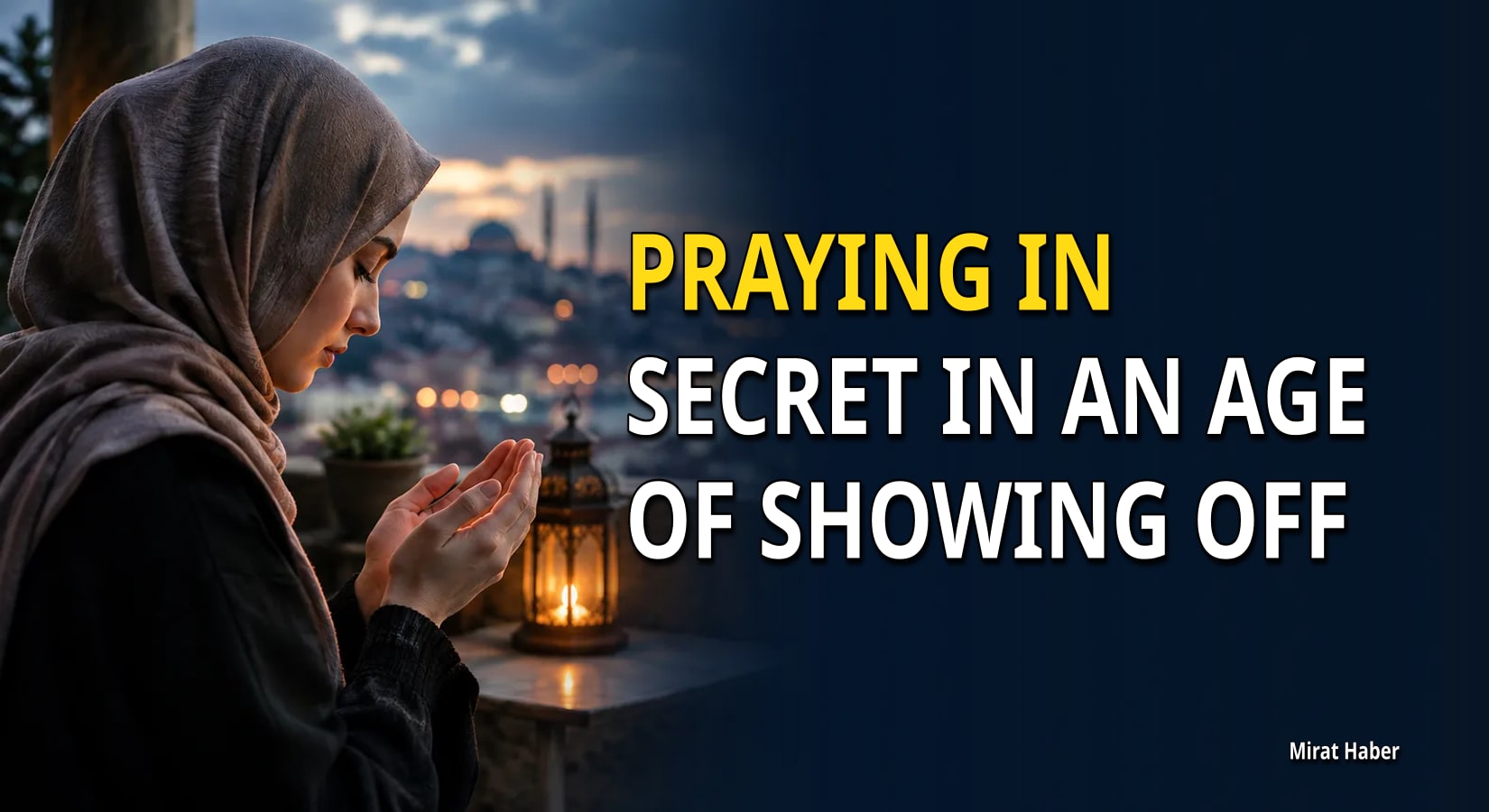
Pray to your Lord with heartfelt supplication and in secret. Surely He does not love those who overstep the bounds. (el-A`râf 7/55)
Today, as the desire to show oneself off and be seen continues to grow, people put almost every moment of their lives on display for others’ approval. This tendency to show off can even find its way into prayer, a person’s most private refuge. Yet verse 55 of Surah A‘râf shows us what our relationship with the sacred should be like. The verse does more than teach the proper manners of prayer; it calls on people to recognize their own helplessness, shun ostentation and turn sincerely to Allah.
The word “tazarruan” (تَضَرُّعًا / pleading, humbly submitting) in the noble verse expresses the servant’s most unadorned state before Allah Almighty: helplessness. As Fahreddin er-Râzî aptly observes, humble supplication occurs when the imperfect bows and pleads in the presence of the Perfect. Thus, until servants recognize their own imperfection and powerlessness, they cannot turn to genuine supplication.[1] Elmalılı Hamdi Yazır, meanwhile, regards the absence of humble supplication as a sign that a servant has not sufficiently grasped their own helplessness and instead sees themselves as possessing independent standing and sufficiency; he describes this as “presumption” and “a kind of swagger.”[2]
The qualification “hufyeten” (خُفْيَةً / secretly, quietly) in the verse is the greatest shield for preserving this humility. Indeed, Hasan-ı Basrî says: “We knew people who would never perform openly any deed on earth that they could perform in secret. Muslims devoted great effort to prayer. Yet their voices could not be heard. Their prayers were no more than a whisper between themselves and their Lord.”[3] The relationship between private worship and sincerity also finds concrete expression through night worship in another passage of the Qur’an. After mentioning believers who leave their beds to pray to their Lord “in fear and hope” (havfen ve tamaʿan) (es-Secde 32/16), it declares that no one can know what delights have been “hidden” (uhfiye) for them as a reward for their deeds (es-Secde 32/17). The fact that hufyeten in A‘râf 7/55 and uhfiye in Secde 32/17 share the same root further highlights the connection in meaning between devotion practised in secret and the reward kept hidden with Allah. For praying in secret preserves the sincerity with which the servant turns to Allah and keeps worship free from the danger of showing off.
Erving Goffman (1922–1982), a prominent figure in modern sociology, explains in his classic work The Presentation of Self in Everyday Life (on how we present ourselves in daily life) that individuals engage in “managing impressions” (impression management) in their social interactions; through speech, behaviour, body language and various other means, they stage a kind of performance to create the impression they wish to make on others. Goffman’s approach, which explains social interactions through the metaphors of theatre and the stage, also offers a valuable framework for considering the visibility of religious practices on social media today.[4] Within this framework, the qualification “hufyeten” (خُفْيَةً / secretly, quietly) in A‘râf 7/55 points to the importance of praying sincerely and without ostentation. In this relationship between the servant and their Lord, it is essential not to seek others’ admiration, not to turn prayer into an act displayed for public approval, and to seek only Allah’s pleasure. Prayer thus becomes a sincere turning of the servant towards their Lord, free from anxiety about making a particular impression on others.
The warning at the end of the verse, “Surely He does not love those who overstep the bounds,” sets an ethical standard for the limits of prayer. What, then, does it mean to be among “al-mu’tedîn” (ٱلْمُعْتَدِينَ / those who overstep the bounds) in prayer? Beyzâvî points out in this context that those who pray should not ask for things that are not fitting for them, such as attaining the rank of the prophets or ascending to heaven. According to another view, overstepping the bounds here means shouting during prayer and speaking at excessive length.[5] Indeed, when our Prophet (peace be upon him) warned his companions on this matter, he indicated that overstepping the bounds in prayer lay in such excesses of language and voice. Abdullah b. Mugaffel’s response to his son’s detailed requests concerning Paradise bears witness to this awareness of limits: “My dear child! Ask Allah for Paradise and seek refuge in Him from Hell. For I heard the Messenger of Allah (peace be upon him) say: ‘Surely there will be people in this community who overstep the bounds in purification and prayer.’”[6]
Moderating one’s voice in prayer is also a way of acknowledging how close Allah Almighty is to human beings. During a journey, the Prophet (peace be upon him) turned to his companions, who were loudly proclaiming Allah’s greatness (Allah is the greatest) and His oneness (There is no deity but Allah), and set the standard for moderation in prayer by saying: “O people, be gentle with yourselves (do not go to excess). You are praying neither to someone who is deaf nor to someone who is absent (not here). You are praying to One who hears everything very well and is very close to you.”[7] Raising one’s voice in prayer therefore also reflects a kind of ignorance, as though one doubted His hearing or imagined Him to be far away. The measure of genuine prayer is not the volume of the voice, but the servant’s turning to their Lord with humble supplication and sincerity.
In short, verse 55 of Surah A‘râf establishes fundamental principles concerning the nature and proper manners of prayer. Prayer is not merely a servant’s communication of requests to Allah; it is also a turning towards the Lord’s power and mercy in recognition of one’s own helplessness and need. Humble supplication in the verse emphasizes servanthood and humility in this turning, while secrecy emphasizes sincerity and the avoidance of ostentation. These two principles become all the more meaningful today, when being visible and making a particular impression on others have taken on such importance. Prayer is not a means of appearing pious to others or asserting an entitlement before Allah. Rather, it is the servant’s turning to their Lord with humble supplication and sincerity, knowing their own limits. For Allah is close to His servant (el-Bakara 2/186) and hears their secret pleas as well. What matters most in prayer, then, is not the loudness of the voice or the showiness of one’s words, but an awareness of one’s servanthood, sincerity and the pursuit of divine pleasure.
[1] Fahruddin er-Râzî, Keys to the Unseen (Beyrut: Dâru İhyâi’t-Türâsi’l-Arabî, 1420/1999), 14/280.
[2] Muhammed Hamdi Yazır Elmalılı, The Religion of Truth, the Language of the Qur’an (İstanbul: Eser Neşriyat, 1979), 3/2194.
[3] Muhammed b. Cerîr et-Taberî, The Comprehensive Exposition of the Interpretation of the Qur’an, edited by Abdullah b. Abdülmuhsin et-Türkî (Beyrut: Dâru Hicr Li’t-Tabaa ve’n-Neşr ve’t-Tevzi` ve’l-İ`lan, 1422/2001), 10/247.
[4] Erving Goffman, The Presentation of Self in Everyday Life (Edinburgh: University of Edinburgh Social Sciences Research Centre, 1956), 8, 13.
[5] Nâsırüddîn Ebû Saîd el-Beyzâvî, The Lights of Revelation and the Secrets of Interpretation, edited by Muhammed Abdurrahman el-Mar`aşlî (Beyrut: Dâru İhyâi’t-Türâsi’l-Arabî, 1418/1997), 3/16.
[6] Süleyman b. el-Eş’as es-Sicistânî Ebû Dâvûd, The Sunan of Ebû Dâvûd, edited by Muhammed Muhyiddin Abdülhamid (Beyrut: el-Mektebetu’l-Asriyye, 1992), “Purification”, 45 (No. 96).
[7] Ebû’l-Ḥasen Muslim b. el-Ḥaccâc el-Ḳuşeyrî en-Nîsâbûrî Muslim, The Authentic Collection, edited by Muḥammed Fuâd ʿAbdulbâḳî (Beyrut: Dâru İḥyâi’t-Turâs̱i’l-ʿArabî, n.d.), “Remembrance, Supplication, Repentance and Seeking Forgiveness”, 2704.
Murat Kayacan
Mirat Haber – YouTube
When we hear the word bigotry, most of us first think of rigidity and intolerance…
Boca Juniors won the title with Enner Valencia’s 90+6 winner, Hürriyet reported. Rosario Central began…
Some works in the history of Islamic thought do more than address the problems of…
Social morality and public order rest on justice and a sense of responsibility. The gains…
Laziness is often understood as not working, putting off tasks that need to be done,…
The Holy Quran states in Surah An-Nisa, verse 76: اَلَّذ۪ينَ اٰمَنُوا يُقَاتِلُونَ ف۪ي سَب۪يلِ اللّٰهِۚ…