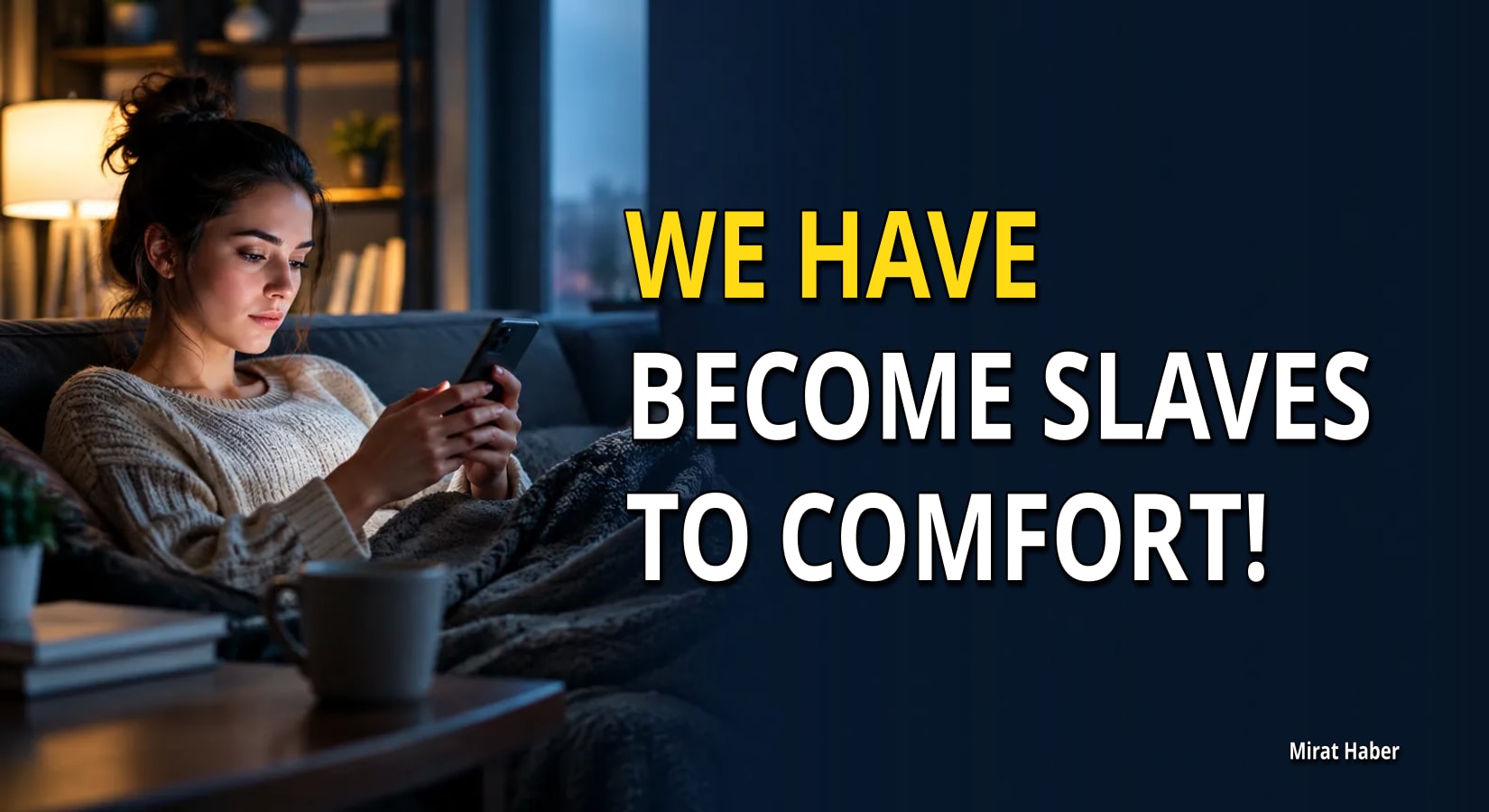
In his work “Mukaddime,” İbn Haldun draws attention to an important concept as he explains how societies rise and, over time, collapse: teref. Teref means becoming accustomed to a life of excessive prosperity, luxury, comfort and splendour.
According to İbn Haldun, teref is not simply a matter of people becoming fond of comfort. It also means the weakening of asabiyet—the solidarity and spirit of collective action that sustain societies—along with the determination to struggle and moral values. Asabiyet is the bond that takes a society from “I” to “we” and makes sacrifice for a common cause possible. When this bond loosens, crowds remain, but society does not.
The generations that struggle under harsh conditions to build a state are gradually replaced by generations that grow up with advantages already in place, become accustomed to prosperity and grow attached to their comfort. İbn Haldun describes this historical cycle as spanning roughly three to four generations: the first generation, which pays a heavy price in founding the state, knows very well the value of the blessings and gains it has secured. The second generation largely preserves this awareness because it has witnessed the preceding generation’s struggle. Later generations, however, become detached from the story of that struggle and the price paid; they begin to see the advantages they have inherited as a natural part of life. Thus, as values such as hard work, sacrifice, contentment and solidarity erode, the desire to consume, ostentation and a fondness for luxury become increasingly widespread. Rising expenditure on luxury increases the state’s financial burden. To meet its growing expenses, the state is forced to increase the tax burden on the people. These mounting economic burdens weaken people’s ability to make ends meet while deepening social unrest. Eventually, society’s spirit of solidarity, determination to struggle and the defensive resilience that sustains the state begin to erode.
In short, according to İbn Haldun, luxury is a cause of collapse that gradually consumes the spirit that enabled a civilisation to rise.
The Qur’an draws attention to the same truth. Surah İsrâ states that a society’s path to destruction lies in the transgression of those spoiled by prosperity:
“When We wish to destroy a country, (We command) its spoiled wealthy people, and they act wickedly there. The decree of punishment against that country is then justified, and We raze it to the ground.” (İsrâ, 17/16)
The word “mütrefîn” in the verse refers to those in the condition İbn Haldun calls “teref.” In other words, what a man of discernment and insight observed centuries later was a truth the Qur’an had revealed much earlier.
What we are experiencing today also brings this observation to mind. Things once considered luxuries are now regarded as necessities. A bigger house, a more expensive car, more ostentatious clothes… What begins as “it would be nice to have” soon becomes “a must-have.” Desires never end, and contentment dwindles. People live not to meet their needs, but to chase their desires. The Qur’an describes this race as follows:
“Boasting of abundance distracted you until you reached the graves (until you died).” (Indeed, according to some commentaries, it immersed you so deeply in worldly life that you even boasted of the number of your dead in the graves.) (Tekâsür, 102/1-2)
Our Prophet (peace and blessings be upon him) says:
“If the son of Adam had a valley full of wealth, he would want another valley.” (Buhârî, Rikāk, 10; Müslim, Zekât, 116)
The problem is not being wealthy, but being enslaved by wealth. Wealth is a blessing for someone who earns through lawful means, fulfils the obligations that come with those earnings and does not let possessions take root in the heart. But when possessions settle in the heart and begin to determine a person’s direction, that person ceases to own them and becomes their slave. Islam opposes not earning but greed; not blessings but wastefulness; not comfortable living but ostentation. Our Lord has drawn the boundary by saying, “Eat and drink, but do not be wasteful.” (A’râf, 7/31)
This is one of our greatest contradictions: instead of living by our beliefs, we shape our lives around our desires. The distance between what we know to be right and how we live grows wider every day.
We talk about honesty, but forget it when our own interests are at stake. We talk about respecting others’ rights, yet can disregard those rights for our own benefit. We see many examples of this in trade, the division of inheritances, neighbourly relations and working life. We can be one person in the mosque, another at work and yet another at home.
Our Lord warns us:
“O you who believe! Why do you say things you will not do?” (Saf, 61/2)
Being a Muslim is not merely about speaking fine words. It means putting what you say into practice. It means not being one person in front of others and another when you are alone. For Allah sees us in every circumstance.
Another of our major problems is using our religious values for worldly gain. Religion can cease to be a standard that disciplines us and become a tool for justifying ourselves.
Some use piety to gain position and prestige; others use politics and ideology to serve their interests. They foreground religious sensitivities when it suits them and ignore them when it does not. They remember verses and hadiths when others are at fault, but forget them when the fault is their own.
Yet morality is not about appearing good before others, but about remaining true to what is right even when no one is watching.
Our Prophet (peace and blessings be upon him) says:
“The signs of a hypocrite are three: when he speaks, he lies; when he makes a promise, he breaks it; and when he is entrusted with something, he betrays that trust.” (Buhârî, Îmân, 24; Müslim, Îmân, 107)
These three signs concern the simplest aspects of everyday life, such as words, promises and things entrusted to us. This means that faith is tested not only in great matters, but also in seemingly small responsibilities. A person’s worth is measured not by their title, their words or the group they belong to, but by their honesty, justice and faithfulness to what is entrusted to them.
Another important observation by İbn Haldun is this: defeated societies regard the victors as superior and begin to imitate their dress, way of life and customs. This is because the defeated identify the victors’ power with their way of life and seek power by copying it.
Over time, such an outlook developed among us too. Instead of adopting the West’s scientific knowledge, technology and experience, we sometimes also embraced its lifestyle and value judgements without question. We lost the standard by which to distinguish what to adopt and what to leave behind.
Of course we will benefit from humanity’s scientific knowledge and technology; wisdom is the believer’s lost possession, to be reclaimed wherever it is found. But adopting technology is one thing; abandoning our own faith and the values of our civilisation is another.
Our Prophet (peace and blessings be upon him) said:
“Whoever tries to resemble a people is one of them.” (Ebû Dâvûd, Libâs, 4)
The issue is not benefiting from the resources others possess, but losing one’s own identity. A Muslim makes use of the opportunities of the age, but does not accept everything the age imposes as right. For our standard is not people’s desires, but Allah’s pleasure.
1. We have gained a more comfortable life than in the past, but lost contentment. Our means have increased, yet we can no longer be happy with what we have.
2. We have gained easy access to information, but not attained wisdom. We have come to learn many things, but have neglected to use what we learn to discipline ourselves.
3. We have made our homes bigger and our hearts smaller. We have begun living in larger spaces, but have reduced the room in our hearts for our families, neighbours and relatives.
4. We have multiplied our means of communication and weakened the bonds between our hearts. We can now talk to everyone, but have forgotten how to listen to and understand one another.
5. We have earned diplomas but neglected good manners and deeper understanding. We have raised knowledgeable people, but have struggled to unite knowledge with morality and success with humility.
6. We have grown wealthier and forgotten how to share. Our possessions have increased, but our concern for the rights of those in need has not grown at the same rate.
7. We have multiplied religious publications, but have not increased religion’s presence in our lives to the same degree. We have spoken more and practised less; we have explained more and set less of an example.
8. We have gained political power, but have not passed the test of justice and trust. We have secured positions, but have not ensured that the understanding of office as service and power as responsibility prevails everywhere.
9. We have learned about others’ civilisations, but have failed to live by the values of our own civilisation or keep them alive.
10. We have set ourselves greater worldly goals and neglected our preparations for the hereafter. As we have sought ways to live longer, in greater comfort and with greater wealth, we have pushed aside the question of how to secure our salvation in the hereafter.
A society’s loss does not always mean becoming poorer, falling behind or growing weaker. Sometimes the greatest loss is to forfeit its identity and its hereafter while gaining all these things.
The issue is not taking our share of this world, but refusing to let the world enslave us. The issue is not having resources, but being able to stay on the right path when we have them.
This well-known counsel attributed to the venerable Ömer is deeply meaningful:
“Call yourselves to account before you are called to account.”
Our Prophet (peace and blessings be upon him) defines true wealth as follows:
“Wealth is not an abundance of possessions; true wealth is richness of heart.” (Buhârî, Rikāk, 15; Müslim, Zekât, 120)
Let us not forget: possessing wealth is one thing; being rich at heart is another. Holding office is one thing; being just is another. Keeping pace with the times is one thing; surrendering to the wrongs of the age is something else entirely.
Our greatest loss is sacrificing contentment, morality, our values and our hereafter for comfort and luxury.
If a society’s homes grow bigger while its hearts grow smaller, its wealth increases while its compassion diminishes, and its resources multiply while its solidarity and spirit of struggle weaken, there can be no talk of genuine development.
This is precisely the danger İbn Haldun drew attention to centuries ago: a civilisation first becomes accustomed to comfort, then loses its spirit of struggle, then its solidarity unravels, and finally it can no longer stand on its own feet.
We must now ask ourselves this question:
“Will we shape our lives according to the standards of the Qur’an and Sunnah, or will we adapt our religion to our own lives in order to justify our desires?”
For a civilisation’s collapse begins in hearts and minds. When hearts are enslaved by the world, a civilisation cannot remain standing, even as palaces rise.
Kadir Bekil
Mirat Haber – YouTube
According to the Holy Qur’an, Islam abrogates earlier religious laws. It has repealed the religious…
The Holy Quran states in verse 4 of Surah Al-Isra: وَقَضَيْنَٓا اِلٰى بَن۪ٓي اِسْرَٓاء۪يلَ فِي…
Whenever Azerbaijan comes up, the words “Friend and Brother” are thrown around. Aliyev is declared…
A Scourge Enveloping the Government, the Opposition and the People BRIBERY: A STAIN ON CONSCIENCE…
We rejoice because Trump lost in the US. Before that, we rejoiced because Biden left,…
Money is an indispensable means of exchange in our lives. Every undertaking, good or bad,…