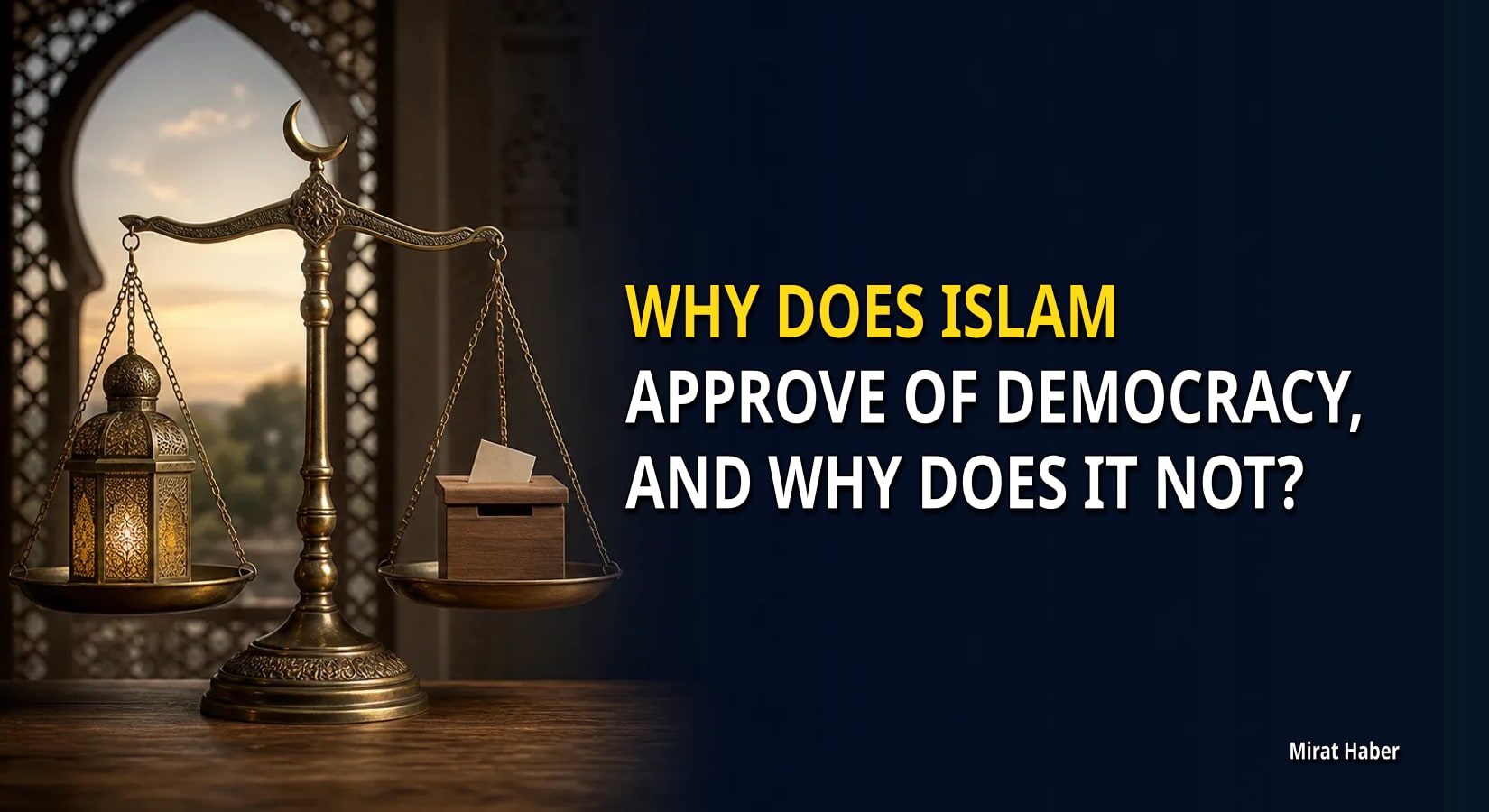
In the name of Allah… I praise our Lord and offer my heartfelt respect and devotion to His servant and messenger, the Prophet Muhammed.
Democracy has many definitions. But let us set intellectual debates aside and get to the heart of the matter.
To explain the relationship between Islam and democracy, we need to examine democracy from an Islamic perspective under four main headings:
1. The people’s ability to choose their rulers through elections,
2. The qualities that those elected must possess,
3. The fundamental principles and laws by which those elected will govern the people,
4. How long those elected will remain in power.
Once we clarify these four issues, we will understand not only why we should support or oppose democracy, but also what position we should take.
If democracy means “the people’s ability to choose their rulers through elections,” then Islam is compatible with democracy. For the principle of consultation established by the Qur’an and the Sunnah requires elections. (Âl-i İmrân 159; Şûrâ 38) Given today’s means of communication and transport, the principle of consultation can only be understood as a principle of election. There is no doubt about this. But democracy is not limited to this.
In earlier times, societies were governed by prophets and those they chose. (For an example, see Bakara 246) But because our beloved Prophet is Allah’s final messenger and the Qur’an he conveyed is the final body of divine laws, Islam establishes principles for choosing rulers.
Our Lord has granted no individual, family, race or people any privilege in matters of government. Nor did our Prophet grant privileges to any individual or community, including his own family, or leave instructions concerning who should succeed him. To put it very briefly, the choice of rulers is governed by the criteria of faith, righteous deeds and competence, through a process of justice and consultation.
Historical practices, such as those of the prophets Davud and Süleyman, who governed according to the revelations they received, are not binding on us. We can say that Islam rules out systems of kings, emperors and sultans, except where a son is also elected after his father.
Democratic countries, including our own, set qualifications for those who are to be elected. They specify who may not stand for election. The Qur’an and the Sunnah regulate this matter in greater detail and in the public interest.
Those standing for election may be young or old, women or men. But they must meet the four qualities/conditions in verse 71 of Surah Tevbe, explained below, and the condition of competence in verse 58 of Surah Nisâ. We believe that verse 71 of Surah Tevbe contains the necessary and sufficient conditions for election. Let us now present the meaning of this verse and examine the qualities it contains:
“Believing men and women are one another’s guardians: they may represent one another and act on one another’s behalf. They enjoin what is right and strive to bring it about, and they discourage what is wrong (in word and deed, to the extent of their ability). They perform prayer together and give zakat. (In the commands and prohibitions of Allah and His Messenger that govern life) they obey Allah and His Messenger. These are the people whom Allah will embrace with His mercy. Surely Allah possesses irresistible power, and whatever He does, He does beautifully.”
a. Being a Believer
In verse 71 of Surah Tevbe in His Noble Qur’an, whose meaning is given above, our Almighty Lord explains that believing men and women are one another’s guardians. The term evliya, whose singular is veli, derives from velayet, meaning guardianship or authority to act on another’s behalf. Alongside many similar verses (Mâide 51, 57), this verse in particular (Tevbe 71) explains that believers may grant the right to represent them legally and act on their behalf only to believing men and women. In other words, believing men may act as guardians for believing women, and believing women for believing men. The Qur’an also declares that failing to exercise guardianship in this sense will cause grave oppression and corruption on earth (Enfâl 73). The condition of being a believer is extremely important. Believers who act as one another’s representatives when voting or standing for election must also possess the three qualities explained below.
Western democracies also impose similar conditions, such as being a citizen of the country and not having committed an offence carrying a severe penalty.
b. Calling for What Is Right and Discouraging What Is Wrong
Being in a position to call for what is right—“mâruf,” as required by Islam, sound reason and knowledge—and to discourage its opposite, “münker,” or what is wrong. Broadly speaking, this condition requires sound health, knowledge of Islam and a good general education; it serves to prevent the election of unbelieving and unvirtuous people, such as deists and homosexuals, who constitute the greatest weakness of democracies.
c. Performing Prayer and Giving Zakat When Its Conditions Are Met
People who are not connected to the public through prayer and through zakat when it is due and its conditions are met cannot become rulers of society.
d. Embracing Obedience to Allah’s Commands and Prohibitions
This means putting Islamic commands and prohibitions into practice. More explicitly, this quality requires observing divine commands, such as being truthful and just, and avoiding forbidden acts, such as interest and illicit sexual relations. Open transgressors who publicly violate these commands and prohibitions may not seek to govern. Allah’s promise of success is only for those who believe and do righteous deeds. (Nûr 55)
e. Being Competent to Govern
Although the four conditions explained above include competence, Nisâ 58 gives it particular emphasis by declaring, “Surely Allah commands you to entrust responsibilities to those among you who are qualified/competent. He also commands you to judge justly when you judge between people…” We therefore felt it necessary to mention it as well.
Those who possess these five qualities must be treated justly if they put themselves forward; that is, the conditions for candidacy must be properly established, and candidates must be able to stand for election on equal terms. This is the meaning of “being just when you judge between people,” which follows the instruction in Nisâ 58 to entrust responsibilities—duties to society—to those who are competent.
This is the most important difference between Islam and democracy. In Western democracies, those elected govern according to laws they formulate in line with the demands of the public—or, more often, of wealthy, organised interests. These laws generally work against the public and, as is the case today, favour international centres of power that also steer governments.
In Islam, however, Allah and His Messenger lay down the fundamental governing principles and laws. For this reason, the Islamic order prevents the exploitation of the people, ensures legal and social justice, and protects people’s material and spiritual health. For example, education cannot be founded on materialist principles, nor can private property be abolished or interest legitimised. Homosexuality cannot be permitted, wars of occupation and exploitation cannot be launched, and alliances cannot be formed for those purposes. The framework based on the Qur’an and the Sunnah, a small example of which we will present below, cannot be altered in any way.
We have no doubt that areas of government outside the framework established by the Qur’an and the Sunnah may be regulated through laws and regulations drawn up by authorised bodies.
With this fundamental difference before us, saying “Islam approves of democracy” is a grave mistake. Let us close this section, seeking blessing, with a verse relevant to our subject:
“O you who believe! Obey Allah’s laws wholeheartedly. Obey Allah’s Messenger Muhammed and the rulers who, like you, follow the Islamic path. When you disagree with your rulers, resolve the dispute according to the standards laid down by Allah and His Messenger. This is what you must do if you believe in Allah and the Last Day. For such a method is better and more beautiful in its outcomes.” (Nisâ 59)
There is no rule that elected rulers will remain in office for life. In earlier times, power was seized unjustly by force and maintained through succession from father to son. This led to debate over whether to rise up against governments that had become oppressive. The only binding requirement for Muslims is fidelity to agreements—that is, adherence to conditions, contracts and laws established in advance. Those elected govern for the specified term. Elections are held at the end of that term.
Viewed in light of the four rules explained above, the oppression and despotism displayed by kingdoms, sultanates and emirates that have emerged/been established in the name of Islam today have no Islamic legitimacy; nor, indeed, do structures such as religious affairs institutions, religious communities and Sufi orders.
As a productive stage on the way to the ideal, Western-style democracies are preferable to the kingdoms, emirates and armed groups claiming their own legitimacy found in the Islamic world. Knowing this, the West has been unable to accept election results in Algeria, Palestine, Egypt and Türkiye. It has engineered coups.
Note: As we have written many articles on this subject, we have not gone into detail here. There may be points in our article to which objections can be raised. We welcome scholarly criticism expressed respectfully and look forward to receiving it.
Ali Rıza Demircan
Mirat Haber – YouTube
One of this week’s talking points was a private tutor’s attitude towards a pupil. The…
1. Our spiritual guide, Muhammed (peace and blessings be upon him), had a perfect and…
Contemporary society disregards morality and puts personal interests first. Yet it claims to be civilised…
For many years, debates over secularism in Türkiye have revolved around religious freedoms, state neutrality…
Allah Almighty says in verse 31 of Surah Al-Ma’idah: فَبَعَثَ اللّٰهُ غُرَابًا يَبْحَثُ فِي الْاَرْضِ…
Strangely enough, those who change their political colours fastest turn out to be among those…