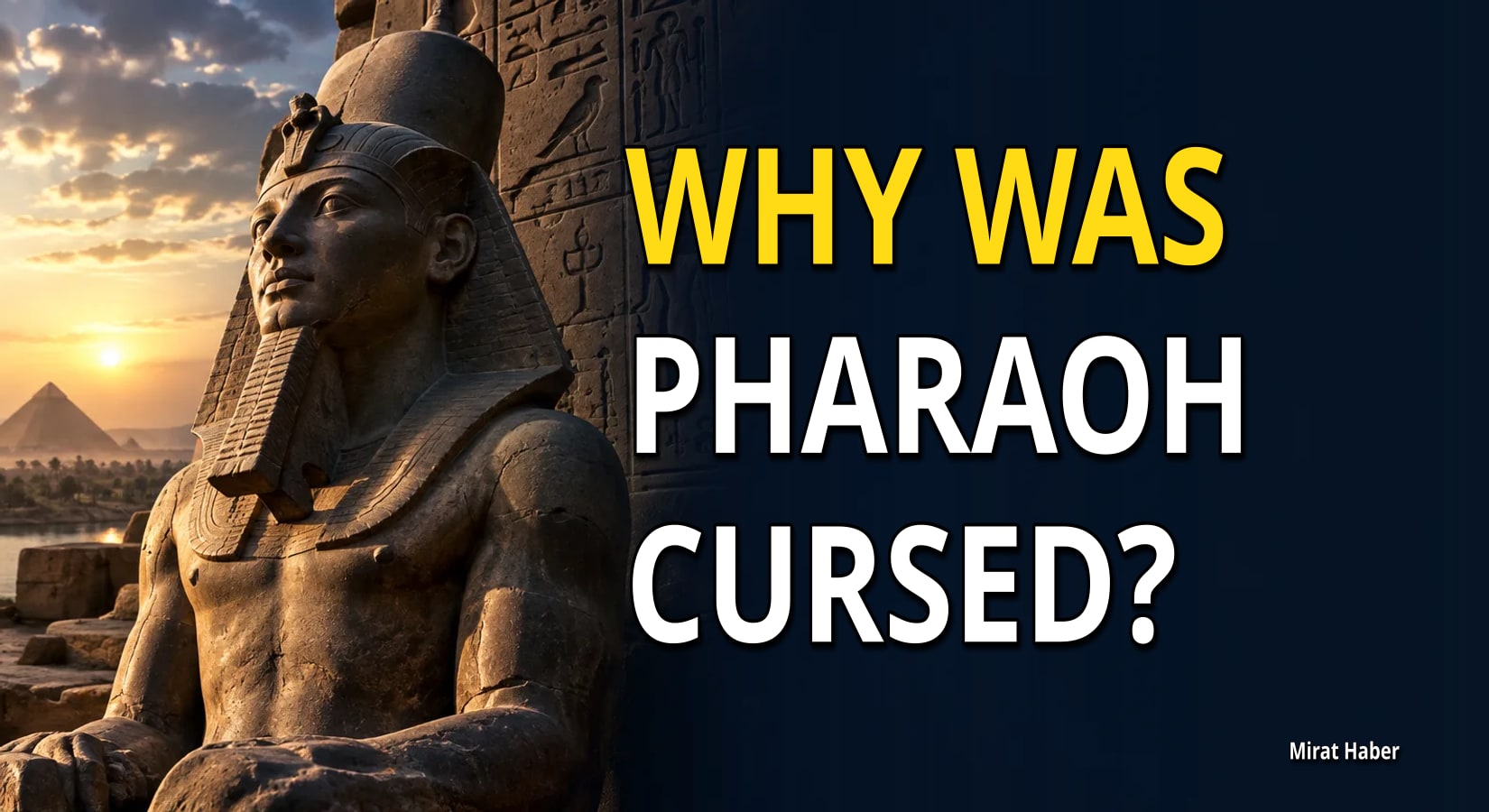
When the Qur’an describes past societies and their rulers, its purpose is not merely to recount historical events. It also reveals the causes of the moral, social and political problems confronting humanity. Among these accounts, Pharaoh is a figure who deserves particular attention. His life shows how a person can turn power into oppression, regard the authority to govern as absolute dominion and reject the truth for the sake of personal interests. The Qur’an’s repeated references to Pharaoh are not simply reminders of a tyrannical ruler who lived long ago. Through him, it describes an approach to government, a way of thinking and a moral collapse that can emerge at different points in human history. Understanding Pharaoh therefore means not merely learning who he was, but examining which of his beliefs and actions brought Allah’s curse upon him and what forms those same wrongs might take today.
Who was Pharaoh, and what position and authority did he hold? Pharaoh is a title used for the rulers of ancient Egypt. The Qur’an does not give the personal name of the Pharaoh who lived in the time of the Prophet Musa. Although historical research has associated him with various Egyptian rulers, his identity has not been conclusively established. According to the Qur’anic account, Pharaoh was a ruler who held political, military and economic power, commanded an extensive administration and exercised considerable authority over people’s lives. Yet what chiefly distinguished him from other rulers was that he regarded his power not as a trust carrying responsibilities towards Allah and other people, but as unlimited dominion belonging to him alone. Verse 24 of Surah Nâziât reports that he said, “I am your most exalted lord.” In verse 38 of Surah Kasas, he tells his leading men that he knows of no god for them other than himself. These statements show that Pharaoh was not content to be merely a political authority; he assumed a position from which he expected absolute obedience from people. Yet according to Islam, no person’s position or authority entitles them to regard themselves as exempt from Allah’s commands and moral responsibility.
Why was Pharaoh cursed? The Qur’an does not limit its answer to his denial of Allah. Pharaoh’s disbelief, arrogance, oppression, humiliation of others, suppression of the truth and subjugation of society are described as a whole. Verses 97-99 of Surah Hûd state that those who followed Pharaoh’s command pursued a misguided path and were followed by a curse in this world and on the Day of Resurrection. A curse means being cast away from Allah’s mercy. At the heart of this divine retribution against Pharaoh were his conscious rejection of the truth conveyed to him and his use of power to oppress people. Verse 4 of Surah Kasas describes how Pharaoh exalted himself in the land, divided its people into groups, weakened a section of them, had their male children killed and spared their women. This was not merely individual wrongdoing, but systematic oppression sustained through the power of government. Pharaoh targeted the right to life, security and future of a community he regarded as a threat. In this respect, his oppression reveals an approach to government that seeks to control not only people’s thoughts but their very existence.
One of Pharaoh’s most striking characteristics was that he treated power as proof that he was right. His palaces, wealth, military forces and administrative resources made him feel superior. Verses 51-52 of Surah Zuhruf describe how he presented his dominion over Egypt and its rivers as evidence of his superiority while belittling the Prophet Musa. Yet material power is not proof that a person is on the right path. A ruler may govern a large country, command powerful armies and possess vast economic resources. None of this, however, demonstrates that he is just. The Prophet defined arrogance as rejecting the truth and looking down on people (Müslim, Îmân, 147). Both characteristics are clearly evident in Pharaoh’s conduct. He refused to accept the truth conveyed to him and regarded people beneath his station as worthless. A similar arrogance can emerge today among those who turn their position into a means of asserting superiority over others, humiliate their employees, determine people’s rights according to their own interests or consider themselves beyond criticism. What matters here is not a person’s title, but the purpose for which they use their power.
Another action that brought Allah’s curse upon Pharaoh was his use of fear and threats to silence the truth. When Allah sent the Prophet Musa to Pharaoh, He said, “Go to Pharaoh! For he has transgressed” (Tâhâ 20:24). At the same time, however, He commanded the Prophet Musa and the Prophet Harun to speak gently to him (Tâhâ 20:44). This command shows that Islam calls for measured, clear and wise language even when conveying the truth. Pharaoh, by contrast, chose threats rather than answering the call made to him with evidence. Verse 29 of Surah Şuarâ describes his threat to imprison the Prophet Musa, while verses 123-124 of Surah A’râf recount his threat to have the hands and feet of the sorcerers who believed in Musa cut off on opposite sides and to hang them. Pharaoh thus sought to control not only people’s actions, but also their beliefs and thoughts. The situation of people today who are unlawfully punished for expressing their views, threatened for objecting to injustice or subjected to repression for speaking out about their rulers’ wrongdoings should be considered in light of the moral lessons of this account. For confronting the truth with threats is a method of oppression, not justice.
Manipulating the public and presenting his own interests as those of society also played an important part in Pharaoh’s approach to government. Verse 29 of Surah Mü’min relates that Pharaoh offered his people only the view he himself considered appropriate and claimed to be guiding them along the right path. Verse 54 of Surah Zuhruf states that he belittled his people and brought them under his influence, and they obeyed him. These verses show that people can be kept under oppression not only through force, but also by manipulating their thinking. Preventing a society from accessing accurate information, concealing rulers’ wrongdoings, portraying criticism as hostility and exploiting public fears to preserve power are examples of this approach that may be encountered today. An important distinction must, however, be made here: not every strong government or political authority is the same as Pharaoh’s rule. The fundamental issue criticised by the Qur’an is not the existence of power, but its transformation into oppression, the suppression of truth and the violation of people’s rights.
Another striking aspect of Pharaoh’s story is that it shows that oppression is not confined to the actions of a single individual. Pharaoh was surrounded by officials, soldiers and leading figures who carried out his orders. Verse 97 of Surah Hûd states that people followed Pharaoh’s command, although his command was not right. This establishes that those who carry out injustice also bear moral responsibility. The Prophet said, “Obedience is only in matters that are legitimate and good” (Buhârî, Ahkâm; Müslim, İmâre). Being a ruler, a superior or the holder of a powerful office therefore gives no one the right to make others commit injustice. A public official’s execution of an unlawful order, an employee’s being forced to violate another person’s rights or someone’s complicity in oppression on the grounds of instructions from higher authorities does not automatically remove their responsibility. The Qur’an also explains, however, that not everyone around Pharaoh made the same choice. Verse 11 of Surah Tahrîm presents Pharaoh’s wife as an example to believers. Verse 28 of Surah Mü’min states that a man from Pharaoh’s household who concealed his faith defended the Prophet Musa. These examples show that people can choose the truth, however oppressive their surroundings may be.
Pharaoh’s end is also recounted in the Qur’an as an important lesson. Facing the danger of drowning at sea while pursuing the Prophet Musa and the Children of Israel, Pharaoh declared his belief in Allah, as related in verse 90 of Surah Yunus. But he was answered, “Now? Yet before this you rebelled and were among those who spread corruption” (Yunus 10:91). This event illustrates the consequences of continually postponing the opportunity to accept the truth. Pharaoh did not abandon his oppression while he held power; he declared his submission only when confronted with death. The Prophet stated that Allah accepts His servant’s repentance before the soul reaches the throat (Tirmizî, Daavât, 98). Verse 92 of Surah Yunus explains that Pharaoh’s body would be preserved as a lesson for those who came after him. The ruler who once believed he held absolute dominion over people’s lives was ultimately unable to preserve even his own. The Qur’an thus reminds us that no political, military or economic power can save a person from death and divine judgement.
What, then, does Pharaoh’s story tell people today? The palaces, instruments of government and social conditions of Pharaoh’s time may have changed. Yet arrogance, oppression, the rejection of truth for personal gain and the tendency to subjugate others have not disappeared. A state’s disregard for innocent lives on security grounds, the targeting of children and civilians in wars, the forced displacement of communities, discrimination against people because of their identities and the systematic violation of their fundamental rights can be compared morally with the conduct condemned in Pharaoh’s story. Likewise, an employer’s failure to give employees their due, an official’s use of public resources for personal gain or the constant oppression of others by the most powerful person in a family are different forms of injustice. The Qur’an’s message concerns not only great rulers, but everyone who uses their power against others. The Prophet’s saying, “Oppression will be darkness on the Day of Resurrection” (Buhârî, Mezâlim; Müslim, Birr), states that injustice has consequences in the hereafter as well as in this world.
Understanding Pharaoh’s story correctly is not simply a matter of condemning a ruler who lived in the past or labelling people we dislike today as Pharaohs. The real task is to recognise the conduct that brought the curse upon him and to ask whether the same wrongs exist in our own lives. People may oppose another’s oppression while failing to see the injustice they themselves commit. They may speak of justice while defending the wrongdoings of those close to them. They may believe they are voicing the truth while rejecting facts that run counter to their interests. Pharaoh’s story therefore places responsibilities not only on rulers, but also on the ruled. People’s obedience to a tyrant, normalisation of injustice, concealment of the truth for personal gain and silence in the face of oppression are also matters that require reflection. The Qur’an’s call for justice requires people to be just even when it goes against themselves and those close to them (Nisâ 4:135). Justice thus becomes not merely conduct expected of others, but a responsibility everyone must fulfil.
Pharaoh was not cursed because he was a ruler, governed a powerful state or possessed great wealth. He suffered divine punishment because he regarded himself as the absolute authority, rejected Allah’s signs, humiliated people, oppressed a section of society, had children killed, silenced the truth and turned his authority to govern into oppression. His life shows that power does not make a person right, that office confers no moral superiority and that no authority is exempt from accountability. Pharaoh, who stood against the Prophet Musa, possessed palaces, armies and wealth. The Prophet Musa, meanwhile, defended truth and justice through Allah’s revelation. In recounting this struggle, the Qur’an teaches us to assess a person’s worth not by the power they possess, but by their attitude towards the truth. The essential question today is not so much who Pharaoh was, but to what extent the beliefs and actions that brought the curse upon him exist in our own lives. For Pharaoh has left the stage of history, but the danger of people considering themselves superior, treating power as sacred and violating the rights of others remains. The Qur’an’s unchanging message to humanity is this: power is not proof of superiority, but a trust for which we will be called to account. Power that is not exercised justly does not elevate a person; it draws them into oppression and moral collapse.
İslam Başaran
Mirat Haber – YouTube
Today, public institutions conduct their financial transactions, decision-making and resource allocation largely through digital systems…
For years, I have had a system in place: my old vehicle’s HGS tolls were…
Once, a voice rose, placing regard for the Truth above all other considerations. Then those…
There is something we hear often these days: “What matters is being a good person.…
Today, we see significant differences between sections of society. These differences can reach the point…
For many years, we had been exploited through interest. In recent days, a fund racket…