İstanbul
Yağmurlu
11°C
İstanbul
11°C
Yağmurlu
Pazartesi
Çok Bulutlu
13°C
Salı
Hafif Yağmurlu
12°C
Çarşamba
Az Bulutlu
16°C
Perşembe
Çok Bulutlu
18°C

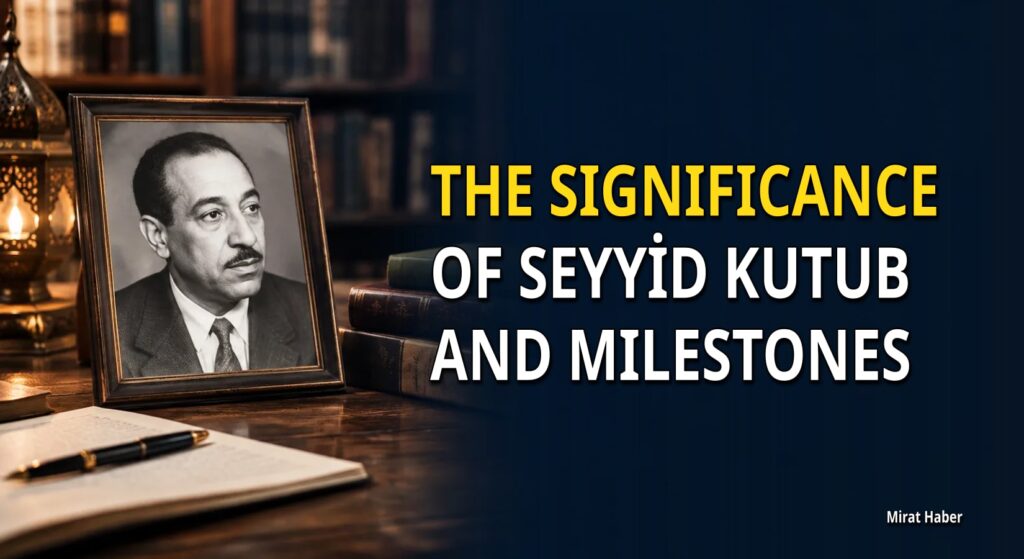
Some works in the history of Islamic thought do more than address the problems of their own time; they also shape later generations’ understanding of religion, society and civilization. Seyyid Kutub’s Milestones is one such book. Its central concern is the place of Islam in human life and the extent to which Muslims’ relationship with the Qur’an is reflected in how they live. For Kutub, Islam is not merely a matter of individual belief and worship. It is a comprehensive understanding of life that shapes human thought, morality, social relations, law and approaches to governance. The problems facing Muslim societies stem not only from political and economic causes, but also from a departure from the Qur’an’s guidance in shaping life.
Who is Seyyid Kutub? Born in Egypt in 1906, Seyyid Kutub was a writer, educator and Islamic thinker. In his early years, he worked in literature and education before turning to Qur’an-centered thought. He became involved with the Muslim Brotherhood movement, spent many years in prison under Cemal Abdünnasır’s rule and was executed in 1966 following a trial in which he was accused of conspiring against the government. His principal works are Fî Zılâli’l-Kur’ân (In the Shade of the Qur’an) and Meâlim fi’t-Tarîk (Milestones). Kutub’s significance lies in his forceful defense of the idea that the Qur’an is not merely a text to be read and interpreted, but a guide that reshapes individuals and society.
Published in 1964, Milestones was written during a period of political and cultural transformation in the Islamic world. As Muslim societies confronted colonialism, Westernization, nationalism and modern conceptions of the state, Kutub raised a more fundamental question: Were Muslims truly living according to the principles laid down by the Qur’an, or were they retaining their religious identity while allowing other values to determine their lives? The book’s central argument takes shape around this question. For Kutub, Islam is not a faith that persists merely as a religious identity within existing social systems; it is a comprehensive way of life with its own understanding of humanity, morality, society, law and governance.
One of the work’s notable features is its emphasis on the first generation of Muslims formed by the Qur’an. According to Kutub, what distinguished the community of companions nurtured by the Prophet Muhammad was that they did not read the Qur’an merely to acquire knowledge or memorize it. The first Muslims put the verses they learned into practice, reflecting their faith in their behavior and social relations. For them, the Qur’an was not merely a book to read, but a guide to live by. Thus, the decisive factor in the formation of Islamic society was the cultivation of people’s faith, thought and moral character before the transmission of religious knowledge. Kutub argues that contemporary Muslims must also regain this understanding. Knowing the Qur’an and living according to the principles it lays down are different things. People may read its verses and perform their acts of worship; yet if they draw the values that guide their lives from other sources, a gap emerges between faith and practice.
One of the central concepts in Milestones is jahiliyyah. Kutub does not regard jahiliyyah solely as the historical period of pre-Islamic Arab society. For him, it is a mindset that arises when Allah’s guidance is removed from human life and people turn the values they have created into an absolute authority. Jahiliyyah is therefore not merely a period in the past, but a system of thought and a way of life that can persist in different forms. Kutub used this concept to criticize the political, economic and cultural structures of modern societies, arguing that societies identifying themselves as Muslim could also display characteristics of jahiliyyah. However, criticizing wrongful practices within a society is not the same as condemning all its people on religious grounds. Kutub’s broad definition of jahiliyyah has subsequently prompted differing interpretations and debates.
The book’s second important concept is sovereignty. According to Kutub, faith in Allah’s oneness is not limited to acknowledging Him as the Creator. The fundamental standards that shape human life must also rest on Allah’s guidance. He connects this idea to the Qur’anic statement, “Judgment belongs to Allah alone” (Yûsuf 12/40). In his view, making human will absolute and establishing a source of judgment independent of divine guidance contradicts the meaning of servitude to Allah. Kutub sees the complete separation of religion from law, economics, governance and social relations as incompatible with the integrated nature of Islam. Nevertheless, taking Allah’s judgment as the foundation is not the same as treating people’s interpretations offered in Allah’s name as beyond question. The Qur’an is divine revelation, but the political and legal models people develop from it are interpretations and applications. No ruler or institution can therefore be exempted from criticism by directly equating its decisions with Allah’s will. The Qur’an’s injunctions concerning justice, competence and consultation (Nisâ 4/58; Şûrâ 42/38) show that governance is also a matter of responsibility and accountability.
Another subject explored in Milestones is the idea of a vanguard community and social change. According to Kutub, rebuilding a society cannot be achieved merely through a change in political power, the enactment of new laws or the reorganization of state institutions. The first requirement is to nurture people who understand their faith, are morally consistent and live according to the principles they embrace. Institutions cannot improve sustainably unless people change; governments cannot do so unless values change, nor can social relations unless morality changes. Kutub argues that the social transformation in Islam’s early period also took place on this basis. The Qur’anic command, “Allah does not change the condition of a people unless they change what is within themselves” (Ra‘d 13/11), reminds individuals and society of their own responsibility.
However, Kutub’s conception of a vanguard community is not confined to moral education. The work also discusses political struggle, jihad and the use of force against existing systems of jahiliyyah. This aspect is an important factor in explaining the book’s subsequent influence on different Islamic movements. While some movements have understood Kutub’s ideas in terms of education, outreach and social renewal, some radical organizations have used his concepts to justify their own understanding of violence. Yet attributing all these organizations’ actions directly to Kutub is not historically accurate either. In assessing the work, it is necessary to distinguish the author’s own views from the conclusions later movements drew from them.
Seyyid Kutub’s significance in Islamic thought is evident in the way he reopened the debate over religion’s place in human life. He did not attribute the problems facing Muslim societies solely to outside interference or political repression; he also questioned the contradictions between Muslims’ own beliefs and the lives they led. In this respect, the work is not merely a civilizational critique of the modern world, but also an intellectual work that calls on Muslims to confront their own condition. The stance on justice taken by those who speak in Islam’s name, rulers’ handling of public assets, fairness in economic relations, the protection of the rights of the poor and orphans, the reliability of the legal system and people’s relationships with one another are all ways these questions arise today.
Yet Kutub’s ideas must also be read critically. Although his sharp distinction between Islam and jahiliyyah offers a powerful framework for questioning the values of modern societies, it can fall short of explaining the complexity of social life. The existence of injustice in a society does not mean that everyone in it shares the same views, just as a government’s use of religious language does not show that all its practices conform to Islam. It is therefore necessary to distinguish religious principles from human practices and to keep criticism within the bounds of justice. Seyyid Kutub’s views, too, are not revelation itself, but the product of an effort to understand revelation and apply it to the problems of his time.
Seyyid Kutub is a thinker who forcefully defended the Qur’an’s decisive role in individual and social life, and whose influence and the debates surrounding him both endure. Milestones is an important work that calls on Muslims to question their own condition, put religious knowledge into practice and reconsider Islam’s social principles. The book’s value lies not only in the answers it offers, but also in the questions it asks readers to confront. Understanding his thought does not mean accepting all his views without question; it means assessing the issues he raised in light of the Qur’an as a whole, the example of the Prophet Muhammad, justice and human responsibility.
The central issue is not merely reading and defending the Qur’an, but ensuring that its principles of justice, morality and responsibility find expression in people’s thoughts, behavior and social life. Milestones is an important intellectual legacy that calls on Muslims to reflect on this issue anew.
İslam Başaran
Mirat Haber – YouTube