İstanbul
Yağmurlu
11°C
İstanbul
11°C
Yağmurlu
Pazartesi
Çok Bulutlu
13°C
Salı
Hafif Yağmurlu
12°C
Çarşamba
Az Bulutlu
16°C
Perşembe
Çok Bulutlu
18°C

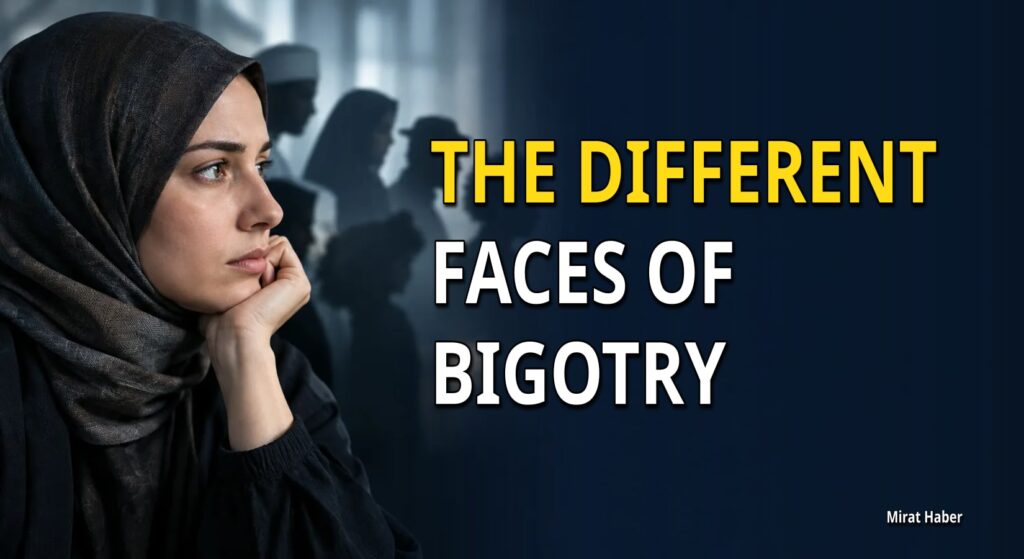
When we hear the word bigotry, most of us first think of rigidity and intolerance in matters of religious belief. Why do we immediately perceive it as a religious concept? Because for years, religious bigotry was cited as the reason for the Ottoman Empire’s decline and its inability to keep pace with change. Similarly, accounts of the dark side of medieval Europe linked it to religious bigotry. But can we not also see bigoted behaviour among people who oppose religion or have no religious beliefs? Can we not also call people bigoted when they regard their own views as the only truth, are intolerant of other people’s ideas, cannot bear those who think differently, and cling blindly and stubbornly to their old views even when presented with rational evidence?
Years ago, I learned from Peyami Safa’s essay “Types of Bigotry” that bigotry is not a concept confined to religion, but something we can encounter in other areas too. Exploring the word’s origins, Peyami Safa explained:
“The French call a bigoted person Fanatique. The word comes from the Latin root Fanum. In antiquity, it was an adjective applied to priests who shed their own blood in a state of ecstasy. Later, the name was given to those who believed that a hidden force governed the course of existence. In its current meaning throughout the world, a fanatic is someone passionately devoted to the triumph of their own belief, intolerant and ready to resort to violence if necessary. Its Ottoman Turkish equivalents are ‘Mutaassıp, Softa, Yobaz’.
Every belief has its bigots, with religious bigotry foremost among them. There are bigots in religion, politics, nationalism, revolution (I call them revolution-mongers), science, technology and history…”[1]
As Peyami Safa points out, bigotry means excessive, blind attachment to an idea, belief or view; belittling other people’s beliefs and ideas and trying to suppress them through coercion; resorting to violence if necessary; and being intolerant. We can encounter bigotry in every area of life—in science, education, politics and family relationships.
Taassup, the Turkish word for bigotry, derives from the Arabic root asb (usûb), meaning ‘to support one’s own kin, to attach oneself blindly’. Its dictionary meaning is ‘to seize, surround, wrap, bind’. “The opposites of bigotry are tolerance and leniency.”[2] Here, leniency means “making things easier”, “behaving gently” or approaching others courteously, without coercion. These criteria give us an important insight into bigotry. This means that people who do not force others to accept their views as the only truth, and who respect beliefs and ideas, cannot be called bigots.
The term bigot can be applied to people who are unaware of the essence of religion, imagine it to consist solely of rigid rules, and narrow its scope. But it is not right to call someone a bigot simply because they observe the requirements of their faith. What defines bigotry is not so much a person’s commitment to their faith as their intolerant and coercive attitude towards different beliefs and ideas.
Bigotry is not an attitude confined to individuals; there are also forms of group bigotry, such as football fanaticism and political partisanship. A person may see it as a mark of superiority, a virtue, to be seen siding with a group to which they feel they belong and which they embrace unquestioningly in every respect. In this way, they feel stronger and safer among people like themselves.
The need to belong to a community and be valued within it can sometimes lead a person away from independent thought and towards a herd mentality. They may thus be drawn into bigotry under the influence of people who hide their aggression behind seemingly legitimate ideas and values. The family in which someone grows up, along with society’s entrenched assumptions and prejudices, can also play a part in fostering a bigoted attitude.
Can education overcome bigotry? We have seen many educated, knowledgeable people cling blindly to their own views and reject differing opinions. With suitable education, we can develop aspects of personality and temperament to some extent. Mental flexibility can be cultivated in educational settings where different views can be discussed respectfully and mistakes are seen as opportunities to learn. In other words, bigotry can be overcome to a degree.
Bigotry means being narrow-minded and closed to critical thinking. By contrast, those who know how to question their ideas and beliefs are open to growth and valid criticism. They recognise that acknowledging their mistakes will not diminish their self-worth.
Being open to new ideas does not mean disregarding the values and beliefs that hold society together. Preserving the moral and human values inherited from the past, and reinterpreting them in changing circumstances without losing their essence, is vitally important to society. In its broadest sense, conservatism is an outlook and attitude centred on preserving the values, traditions and cultural heritage a society has developed throughout its history. Conservatism and bigotry may seem intertwined; yet bigotry entails unconditional resistance to change, whereas conservatism is fundamentally concerned with preserving values.
We often see the Turkish word tutuculuk, meaning resistance to change, used as an equivalent of conservatism. In my view, “resistance to change” falls short of conveying what conservatism means. The latest information I have come across finally clarifies my thoughts:
“In earlier years, when conservatism was only beginning to be recognised as a political ideology, some translated the English term ‘conservatism’ into Turkish as tutuculuk, or ‘resistance to change’. In recent years, however, as the concept has become clearer and its adherents have emerged and identified themselves as ‘conservatives’, this conceptual confusion has been overcome.”[3]
At the beginning of this article, we said that the concept of bigotry immediately brings religious rigidity to mind. Yet we can say that anyone who regards their own views as the sole, indispensable and unquestionable truth, and uses coercion when necessary, is a bigot. Someone who wishes to fulfil the requirements of their religious faith, or even defends that faith in an appropriate manner, can be called conservative rather than bigoted. Upholding the values of the past is not the same as closing the door to new ideas. Bigots who opposed change played a part in the Ottoman Empire’s decline; yet religious faith was also the force that revived a nation on its deathbed. While preserving their beliefs and values, people should also be able to respect different ideas and, when necessary, question their own views.
[1] Peyami Safa, Din, İnkılap, İrtica (İstanbul: Ötüken Neşriyat, 1978), 231-232.
[2] Mustafa Çağrıcı, “Bigotry”, Türkiye Diyanet Vakfı İslâm Ansiklopedisi (Accessed 8 November 2026). https://islamansiklopedisi.org.tr/taassup
[3] Bekir Berat Özipek, “What Is Conservatism?”, Köprü Dergisi (Accessed 8 November 2026). https://www.koprudergisi.com/kis-2007/muhafazakarlik-nedir/
Ayşegül Ünal
Mirat Haber – YouTube