İstanbul
Az Bulutlu
16°C
İstanbul
16°C
Az Bulutlu
Pazartesi
Yağmurlu
20°C
Salı
Az Bulutlu
9°C
Çarşamba
Parçalı Bulutlu
10°C
Perşembe
Az Bulutlu
14°C

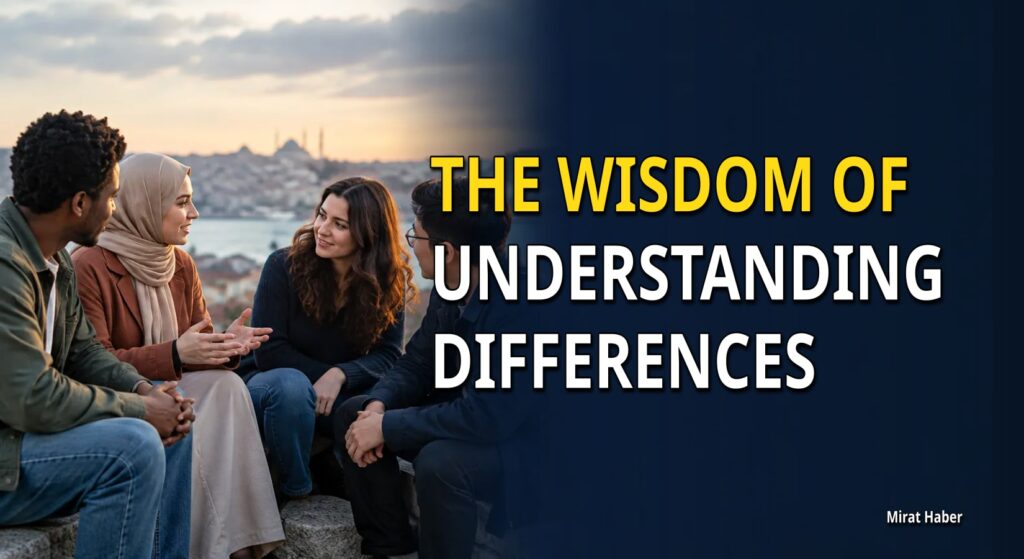
While Nasreddin Hoca is serving as a judge, a man comes to him with a complaint about his neighbour and pours out his troubles. Hoca finds him to be in the right. Another day, the neighbour he complained about comes to Nasreddin Hoca and explains his side. Hoca tells him, too, “You are right!” Having listened to both men separately and at length, Hoca tells each of them, “You are right!” His wife, who witnesses this, finds it strange. She asks Hoca why he told both sides they were right. Hoca thinks for a moment and says, “You are right, too!”
What is this humorous tale trying to draw our attention to? Who is more justified: Nasreddin Hoca, who finds everyone to be right, or his wife? His wife is not wrong to question him. Nasreddin Hoca, however, can take a broader view of the matter, acknowledging the reality each side sees from a different perspective. He recognises their need to be understood and to have their position acknowledged, and finds an answer that satisfies them all: “You are right, too!”
By moving beyond rigid boundaries of thought, Nasreddin Hoca’s approach brings to mind the way of thinking called “saçaklı mantık” in Turkish (“fuzzy logic” in English, also commonly translated into Turkish as “bulanık mantık”). Rather than judging events and situations solely through absolute opposites such as “true–false”, “good–bad” or “present–absent”, a system of logic that accepts varying degrees between these extremes is called “saçaklı mantık” or “bulanık mantık”.
According to classical logic, a situation is either “completely true” or “completely false”. Fuzzy logic, by contrast, allows for partial truth or a degree of validity rather than rigid boundaries. Life’s complexity does not always lend itself to clear-cut classifications. Concepts whose boundaries cannot be precisely defined are assigned degrees and, through mathematical modelling, incorporated into modern technologies and our daily lives. In artificial intelligence, medicine, automatic control systems… fuzzy logic makes our work easier in many fields.
We can draw on fuzzy logic in our everyday lives, in our relationships and in complex, uncertain and changing situations. Thinking in terms of fuzzy logic is also useful for understanding another person’s perspective, showing empathy and recognising differences without being confined to a single, rigid framework.
People may naturally believe strongly in the correctness of their own ideas, but this belief does not prevent them from accepting that different ideas may contain some truth. With such an understanding, many disagreements thought to be insoluble may end in reconciliation. To make the point a little clearer and easier to understand, let us use a real-life example to show how a solution different from Nasreddin Hoca’s approach can be found:
A judge who likes to resolve cases quickly through amicable settlements seems to have a difficult task this time. On the way to inspect the shop at the centre of the dispute, the clerk is somewhat anxious and suggests, “These are dangerous people. Perhaps we should ask the security forces for help.” But with the confidence of someone who has spent many years in the profession, the judge says, “Let’s take a look,” and calmly sets off.
When they arrive at the site, the parties to the dispute have, as expected, already begun arguing, each side raging at the other. In a calm, firm voice, the judge says, “Stop, calm down. First, I will hear all of you out!” The noise subsides. The judge listens patiently and at length to both sides. Once he has heard them, he says, “Now let’s reach an agreement,” and succeeds in reconciling them.
One day, when the judge returns to the industrial district to resolve another case, a man approaches him and wants to kiss his hand. The judge does not recognise him, so the man introduces himself. He reminds the judge of the day of the case and says, “Judge, I owe you a debt of gratitude. If you hadn’t reconciled us that day, I could have become a murderer. I had brought my pistol. I could have been in prison and he could have been in his grave. Now we are friends.”
Here, unlike in Nasreddin Hoca’s case, both sides are invited to take a step towards peace. In other words, they are helped to reach a shared solution to which both can agree. Each side can see not only where it is right, but also where the other side is right.
Fuzzy logic does not advocate a relativistic approach in which everyone’s own truth is valid. There is room for critical thinking; rigid ideas and categorical judgements can be questioned. This allows people to recognise the limits of their own reasoning and adopt a humbler attitude.
Some people see their ideas as an inseparable part of their identity. They may therefore perceive criticism of their ideas as a threat to their sense of self and become aggressive. Accepting that an idea is wrong does not diminish a person’s worth. Being able to change one’s views when necessary is a sign of intellectual maturity.
An inability to tolerate hearing or listening to what others hold to be true may sometimes stem from arrogance, sometimes from dogmatism, and sometimes from a fear that one’s own beliefs and values will be shaken. One of the defining features of dogmatism is seeing one’s own ideas as unquestionable truths. Arrogance involves a similar rigidity.
Building good relationships with people requires, first and foremost, understanding them and approaching them respectfully. I have always found the advice “First seek to understand, then to be understood” meaningful as a guide to successful communication. Even when we disagree with the ideas of people we respect, we can listen to them and discuss those ideas without belittling them.
By respect for ideas, we do not mean that every idea deserves respect or is valid. Ideas that sow discord and malice, encourage violence and discrimination, or conceal the truth do not deserve respect. Every person’s dignity deserves respect—or, more precisely, every person deserves to be treated courteously. Let us not understand respect solely as deference; showing courtesy is also an expression of respect.
Respect for different beliefs both fosters social peace and can be a way of conveying the faith. We have no right to look down on anyone because of their belief or lack of belief. According to Gazâlî, we should not be arrogant even towards an unbeliever, because we cannot know who will have faith when they draw their last breath.
Everyone sees the world through their own window. Our Almighty Creator has made us different from one another. Like our physical characteristics, our ways of feeling and thinking, our upbringing and our life experiences differ from everyone else’s. Our ability to build good relationships despite these differences depends on the effort we make to understand one another. Nasreddin Hoca’s words, “You are right, too,” remind us that there may be other realities beyond the one we ourselves see. They open the door to listening to and understanding one another. Seeing ourselves as entirely in the right can sometimes drive us apart. If we do not want that distance to grow, yet cannot make ourselves heard, let us find someone who will understand and listen to us. Perhaps, once we have expressed what is inside us, we will see and understand everything more clearly.
Ayşegül Ünal
Mirat Haber – YouTube