İstanbul
Az Bulutlu
13°C
İstanbul
13°C
Az Bulutlu
Salı
Az Bulutlu
13°C
Çarşamba
Az Bulutlu
17°C
Perşembe
Az Bulutlu
20°C
Cuma
Çok Bulutlu
20°C

The conditions and propaganda particular to Muslim countries with secular governments, including our own, make it necessary to enlighten people who are devoted to Islam yet dependent on secular life.
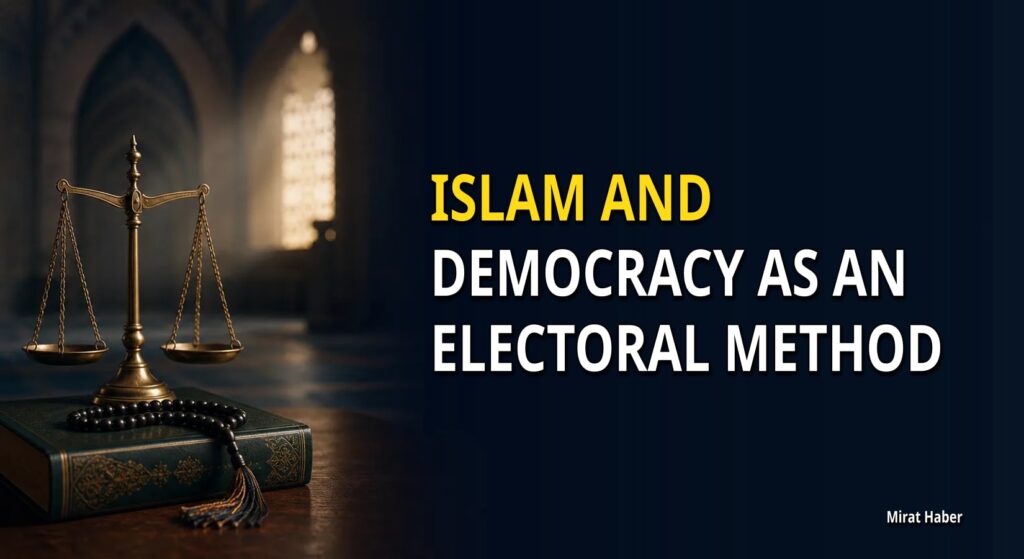
One subject that needs clarification is the relationship between Islam and democracy.
According to the teachings of our Qur’an, believers, as Allah’s vicegerents on earth, are responsible for applying divine laws and shaping the societies in which they live according to the divine will. When forming governments, they must uphold not only the principles of justice and appointing qualified people but also the rule of “shura.”
Shura, prescribed by verse 159 of Surah Âl-i İmrân and verse 38 of Surah Şûrâ, is a framework principle that can be implemented in different ways according to different social conditions.
The Companions, an exemplary generation whose example we can follow, applied this principle when electing the first head of state, the venerable Ebu Bekir, in light of the practices they had observed the Prophet following. Under the conditions of their time, however, they could implement this principle only by consulting leading figures who were the natural representatives of society.
In our age, when transport and communication have advanced and individuals can fulfil their duties through direct action, believers must fulfil their duty to practise shura through an electoral process in which they can cast their votes themselves. This is a requirement not only of mature reason but also of Islam, which addresses itself to reason. There is therefore no doubt that Islam would approve of electing leaders through democratic procedures and in accordance with the principle of pluralism; indeed, it would go beyond approval and impose this as a duty.
* * *
Having noted that Islam can prescribe an electoral system as a duty, we can also summarize its approach to the laws to be applied in government as follows.
According to Islam, the right to determine the fundamental laws governing people belongs to Allah alone. These fundamental laws, laid down through divine codes of law, are summarized in the Qur’an, the final collection of divine messages. To exclude these laws and rebel against the Creator’s sovereignty over humanity is to deify human beings in place of the Creator. There should be no doubt that this deification—the act of associating partners with Allah, itself a grave injustice—is the source of all injustices committed on earth.
To dispel misleading associations, we can summarize these fundamental laws, which were in fact laid down to liberate people and prevent their exploitation, as follows.
“Allah’s sovereignty stands above all individual and collective sovereignty. Despite differences in colour and language, people are created free and equal as human beings.”
“Superiority lies in faith and virtuous living. Freedoms cannot be restricted except in cases of open rebellion against Allah and violations of human rights. Fundamental rights and freedoms—such as the inviolability of life and property, freedom of conscience and religion, and the rights to education, association, voting and standing for election—are inviolable values bestowed by Allah. Justice, appointing qualified people, shura (consultation and election), and encouraging what is beneficial and discouraging what is harmful through speech, writing and action are the fundamental laws of social life. Peace is the principle. Oppressing people and torturing living creatures are forbidden. The laws bind everyone. Punishment applies only to the offender. Qisas, the method of imposing a punishment corresponding exactly to the crime by judicial ruling, is a sacred principle. The family order based on the marriage contract is the foundation of social life and the means of procreation. Inheritance is a right.”
“Killing people, illicit sexual intercourse, false accusations of illicit sexual intercourse, theft and armed rebellion against legitimate government are prohibited acts subject to criminal penalties. Alongside these divine prohibitions, forbidden acts such as repression of beliefs, alcohol, gambling, interest, bribery, oppression and slander are also acts that cannot be legitimized.”
“The purpose of life is to attain the happiness of eternal life by living in accordance with these fundamental laws and prescribed acts of worship, conscious of one’s servitude to Allah.”
As is well known, a large proportion of these fundamental laws, towards which people are naturally inclined, which they have learned from divine codes of law and which they have confirmed through experience, are values that secular systems have also enshrined in law.
Islam makes these fundamental laws unalterable, grounding them in its system of faith and linking their observance to Paradise and their violation to Hell. It has entrusted all believers with the duty of understanding and practising them. The duty of making any additional laws, statutes and regulations that may be needed in accordance with these fundamental laws has been entrusted to believing scholars.
Believers, endowed with the rights to vote and stand for election by the command of shura given by our Lord Allah in the Qur’an, can undertake the initiatives their society requires. For example, they can establish political organizations to make Islam’s unalterable fundamental principles and laws, summarized above, prevail.
They can seek to govern through programmes built around these unalterable principles, emphasizing different methods and priorities and gradual implementation.
These political institutions can compete among themselves to take office, just as they can compete with other secular political organizations in societies encompassing different beliefs.
These institutions, which may be described as Islamic but would govern solely on behalf of their voters, not on behalf of Allah, would relinquish office by majority vote, just as they could come to office by majority vote, in accordance with the electoral system they have accepted. They would relinquish it because it is clear that Islam, which does not approve of coercion in its favour under the principle that “There is no compulsion in religion.” (Bakara 256), would not endorse impositions made in its name against the majority’s freely expressed choices. This truth was exemplified by our Prophet’s adherence to the Hudeybiye Peace Treaty that he signed with the City-State of Mecca.
Here we wish to emphasize this truth: Islam is a religion sent to be practised to the extent of one’s ability in every society and under every condition, not only in societies where it has established its political and legal sovereignty. What its believers cannot accept is not this or that, but only restrictions on freedom of conscience and religion. In other words, the shackling of human free will. For Almighty Allah wants people to fulfil the duties of worship and service He has imposed upon them of their own free will.
* * *
We have tried to present Islam’s approach to elections and the laws that are to form the basis of government. In doing so, we have also noted that principles described as requirements of democracy—such as human rights and freedoms, the rule of law and public participation in government—are among Islam’s unalterable principles.
To sum up, our religion, Islam, which is our reference point and standard of judgement, is the religion the Creator established for the happiness of the people He created. By its nature, this true religion accepts humanity’s shared inclinations and accepted practices, such as democracy, either directly or with the necessary adjustments. For its lawgiver is Allah, the Creator of humanity.
In light of this general rule and the information presented, we believe that Islam would approve of a democracy that respects the laws revealed by Allah that the majority would choose; and that the democracy thus approved would, in turn, respect Islam, which sanctifies its aims.
I seek refuge in Allah from being mistaken and misleading others, and conclude our Friday Message with a verse.
Surah Nahl, verse 9:
“(Because your Creator is a most merciful Lord) Allah has undertaken to show you the right path. For there are (many) people who will stray from that path. (To test you, He confined Himself to showing the right path.) For had He willed, He would have guided you all to the right path.”
Ali Rıza Demircan
Mirat Haber – YouTube