İstanbul
Çok Bulutlu
16°C
İstanbul
16°C
Çok Bulutlu
Pazar
Hafif Yağmurlu
12°C
Pazartesi
Hafif Yağmurlu
8°C
Salı
Hafif Yağmurlu
7°C
Çarşamba
Yağmurlu
7°C

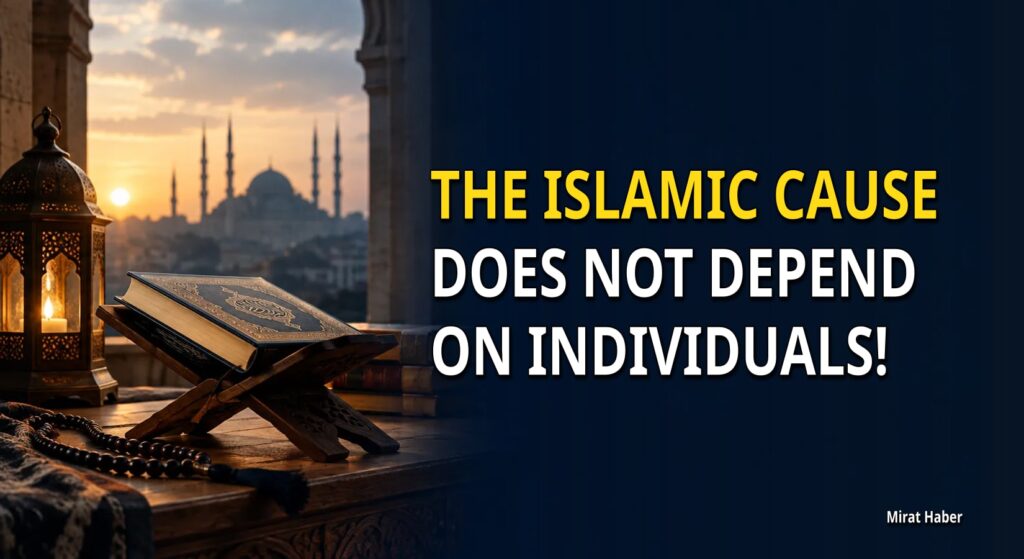
A cause…
It is the struggle and effort undertaken by a person or people to defend a right, idea, belief, ideal or goal, to realize it and to persuade others to accept it.
Causes such as Marxism, Socialism, Capitalism or Kemalism, concerned solely with this world and worldly matters, depend on individuals…
But true causes such as Islam do not depend on individuals or leaders. For the Islamic cause has endured since the world began. This struggle between truth and falsehood will continue until the Day of Judgment…
Indeed, the Islamic cause does not depend even on prophets…
Recall how, during the Battle of Uhud, when “the rumor that our Prophet (peace and blessings be upon him) had died” spread among the soldiers of the Muslim army, the Muslims did not know what to do. Even such valiant men as the venerable Ömer were overcome with despair on the battlefield and were utterly devastated…
It was at precisely this point that our Almighty Lord warned us Muslims through the following blessed verse, declaring that the Islamic cause does not depend on individuals or prophets:
“Muhammed is not a superhuman, immortal being or an angel, but only a messenger. Indeed, many messengers came and went before him. Thus, like the other prophets, he too is mortal and will certainly die one day.
Now, if he dies or is killed, will you abandon the true religion he conveyed and turn back on your heels?
Whoever should turn away from this path should know full well that by doing so, they cannot harm Allah in any way. They will only have cast themselves into the fire, nothing more.
For Allah will punish those who show ingratitude by abandoning the struggle on the path of truth, and will reward those who give thanks to Him by sacrificing their wealth and their lives in His cause. So never abandon jihad in the cause of Allah. If you fear death.” (Âl-i İmrân, 144)
Yet even immediately after the death of our Prophet (peace and blessings be upon him), Muslims fell into disagreement over the leader (caliph) they would choose, and the negative repercussions of that division have persisted to this day.
Muslims have at times gone astray over “obedience to those in authority” (Surah Nisâ, 59), turning that obedience into, or making it dependent on, a “cult of the leader” [1]. This has created major obstacles for them.
Take the example of the Abbasid Caliph Mansûr…
Over time, religious and political authority began to intertwine in the Abbasid caliphs’ understanding of power. A striking statement is attributed to Caliph Mansûr:
“I am Allah’s authority on earth (Sultânullâh fî ardihî).”
In short, at certain points in history, Muslims have crossed the fine line between obedience and sanctification, and have consequently strayed far from their path…
Having reached this point, I cannot move on without giving an example from the Age of Felicity.
As you know, at Hudeybiye, the noble Companions initially struggled to accept the terms of the agreement made by our Prophet (peace and blessings be upon him).
Indeed, Companions such as the venerable Ömer expressed their bewilderment and sorrow to our Prophet (peace and blessings be upon him). Some even experienced profound sorrow and bewilderment, which they also conveyed to our Prophet (peace and blessings be upon him).
The Companions, whose faith in and submission to Allah’s Messenger knew no bounds, and who unhesitatingly gave their wealth, possessions and even their lives for the Islamic cause, taught us this through their conduct:
“Obedience does not mean silencing reason; loyalty does not mean ceasing to question.”
Today, too, those who fail to draw the fine line between obedience to those in authority and a cult of the leader, or who ignore that line, sometimes fall into grave error.
Yet whatever the issue, a Muslim must know how to view unfolding events from an Islamic perspective and must regard warning their leaders when necessary as a duty.
Let us not forget that bending the truth to suit a leader eventually means losing the cause itself in that leader’s shadow.
[1] The excessive glorification of a leader’s character, ideas and decisions within a society or political structure, effectively placing the leader beyond criticism and treating them as infallible and indispensable.
Şaban Doğan
Mirat Haber – YouTube