İstanbul
Yağmurlu
14°C
İstanbul
14°C
Yağmurlu
Çarşamba
Çok Bulutlu
17°C
Perşembe
Hafif Yağmurlu
17°C
Cuma
Hafif Yağmurlu
17°C
Cumartesi
Hafif Yağmurlu
15°C

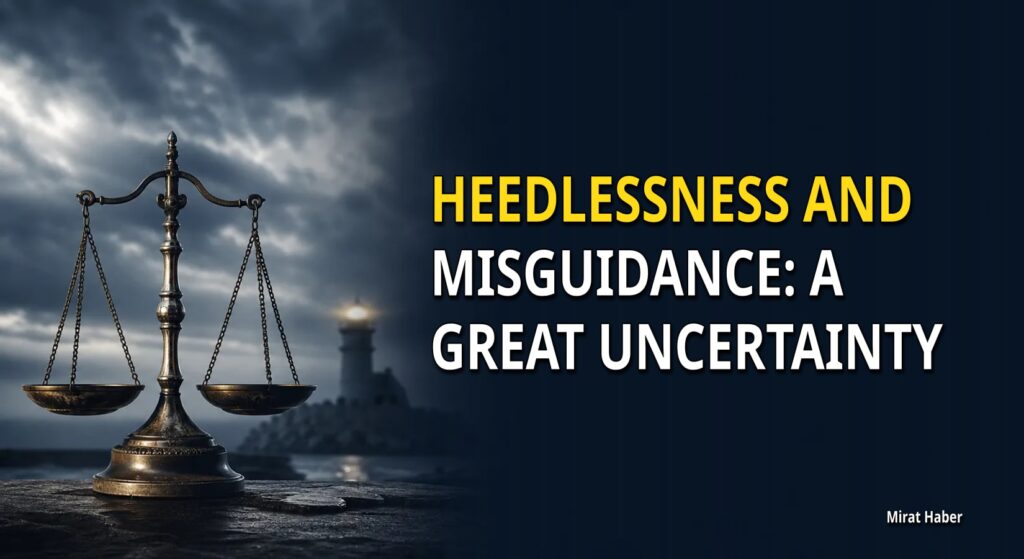
The danger of heedlessness and misguidance is not only taking the wrong path, but failing to realize that one is on it.
One of the most important questions in life is what we believe, why we live and where we are heading. A human being does more than work, earn, consume and stay alive. At the same time, they think, question, choose, and are accountable for what they do. Yet sometimes a person neglects this responsibility amid the busyness of life. They begin to live without asking why they live, to work without thinking about what they serve, and to accept ideas presented to them without investigating whether they are true. Over time, habits come before thoughts, and interests come before principles. At this point, two important concepts that deeply affect a person’s life appear before us: heedlessness and misguidance. Although they are related to each other, these two concepts do not mean the same thing. Understanding the difference between them is important for correctly assessing the state a person is in.
Heedlessness is living unaware of the truths a person should know and care about, or becoming insensitive to the realities one already knows. Misguidance, on the other hand, is straying from the right path and adopting a wrong thought, belief, or way of life. The basic problem in heedlessness is a lack of conscious awareness. In misguidance, however, a person’s sense of direction has gone awry. While the heedless person neglects the truth, the person who falls into misguidance may accept a wrong path as right. Heedlessness is a failure to wake up; misguidance means heading in the wrong direction. So heedlessness does not always amount to misguidance, and not every wrong turn can be explained by carelessness alone. Sometimes a person strays because they do not know; sometimes because they do not value what they know; and sometimes because of their own choices, they move away from the truth.
Let us explain heedlessness with an example from daily life. A person knows that death is inevitable, yet may live as if they will never die. They believe they will be held to account, yet may give little thought to the consequences of their actions. They say justice is important, but may remain indifferent to the injustices happening around them. They state that they believe in Allah, yet may not take Allah’s commands into account when making decisions about their life. This does not necessarily mean that the person has abandoned their faith. The real issue is that the truths they believe in no longer guide their life. In the Qur’an, the statement, “They have hearts, but do not understand with them; they have eyes, but do not see with them; they have ears, but do not hear with them” (A’râf, 7/179), shows how serious it is for a person not to use their capacity to understand.
Misguidance is a different situation from this. Here, a person does more than neglect their responsibilities: they may adopt a mistaken outlook and build their life around it. For example, if a person knows that unlawful gain is wrong but still does it, there is a contradiction in their behavior. But if, over time, they begin to see unlawful gain as legitimate, consider honesty unnecessary, and deem every means permissible in order to gain advantage, they have adopted a false standard. Likewise, when a person remains silent in the face of injustice, they may be showing heedlessness; but when they begin to argue that the strong are always right, they are moving toward a false understanding of justice. Heedlessness means becoming insensitive to what is right; misguidance means accepting what is wrong and turning toward it.
A major reason people slip into these two states is their reluctance to question their own thinking. For people often want to see themselves as right. Admitting one’s mistake, changing habits, and taking responsibility can be difficult. For this reason, they produce justifications that fit their behavior. A person who commits injustice may comfort themselves by saying that everyone acts the same way instead of evaluating the wrongness of what they have done. In this way, they do not eliminate the truth that disturbs their conscience, but try to lessen its effect. The more often this happens, the easier it becomes to accept one’s own wrongdoing. The most dangerous stage is when the wrong is no longer seen as wrong. Someone who admits a mistake has a chance to change; someone who regards it as right may see no reason to change.
One of the major problems facing people today is that, despite being constantly occupied, they do not think enough about the meaning of their lives. A person may calculate at length what to buy, how to earn more, and how they will be seen in society. But they may not think about why they live, which values they are committed to, or where their actions are taking them. Judging success solely by money, status, power and reputation can push moral responsibilities into the background. Yet the fact that a person knows a great deal, works hard, or has great opportunities does not show that they are living rightly. Knowledge is not the same as awareness, nor is success the same as righteousness. If a person puts their outer life in order while neglecting their inner life, something fundamental is missing.
Heedlessness and misguidance are not limited to an individual’s life; they can also affect the thinking and behavior of societies. When injustices become widespread in a society, people can gradually grow accustomed to them. In an environment where bribery is treated as normal, personal connections take precedence over merit, and the powerful are seen as right, wrong practices become ordinary. Behaviors that initially provoke opposition come to be accepted over time as though they were unchanging facts of life. Here, social heedlessness means that people lose sensitivity to the wrongs taking place. Social misguidance, by contrast, is a mindset that regards these wrongs as legitimate, defends them and accepts them as the proper way to live. In this way, society does not merely grow used to wrongs; it may also develop ideas that protect them.
This situation shows itself especially in politics, economics, education, and social relations. People may defend an idea not because it is true, but because it benefits them or the group they belong to. The same injustice may be tolerated when committed by someone from their own circle, yet harshly criticized when committed by someone from the other side. Justice then ceases to be a principle that applies to everyone and becomes a matter of personal preference. The Qur’an’s command that justice be upheld even against oneself and one’s relatives (Nisâ, 4/135) sets out a clear measure against this contradiction. Truth does not change according to who people are or which side they are on.
Another danger is letting others do our thinking for us. Accepting what a leader, opinion-maker, community, or majority says without investigating can distance a person from using their own mind. In such an environment, instead of asking what is right, people begin to look at who said what. Yet the fact that an idea is defended by many people does not prove that it is true. The Qur’an calls people to research and to act with a sense of responsibility by saying, “Do not pursue that of which you have no knowledge” (İsrâ, 17/36). We can learn from other people’s thinking, but we cannot leave them entirely responsible for judging our own choices.
One of the most important consequences of heedlessness and misguidance is the loss of clear standards in a person’s life. This uncertainty is a deeper issue than simply not knowing what will happen in the future. When a person loses the firm standards that determine what is right and what is wrong, they begin to live a life that changes according to circumstances. They may abandon a principle they defended today for the sake of their own interest tomorrow. While defending right and justice in one matter, they may ignore the same values in another. A growing distance forms between the values they say they believe in and the life they actually live. This contradiction harms not only the person’s own life but also the trust of the people around them. When someone’s principles keep changing, others can no longer predict how they will act in any given situation.
So what is the way out of this situation? First, a person must have the courage to question themselves. They should evaluate what they believe in, by what standards they make decisions, and how closely their actions align with their faith. They should make it a principle to correct their mistakes rather than defend them, to learn by admitting what they do not know, and not to place habits above the truth. We can escape heedlessness by becoming aware; we can turn back from misguidance by abandoning the wrong path and turning toward what is right. These two processes can complement each other; however, they are not the same. Awareness alone may not be enough. A person must also show the will to act in accordance with the truth they have recognized.
From an Islamic perspective, finding the right path begins with taking Allah’s guidance as our foundation. This guidance is not limited to a verbal declaration of faith. It must be reflected in a person’s justice, honesty, mercy and trustworthiness, and throughout their life. The Qur’an’s call for people to think, reason, take heed, and evaluate what they do is important in this respect. The command, “Let everyone look to what they have sent ahead for tomorrow” (Haşr, 59/18), invites people to reflect on the consequences of the life they are living. Being responsible means not only thinking about the future, but also understanding the consequences of the choices we make today.
Heedlessness is a person losing their alertness toward the truth; misguidance is adopting a wrong direction by moving away from the truth. The person in heedlessness needs to be warned, while the person turning toward misguidance needs to turn back from their wrong assumptions and choices. Societies too must distance themselves not only from wrong practices, but also from the ways of thinking that normalize and legitimize them. This means uniting knowledge with awareness, faith with conduct, and justice with every aspect of life.
A person’s greatest loss is not losing their way, but losing the awareness that could make them realize they are on the wrong path. While heedlessness prevents a person from seeing the truth, misguidance may cause them to mistake the wrong path for the right one. Therefore, the real issue is not only knowing where we are going, but also being able to question whether the path we are taking is right. For the greatest uncertainty before the person who has moved away from the truth is not what their future will be, but not knowing in which direction they are walking today.
İslam Başaran
Please follow this link to read more articles by this author.
Mirat Haber – YouTube