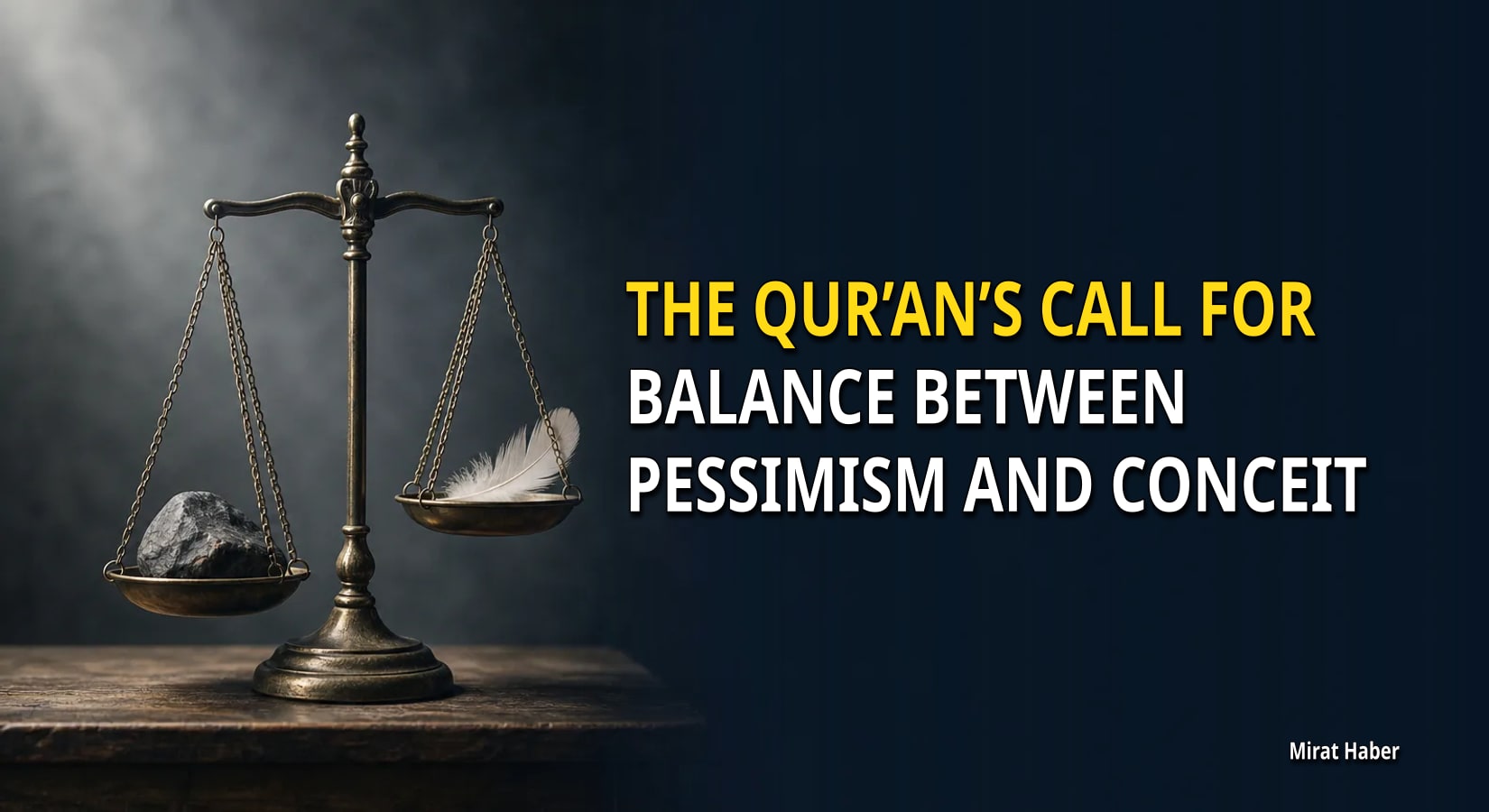
Today, attitudes fostered by popular and secular culture can send people veering between two extremes. At one extreme, they may succumb to hopelessness and pessimism; at the other, their achievements and opportunities may lead them into conceit, thinking, “I did it. I succeeded.”
In the following verses, the Qur’an describes both these extremes and explains how we can become spiritually balanced, mature individuals without falling into either of them:
“If We let a person experience mercy and goodness, then take it away from him, he becomes utterly hopeless and deeply ungrateful. If We let him taste a blessing after hardship has befallen him, he says, ‘My troubles have left me.’ From then on, he does nothing but act conceited and boast. But those who are patient and do beneficial deeds for this world and the hereafter are not like this. For them there is forgiveness and a great reward.” (Hûd 11/9-11)
There is a striking psychological relationship between these two poles, which we might call “pessimism” and “conceit.” If a person’s sense of self depends excessively on success, the approval of others and the belief that they can control events, they may react disproportionately to success and failure. The higher they place themselves and the greater their sense of superiority, the more devastating their fall may be when they fail.
To draw an analogy, someone who falls from a height of two metres will not suffer the same injuries as someone who falls from ten metres. Similarly, when someone accustomed to always succeeding fails an important exam, they have not merely failed an exam; the sense of superiority they have developed about themselves may also be shaken. An ordinary failure can therefore become, in their eyes, a great catastrophe threatening their entire future.
The ninth verse of Hûd mentions “becoming hopeless” and “becoming deeply ungrateful” together when a person is deprived of a blessing. There is a striking psychological relationship between pessimism and ingratitude: pessimism makes it difficult for people to recognise the unique blessings they have experienced and continue to experience; in short, it can make them ungrateful.
Under the weight of hardship, a person may forget the blessings Allah has previously given them. The resources they once had, the opportunities offered to them and the good things that remain may become invisible in the shadow of their present pain. They may begin to think as though their hardship were the only thing in their life and nothing else mattered.
What happens here is that people generalise their present condition and treat it as absolute. When hardship comes, they think, “Nothing will ever get better.” They do not take into account the opportunities they had in the past or the possibility of experiencing good things again in the future. From a temporary loss, they draw a negative conclusion about their entire life.
The tenth verse of Hûd describes another misconception held by a person who receives blessings after misfortune. Believing that all their difficulties have disappeared, such a person says, “I am free of misfortune; it is plain sailing now.” They then succumb to pride and conceit.
Of course, feeling joy upon receiving a blessing is a natural human response. What the verse criticises is the transformation of that joy into excessive pride, boasting and a sense of being completely secure. Thinking their troubles are behind them, people forget that life is changeable; they come to believe that the resources they possess will protect them from every adversity.
Indeed, the Qur’an draws attention to the wealthy person’s assumption that their wealth will make them immortal. (Hümeze 104/3) In this way of thinking, wealth ceases to be merely a resource and becomes something that gives a person a sense of immortality and unlimited security. They imagine that their wealth will protect them from the ravages of time and life’s inevitable end.
Here we encounter a person spoiled by comfort, prosperity and material resources. Rather than seeing what they possess as temporary blessings bestowed by Allah, they may regard these things as a sign of their own superiority and power. Their wealth and power may give them an unrealistic sense of security and lead them to see themselves as self-sufficient, which in turn may draw them away from the truth and into spreading corruption. (Alak 96/6-7)
We see an example of this in the legendarily wealthy Karun. He attributed all his wealth to his own skill and ability, and this led him into arrogance and conceit. (Kasas 28/76-78)
What causes these emotional swings? One of the main reasons is the assumption that one’s present circumstances are permanent. Yet a person is a trustee in this world. Their wealth, health, power, position and other resources have not been given to them without limit or for eternity. Nor should people forget that the world is not always a safe and predictable place. As life unfolds, they may encounter developments they never expected; they may lose some of what they possess or, conversely, receive blessings they had never even imagined.
How can people protect themselves from being tossed between these two extremes? In other words, how can they become more balanced and mature in terms of their psychological well-being? The eleventh verse of Hûd answers this question by describing an exception to the deviations mentioned earlier: “But those who are patient and do beneficial deeds for this world and the hereafter are not like this. For them there is forgiveness and a great reward.”
Here, patience does not simply mean enduring hardship. It also means the determination to remain on the right path without becoming conceited when blessed or hopeless when misfortune strikes. Righteous deeds, meanwhile, mean reflecting one’s faith and values in one’s behaviour, fulfilling one’s responsibilities and leading a life centred on goodness.
Of course, this does not mean that such people will never experience sadness, fear, anxiety or joy. As human beings, they too experience a range of emotions. But they do not allow these emotions to govern their entire lives. Even if they sometimes feel an inclination towards pride or encounter disappointments, they have the faith and maturity to regain their balance.
We can also express the solution through the principle in Islamic belief of “maintaining balance between fear and hope.” “Fear” here means fear nurtured by an awareness of one’s responsibility towards Allah; “hope” means hope in His mercy and grace.
When people preserve this balance, they neither become intoxicated by a sense of security nor surrender to the consuming pessimism of fear. They learn not to become conceited when blessed or lose hope when faced with hardship. They know that what they possess does not make them absolutely secure, but they also recognise that the difficulties they encounter do not require them to give up hope in Allah’s mercy.
One of the principles the Qur’an seeks to instil in people is this: you may encounter unexpected developments on life’s journey. At a moment when you least expect it, you may face hardship and lose what you possess. Indeed, verses 97-99 of A’râf question people’s sense of being safe from Allah’s punishment and unexpected consequences. These verses remind us not to fall into heedlessness through a false sense of security.
In this way, people can cultivate inner tranquillity and peace. They strive to preserve both their spiritual lives and their psychological balance. They draw their true sense of security not merely from wealth, position, success or external circumstances, but from their deep faith in Allah. The meanings of peace, trust and safety expressed by Allah’s names “es-Selâm” and “el-Mü’min” also hold an important place in their understanding of Allah.
In short, people should neither assume that their blessings will last forever nor regard their hardships as an unchangeable fate. They should accept life’s changing nature and do their best, see blessings as occasions for gratitude and responsibility, and preserve their hope and direction in the face of misfortune. Such awareness can protect people from emotional swings and open the door to a more balanced, peaceful and meaningful life.
Prof. Dr. İbrahim Hilmi Karslı
Mirat Haber – YouTube
Divine guidance means seeking the truth before knowing the right path, and, once that truth…
Provided the Governing Rules Are Islamic ISLAM ENDORSES A REPUBLIC, NOT A MONARCHY It is…
Civilization is often associated with urbanization, institutional development, science, art and technology. Culture, meanwhile, expresses…
I keep talking about renewing our faith, but how should we go about believing? “O…
Every blessing calls for gratitude. Every good thing Allah has given us brings with it…
In the name of Allah… I praise our Lord and offer my heartfelt respect and…