İstanbul
Çok Bulutlu
17°C
İstanbul
17°C
Çok Bulutlu
Perşembe
Az Bulutlu
20°C
Cuma
Az Bulutlu
20°C
Cumartesi
Hafif Yağmurlu
20°C
Pazar
Çok Bulutlu
13°C

Among Islam’s teachings is that we should express and sustain our gratitude not only to the living but also to our dead who have benefited us personally or our society through their work, the things of value they produced, and the material and spiritual legacies and works they left behind.
One of the main ways of expressing gratitude to our dead is to dedicate to their souls the spiritual rewards earned by establishing public amenities such as roads, fountains, schools, mosques and healthcare institutions for the living, and by providing material assistance.
A companion asked our beloved Prophet whether charitable donations made on behalf of his mother, who had died suddenly without being able to leave a will, would earn her spiritual rewards. The Prophet’s glad tidings that they “would,” along with similar statements, establish the legitimacy of expressing gratitude to the dead by doing charitable deeds on their behalf.
Another main way of expressing our devotion to our dead is to pray for them to be forgiven and granted further blessings.
Our Qur’an establishes this practice, and Surah Haşr offers the following example of a prayer, taught through the words of beloved servants of Allah:
“O our Lord! Forgive us and our brothers and sisters who believed before us, and leave no room in our hearts for unfounded and improper thoughts and feelings towards believers. O our Lord, You are compassionate, the source of mercy.”
* * *
Although we may pray for the dead at any time, visiting their graves and praying for them is also a practice recommended by our religion. However, the main reason we are encouraged to visit graves, especially those of our parents, is not that prayers offered during such visits are more likely to be accepted. Rather, it is to foster spiritual and moral growth by remembering death and the afterlife as we pray for the dead on these visits.
Our glorious Prophet says:
“I had forbidden you to visit graves (because of the harmful practices arising from your ignorance). But now I urge you: visit graves. For these visits temper your attachment to worldly life, soften your hearts, bring tears to your eyes, remind you of your afterlife and offer you a lesson.”
As is clear from the opening of the hadith presented above, in which we have combined different narrations, Allah’s Messenger, the Prophet Muhammed, prohibited visits to graves when he began proclaiming the unchanging principles of faith conveyed by all prophets. For he observed that, just as in ancient Greece and among the Shinto communities of Asia, pre-Islamic Arabia harboured superstitions about the dead and their graves that were contrary to revelation and reason.
We can summarise the deviant beliefs about the souls of the dead, of which we still see many vivid examples today, as follows:
a. Regarding the souls of the dead as intermediaries between Allah and human beings,
b. Believing that Allah’s will manifests itself through the dead and that help can therefore be obtained from their souls,
c. Worshipping the souls of the dead, directly or indirectly.
While protecting believers from these primitive and superstitious beliefs, traces of which can still be seen in some religious orders today, Islam has also imposed prohibitions concerning graves where such distorted thinking is displayed. We can summarise these prohibitions in language more readily understood by people today.
Making graves into:
a) Places of worship,
b) Sites for festivities and ceremonies,
c) Places of mourning,
d) Public forums where spoken and written ideological messages are delivered, oaths of allegiance are sworn, hatred is vented and complaints are aired,
e) Places where wishes are expected to be fulfilled through divine assistance…
The beliefs and actions we have summarised are expressed today through practices such as forming spiritual bonds with those buried in shrines; tying strips of cloth or thread, lighting candles, standing in respectful silence, signing special memorial books, staging displays of strength, making wishes, chanting slogans and holding commemorations with instrumental music. Though thought peculiar to our age, they have, in essence, persisted throughout history and are undoubtedly contrary to Islam’s system of belief. Some constitute associating partners with Allah, the greatest of sins; they are a rejection of reason and a path to Hell.
To close this path to Hell, our glorious Prophet repeatedly gave the following counsel:
“Take great care. Some individuals and communities before you made the graves of their prophets and the righteous servants who had lived among them into places of worship. Take heed of my warning: I forbid you to turn graves into places of worship.”
Our beloved Prophet took particular care to prohibit, in language invoking a curse, the turning of his own grave into a place of worship or ceremonial gatherings after his death, and prayed:
“O Allah! Do not allow my grave to be sanctified like idols that are worshipped.”
We would like to take this opportunity to emphasise a truth. The plots of earth in which bodies are buried are merely points of connection; the true graves, where happiness and torment are experienced, are the dwelling places of souls, formed according to beliefs and ways of life.
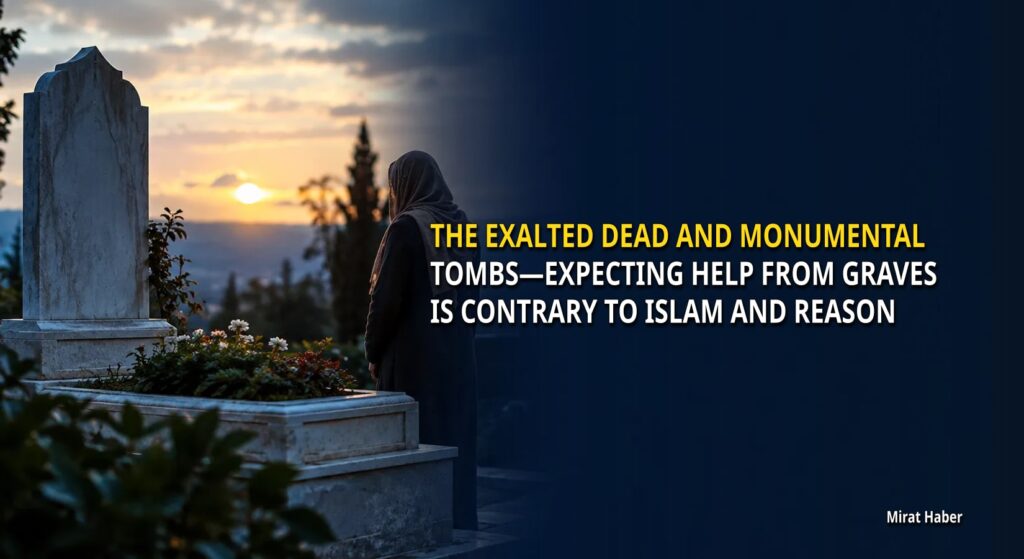
Many graves—from shrines associated with prophets to the graves of companions, from the mausoleums of sultans and kings to the monumental tombs of historical and contemporary figures, and the tombs of people believed to be friends of Allah (saints)—have been made into places of worship or situated beside houses of worship. Some graves, as exemplified by sultans’ mausoleums and monumental tombs, have also been surrounded by enormous domes and monuments and turned into temples and ceremonial grounds.
Such beliefs and practices have ultimately led us to seek help from the dead and turn graves into places of worship.
Thus, alongside the primitive behaviour of ignorant religious people who seek help from the graves of sanctified figures, we have also begun to witness the wretchedness of intellectuals who turn graves into shrines and temples on an inconceivable scale and hold ceremonies there.
Yet there is no benefit to be gained from the souls of the dead, even those of prophets, or from graves made into monuments before which people stand in prayer or hold ceremonies. Nor is there any inspiration to be drawn from them.
The Qur’an states clearly that, except as Allah wills, prophets neither know the future nor have the power to bring benefit or harm. (See Araf 188, Ahkaf 9, Kasas 56, Enam 35, Neml 80-81)
In a practice particular to our country, begging for help and inspiration from historical figures who enshrined opposition to tomb shrines in law demonstrates how deeply at odds we are with scientific reason as well as Islam.
We should express gratitude to the dead as we do to the living. We should remember them by creating works that benefit society and by praying for them. We should also visit graves to see our world as it truly is. We should ask for material and spiritual assistance directly and solely from Allah. We should ask Allah for help, but expect it through the reason He has given us, the knowledge produced by that reason, and the skills of faithful, ethical experts.
I conclude this article with verse 84 of Surah Tevbe, which establishes that prayers may not be offered for the dead who did not believe in Allah and His Prophet Muhammed, nor may their graves be visited for that purpose:
“Never perform the funeral prayer for anyone who leads others to deny Allah and His messenger Muhammed and remains in this unbelief, and never stand at their grave.”
Ali Rıza Demircan
Mirat Haber – YouTube